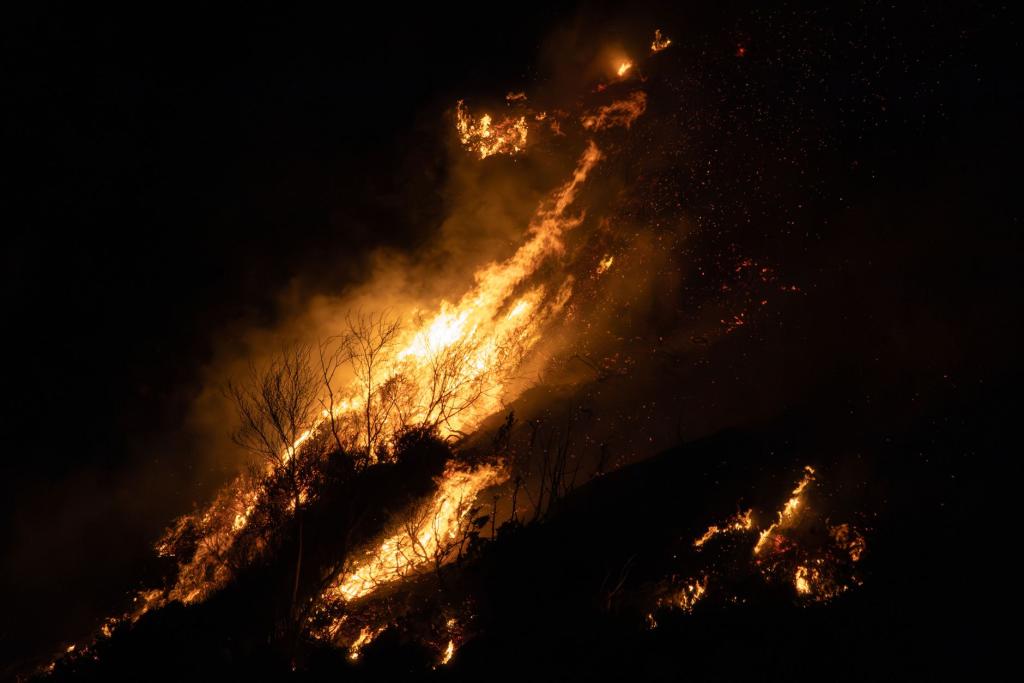
The Bryson Fire Malibu residents woke up to on Friday is still growing, and the weather is not about to cooperate. The brush fire started late Thursday afternoon in the Santa Monica Mountains, and according to NBC News, it has already burned one hundred forty-six acres and triggered evacuation orders across several canyon neighbourhoods.
The scary part is not just the fire itself. It is the forecast. Hot, dry Santa Ana winds are blowing through Southern California, and officials say the red flag alert is not going away until at least Saturday night.
What we know about the Bryson Fire Malibu evacuations
The blaze began on rugged terrain along Encinal Canyon Road in western Malibu. Los Angeles County Fire Chief Anthony Marrone said on Friday that more than four hundred firefighters are assigned to the incident, backed by more than seventy-five ground and aerial resources, according to NBC News.
Evacuation orders, which mean residents must leave immediately, cover the Encinal, Trancas and Zuna Canyon areas. About a dozen additional evacuation warnings are in place around those canyons, telling people to be ready to go at a moment's notice. The Red Cross opened one emergency shelter at Agoura High School.
As of Friday morning, no deaths and no lost or damaged structures had been reported. Marrone estimated that more than one hundred structures near the fire are threatened. One firefighter had minor injuries overnight, was taken to a hospital and is expected to recover.
How fast it moved
This thing did not creep. The Washington Post reported that the Bryson Fire sparked around four forty on Thursday afternoon and jumped from roughly two acres to one hundred in under two hours, amid bone-dry conditions and powerful winds. That is the kind of speed that makes a fire hard to chase.
Firefighters worked through the night and got containment to seventeen percent by Friday morning, according to Los Angeles County Supervisor Lindsey Horvath. That is real progress, but it is a thin cushion. Marrone put it bluntly, saying that if the winds kick up and crews lose containment, a larger area could be affected and under threat.
The wind is the real villain
According to the National Weather Service, winds of up to thirty-five miles per hour are expected, with gusts in the mountains forecast to reach seventy. The Los Angeles office warned that winds would increase significantly overnight, with gusts potentially hitting fifty to sixty miles per hour.
Those gusts do two things. They push flames faster, and they throw embers well ahead of the fire line, which is how a single brush fire can spawn new ones. Officials said the risk is highest Friday for western Los Angeles County, Ventura County and southeastern Santa Barbara County.
Utilities have also shut off power to tens of thousands of customers across California to reduce the chance of lines sparking new fires, according to the Associated Press. Power shutoffs are a hassle, but they are a deliberate trade for safety when the air is this dry.
Not the only fire in the region
The Malibu blaze is not alone. Hours before it started, the Peak Fire broke out in Azusa, north of Los Angeles, burning forty-three acres and briefly forcing evacuations in a foothill neighbourhood. Crews stopped its forward progress by Thursday night and had forty-one percent containment.
On Friday, the Associated Press reported a separate fast-moving fire in Orange County that burned at least four homes, with television footage showing houses on fire in San Juan Capistrano. Evacuations and outages followed there too. Fire season in Southern California clearly has not got the memo that it is mid-October.
Why Malibu knows this story too well
Malibu has been here before. The Post noted that a community brigade of trained volunteers helped fire crews this time, a group formed after the deadly and destructive 2018 Woolsey Fire. That history is why locals take evacuation orders seriously and why officials keep repeating the same message.
Horvath's advice on Friday was simple: stay vigilant and be prepared. If you live near the Santa Monica Mountains, that means having a go-bag ready, knowing two ways out, and checking official alerts instead of social media rumours. You can follow the incident page at the state fire agency, and you can read more climate and disaster coverage in our climate emergency section.
For now, the Bryson Fire Malibu story hinges on the next forty-eight hours. If crews hold the line while the winds peak, this stays a close call. If they do not, a very familiar and very scary weekend could unfold along the Malibu coast.
Comments 0
No comments yet. Be the first to share your thoughts!
Leave a comment
Share your thoughts. Your email will not be published.