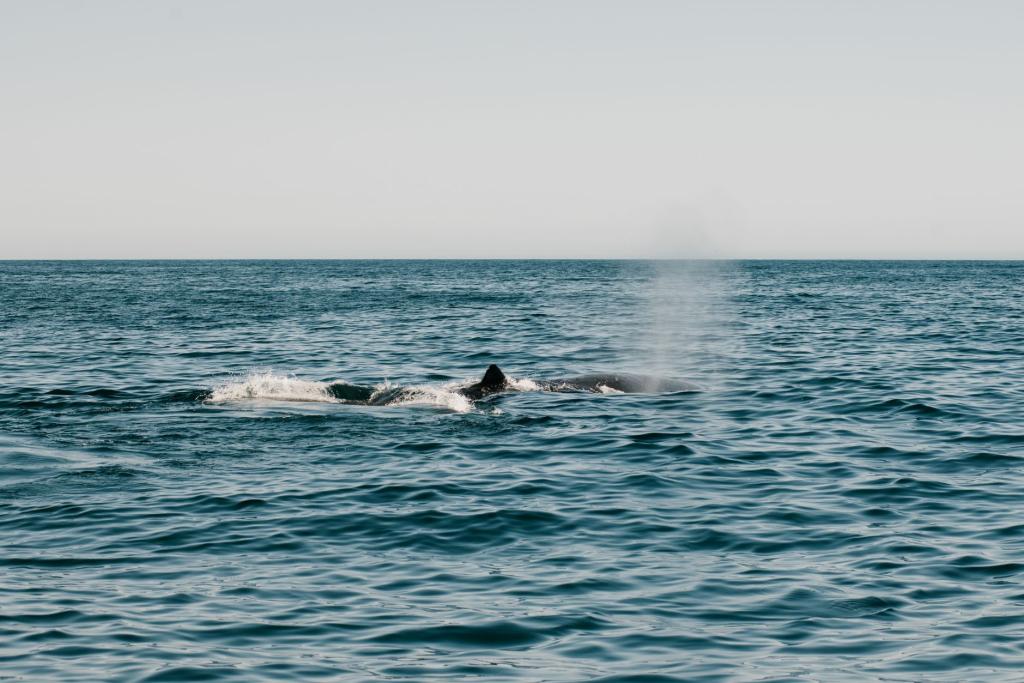
In July 2025, a rescue boat captain filming off Palm Beach on Australia's Gold Coast captured something scientists had never documented: a Humpback Whale Calf lying stillborn on the seafloor, with its mother hovering beside it and refusing to leave. She dove back down to the body again and again, held eye contact with it, rested beside it, and draped a pectoral fin over it — behavior that stretched across hours and may have continued for days, according to SciTechDaily.
What the camera caught
The birth happened about 1 km off the beach, with an escort whale swimming nearby. The calf measured under 4 meters long — noticeably short even by newborn standards, since humpback calves usually arrive at 13 to 15 feet. What struck the scientists was what the mother did not do: she made no attempt to lift the calf to the surface, a move toothed-whale mothers are known to make.
Andrew Mulville, a Sea World Foundation rescue boat captain who recorded the encounter with a GoPro, said: "When I actually worked out what was happening, I was totally surprised." He added: "At first sight, I thought it was just two whales resting on the surface, but their behavior was unusual."
A first for science
The encounter became the first documented case of post-mortem attendance in a humpback whale, published in September 2026 in the journal Discover Animals by Griffith University researcher Jan-Olaf Meynecke and Mulville. "Unlike reports of toothed whales where mothers have been observed lifting their dead calves to the surface, this humpback whale mother showed prolonged post-mortem behavior and attention towards her deceased calf under the surface," Meynecke said.
"She remained close to the calf, maintaining eye contact and positioning herself next to her calf over several hours and maybe even days," he added. Such vigils are well known in toothed whales — orcas, dolphins, and pilot whales — most famously the orca Tahlequah, who carried her dead calf for 17 days across roughly 1,500 km in 2018. Baleen-whale cases are far rarer, the paper's authors explained, because newborn baleen whales carry little blubber and sink quickly, so people almost never witness what happens next.
The timeline for this Humpback Whale Calf is compact but striking: the encounter that July, filmed on the spot; the peer-reviewed paper arriving more than a year later; and the story reaching the wider public this October, with Science News reporting the footage and its implications for how scientists think about whales.
Could a whale grieve?
The behavior invites comparison with elephants and great apes, both known for post-mortem attention to their dead. Humpbacks carry spindle neurons — brain cells tied to social awareness and emotional processing also found in those species — and mothers are famous for fierce investment, even driving off killer whales that threaten their calves. The ecological backdrop is sobering too: that same month, researchers logged seven dead humpback neonates and one floating young whale along the coast between K'gari Island and Ballina, while this birth happened more than 500 km south of the main breeding grounds in water around 20.5C, Earth.com noted. The drivers are unknown, but one hypothesis points to fluctuations in Antarctic krill that may be affecting mothers' condition.
But the researchers themselves urge restraint. Whether the mother experienced grief cannot be established from observation alone, and the paper frames the behavior as grief-like post-mortem attendance — attentive and caregiving in character, but not proof of an inner emotional state. "These observed behaviors were consistent with caregiving or nurturing actions and post-mortem attentive responses documented in socially complex mammals and indicated an inherent, strong maternal attachment to the calf," Meynecke said.
Even so, the finding matters. If large whales register loss in any form, it raises the stakes of threats like ship strikes, entanglement, and ocean noise. The paper closes with a call for systematic documentation of rare neonatal deaths, since only careful observation can reveal the cognitive and emotional lives of large whales. "This case study highlights the need for continued systematic documentation of rare neonatal mortality events to better understand the cognitive, emotional, and evolutionary significance of post-mortem behavior in large whales," Meynecke said.
Ocean wildlife is under pressure on many fronts. Read about the penguin colony collapse that ended Zavodovski's reign, the record-speed recovery of bleached coral found in a Stanford study, and the swimming sea cucumber rerouting ocean carbon.
Comments 0
No comments yet. Be the first to share your thoughts!
Leave a comment
Share your thoughts. Your email will not be published.