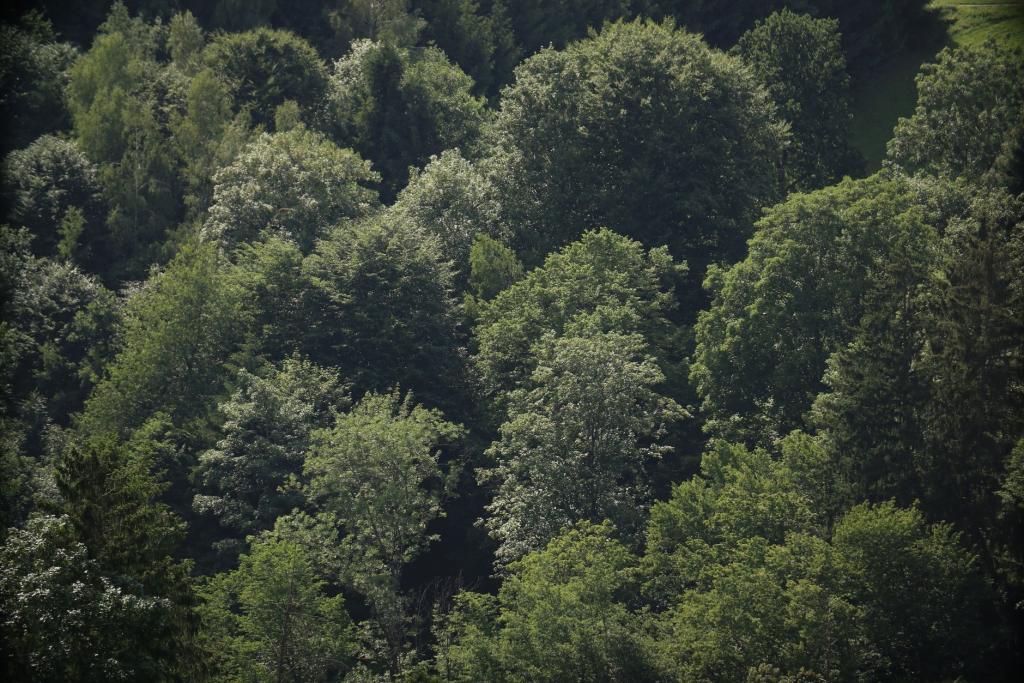
A satellite built to track air pollution just became a bark beetle early warning system for Western forests. University of Utah researchers report that a faint glow given off during photosynthesis dimmed in conifer stands roughly two years before USDA Forest Service aerial surveys logged bark-beetle mortality in the same places. The study, published in Remote Sensing of Environment by Lewis Kunik and colleagues, is described as the first of its kind at this scale. It does not predict which individual trees will die. But it hands forest managers a landscape-level flag two years ahead of visible die-off, which could mean earlier ground crews, earlier funding and earlier inspections before mortality spreads.
The signal is solar-induced chlorophyll fluorescence, or SIF. When chlorophyll absorbs sunlight, a small share of that energy leaks back out as a faint red glow, and the glow tracks how efficiently a plant is using the light it captures, so it dims when trees are stressed. It is far too weak to see from the ground, but spectrometers in orbit can separate it from reflected sunlight. TROPOMI, the Tropospheric Monitoring Instrument aboard Europe's Copernicus Sentinel-5P, was built for atmospheric chemistry rather than vegetation. Its wide swath and near-daily passes still produced the repeat time series a multi-year bark beetle early warning trend requires.
Why green forests fool normal satellites
The Utah team found SIF moved earlier than the usual canopy products. Land surface temperature and NDVI, the standard greenness index, did not react the same way. Evergreens are part of the reason: pines, spruces and firs can keep their needles while effectively dormant, so the canopy still looks like a canopy from above even as the stand's machinery slows. According to the paper's comparison, a derived metric called SIFyield responded earlier and more sensitively than every other product tested. In practice that means a forest can look intact in standard satellite views while its photosynthesis is already failing, which is exactly the gap this bark beetle early warning tries to close.
The controls that kept drought out of the picture
Drought could have explained the whole signal, so the researchers designed the study to rule it out. Disturbed areas were matched against similar forests that saw little wildfire or beetle mortality but endured comparable drought. The control forests' glow still faded, as drought-stressed vegetation does, yet the decline was ten to twenty percent less severe than in the stands beetles later infested. Across moderate-to-severe beetle mortality, growing-season SIF fell to roughly three-fifths to seven-tenths of pre-drought levels and stayed there for multiple years, according to the study. In other words, dry conditions were part of the story everywhere, and something additional was happening in the stands that would go on to die.
Wildfire served as the calibration case, because burn severity is far easier to quantify than beetle activity, which spreads unevenly and is often catalogued only after crowns turn red. Against fire, the SIF decline scaled with vegetation loss, dropping to about one-fifth of pre-fire levels in the most heavily affected areas. The analysis combined TROPOMI data gridded at roughly five-kilometer resolution with MODIS vegetation products and tree-mortality grids for the western United States covering 2018 through 2023, with control comparisons extending back to 2011. That design is what gives the bark beetle early warning claim its footing: a physiological signal that shifted first, at a scale no ground survey can match.
What the signal can and cannot do
The authors are blunt about the limits. Attributing a single year's SIF change to one cause remains difficult, since drought, insects, canopy dieback and even lighting geometry all push the number around, and nothing here amounts to an operational deployment. "I don't know of any other tool that can detect this type of signal before tree mortality becomes obvious at a scale large enough to assess the health of entire forests," said lead author Lewis Kunik, who recently completed his doctorate at the university under co-advisors John Lin and David Bowling. The stated goal is triage rather than diagnosis: flag areas of concern early so managers can investigate on the ground, mobilize crews and line up funding before the dead crowns appear. A bark beetle early warning is only useful if someone acts on it.
The team also sees a carbon angle. Because the glow functions as a fingerprint of plant carbon dioxide uptake at regional scales, the authors argue a bark beetle early warning network could also track whether repeated disturbance weakens the uptake capacity of Western forests, and whether those forests drift from carbon sink toward source. Lin points to ESA's FLEX mission as the next step, promising sharper fluorescence maps than TROPOMI's coarse pixels. Funding came from NASA's Carbon Monitoring System, an NSF graduate fellowship, Utah's Wilkes Center for Climate Science and Policy, and a USDA Forest Service agreement. Coverage of the findings appeared in the University of Utah's announcement and Phys.org's report on the research; the paper is Kunik et al. in Remote Sensing of Environment, DOI 10.1016/j.rse.2026.115550.
Comments 0
No comments yet. Be the first to share your thoughts!
Leave a comment
Share your thoughts. Your email will not be published.