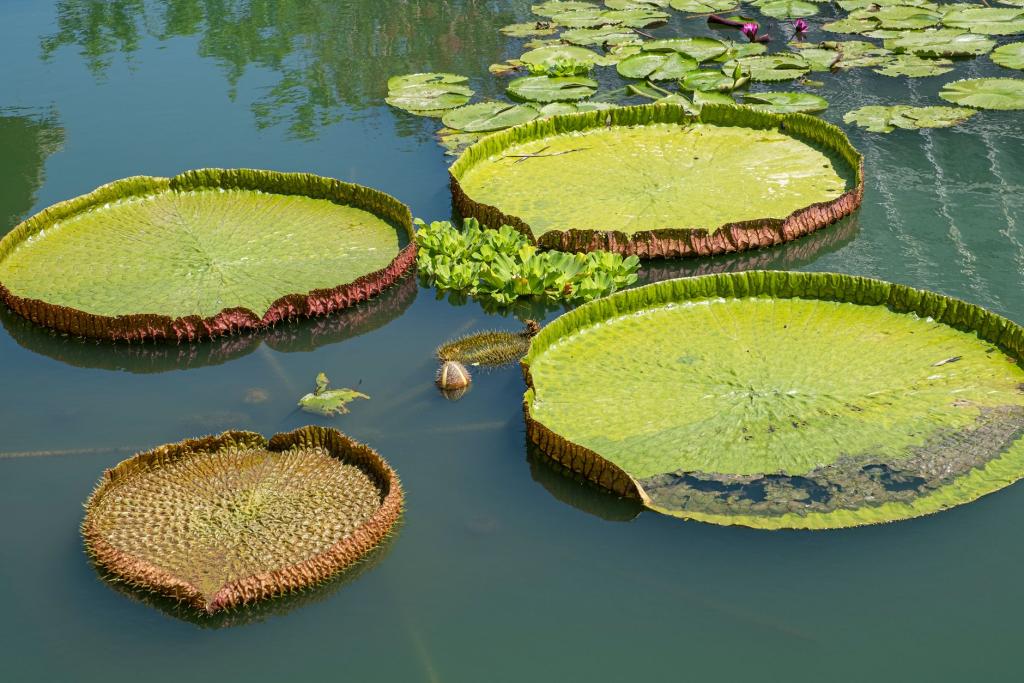
In December 2021, Jeremiah Harris stood beside an enormous water lily in Colombia's Inírida region and posted a selfie to Instagram. The Colorado nursery owner assumed the plant in the background was Victoria amazonica, the well-known giant water lily of the Amazon basin. He was wrong — and his mislabeled photo has now led scientists to a brand-new species. In October 2026, botanists formally described Victoria colombiana, a giant water lily with floating leaves that can span two meters across, according to a paper published in the journal Phytotaxa.
The story of the Giant Water Lily begins with a horticulturist's trained eye. Carlos Magdalena, a botanical research horticulturist at the Royal Botanic Gardens, Kew, who has spent more than two decades studying the Victoria genus, spotted Harris's photo online and immediately noticed something off. No known species of Victoria naturally occurs near the Inírida River, which drains into the upper Orinoco watershed rather than the Amazon. If the plant was growing where the photo's location said it was, it could be a species unknown to science, according to reporting by Gizmodo.
From a photo to a five-day jungle expedition
Magdalena did not rush to publish. He cross-referenced the Instagram post's location against satellite imagery of the region and confirmed that Victoria-type plant populations were present in the Inírida area. Harris confirmed that the satellite images matched the plants he had visited. Then came the slow work: it took nearly two years before Magdalena, working with Mauricio Bernal-Rodríguez of Bogotá's Jardín Botánico José Celestino Mutis, could organize a field expedition with members of Indigenous communities in the area.
During five days in flooded rainforest, the team located seven plants across two lakes. Finding a flowering specimen — the piece botanists need to examine the key features used to define a species — proved difficult. With help from Gustavo Melo, a boatman from the Indigenous Tucano community, the team reached a secluded lake in the early hours and found five additional plants, including one in flower. By comparing those specimens with existing botanical collections, the researchers confirmed the plant was distinct from every described species, Phys.org reports.
The team also used satellite imagery to identify a third lake where the water lily grows, and further surveys could reveal additional populations and clarify the full range of a plant that remained invisible to science until a stranger's vacation photo crossed a researcher's feed.
A fourth giant joins a tiny family
The Giant Water Lily enters one of botany's most exclusive clubs. With only three previously described species — V. amazonica, V. cruziana, and V. boliviana — the Victoria genus was small enough to fit on one hand. The new description makes V. colombiana the fourth scientifically recognized member, and it arrives just four years after V. boliviana was named in 2022, a reminder that even the most photographed plants can hide surprises.
The discovery also lands at a precarious moment for the species itself. Researchers estimate that only 30 to 50 individual plants survive in the wild, and the team plans to submit the species for a critically endangered designation from the International Union for Conservation of Nature. Their findings, published October 9, 2026, make formal protection and further surveys a conservation priority, as the tiny wild population could be wiped out by habitat changes before botanists even map its full range.
There is a plan to keep the Giant Water Lily from vanishing. The researchers hope to establish a population in lakes closer to Indigenous residents who can monitor the plants, and to cultivate seeds at Bernal-Rodríguez's botanical gardens in Bogotá — with the Royal Botanic Gardens, Kew, a possible future home. "Connecting these people from different backgrounds is key in a rapidly changing world," Magdalena said. "We all had one thing in common: we are all fascinated by nature."
Why a selfie matters for science
The discovery is a case study in how much biodiversity still hides in plain sight — and in how ordinary posts can become scientific data. Herbarium specimens and field expeditions remain the gold standard, but a social media feed scrolled by the right expert can point researchers at places they had no reason to look. For a generation that documents everything, the message is simple: the next great discovery might already be sitting in someone's camera roll.
The finding also underscores how much of the Amazon and Orinoco basins remains unsurveyed. A plant with two-meter leaves evaded formal description for centuries, not because it was microscopic or remote beyond reach, but because nobody with the right training looked at it in the right place. If something that enormous slipped through, the backlog of undescribed life in the world's great river basins may be far larger than anyone has guessed.
Plant discoveries have been making steady headlines, from the world's tiniest flowering plant shrinking down to duckweed to trees that carry drought memory in their leaves and houseplants becoming a generation's mood fix. But few recent finds have a better origin story than a selfie that accidentally rewrote a botanical genus.
Comments 0
No comments yet. Be the first to share your thoughts!
Leave a comment
Share your thoughts. Your email will not be published.