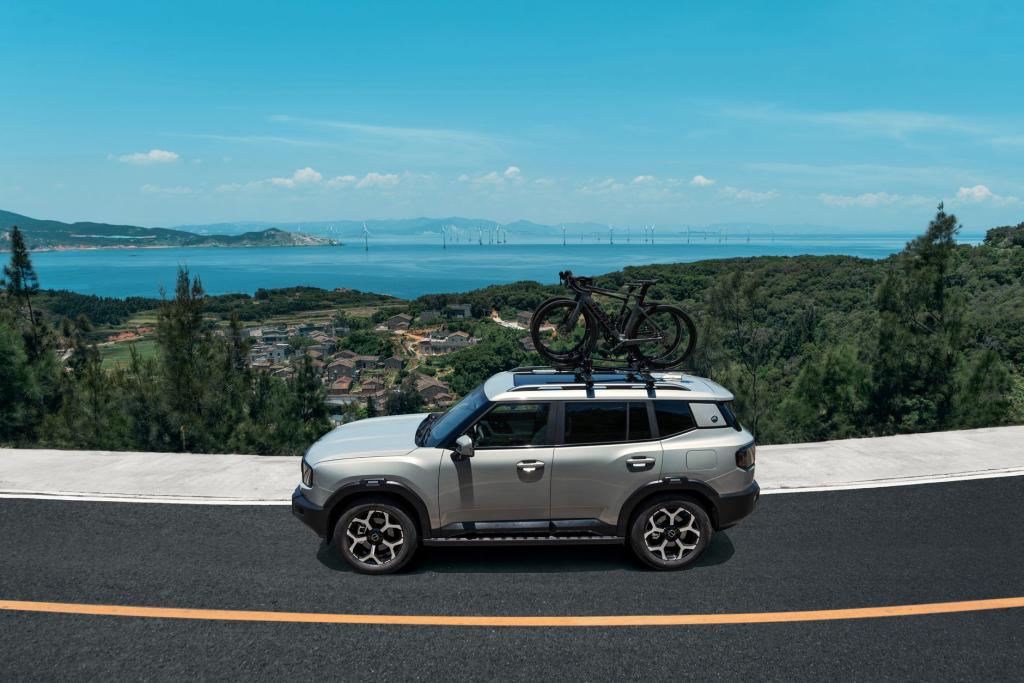
Chinese EV maker XPeng has picked Paris for one of the most ambitious launches in its history. The company announced on October 1, 2026 that its Next-Gen AI Flagship SUV, the G9L, will make its global debut at the 2026 Paris Motor Show on October 12, 2026, according to the announcement. European order books open at the event, and European pricing will be revealed there. This Robot SUV is not just another model launch. Paris is the first stop in a rollout across 64 global markets, making the show the starting gun for XPeng's biggest international push yet.
The timing is no accident. The G9L had its China launch event in Beijing on September 17, 2026, as detailed on XPeng's official press page. Less than a month later, the spotlight moves to France. The compressed timeline — September 2026 in Beijing, October 2026 in Paris — signals how aggressively XPeng is chasing growth outside its home market. The show, running October 12, 2026 through October 18, 2026, gives the company a week-long European stage to make its case to buyers who have never owned a Chinese car.
What XPeng is bringing to Paris
The G9L is a physically imposing flagship. It measures 5,120 millimeters long, which works out to about 201.6 inches, riding on a 3,100-millimeter wheelbase, roughly 122 inches, giving a wheelbase-to-length ratio of 0.605. XPeng says that proportion delivers better interior space and handling than what segment peers offer. Buyers will be able to choose between a battery-electric version and a range-extended version, known as REEV, which pairs an electric drivetrain with a generator for longer trips.
The Robot SUV label is not just marketing. The G9L runs XPeng's VLA 2.0 model for smart driving, designed to generalize quickly across regions — a must-have for a vehicle heading to dozens of countries. It uses the same Turing AI chip found in XPeng's IRON humanoid robot. Chairman and CEO He Xiaopeng has described the company philosophy as "car as robot," framing vehicles and humanoids as powered by one shared in-house AI foundation, according to EV industry coverage of the launch. The company now describes itself as a "Physical AI" company and has commissioned what it calls the world's first automated production line for advanced general-purpose humanoid robots.
Safety credentials are stacked. The SUV meets design standards for four major five-star safety ratings and completed 192 crash tests across Euro NCAP, ANCAP, C-NCAP and CIASI protocols, covering more than 110 individual test items. Validation also included three years of global road testing across 26 countries and regions, with cumulative mileage above 6.74 million kilometers — around 4.19 million miles. Its electric powertrain was engineered to global vehicle standards, reported by CleanTechnica, which also covered the model's global-readiness program ahead of the Paris reveal.
Why building it in Europe matters
Production will begin in Guangzhou, China, and in Graz, Austria, at Magna's plant. The G9L becomes the fourth XPeng model produced in Europe, following the G6, G9 and P7+, under a cooperation with Magna announced in September 2025. XPeng says it completed that localization sprint within a single year as part of its "Global Standards, Global Manufacturing" strategy.
That localization strategy carries real weight for European buyers. Cars built on the continent face fewer tariff and logistics hurdles than vehicles shipped from China, which could help XPeng price the G9L aggressively when order books open in October 2026. Pricing has not been disclosed yet, so the numbers revealed at the show will decide whether the company can undercut established rivals or ends up asking for premium money. A competitive sticker would be the single biggest lever XPeng has against Tesla, Volkswagen and BYD, all fighting for share in an already crowded European EV market.
The range-extended option is aimed squarely at a common buyer hesitation. Charging infrastructure remains patchy across parts of Europe, and a REEV drivetrain lets drivers run electric for daily trips while carrying backup range for longer journeys. For commuters who park on the street or live far from fast chargers, that flexibility could be the difference between considering the car and dismissing it. It is a pragmatic hedge while infrastructure catches up.
The counterpoint is scale of competition. Europe is not short on electric SUVs, and Chinese brands have multiplied there in recent years. XPeng's answer is to lead with technology rather than price alone: an AI stack shared with its humanoid robots, a European-built footprint, and validation data that reads more like an aviation program than a car launch. Whether buyers respond will become clearer once reservations open and reviews land after the Paris debut.
For now, the calendar is set. Beijing introduced the model in September 2026, Paris hosts the world premiere, and markets worldwide wait in line after that. If the Paris reveal lands, the robot SUV could become the benchmark Chinese buyers already know and European buyers are about to meet. Check the latest gadgets topic for more coverage of tech launches, and see how AI wearables are finding their audience for another take on AI hardware crossing into the mainstream.
Comments 0
No comments yet. Be the first to share your thoughts!
Leave a comment
Share your thoughts. Your email will not be published.