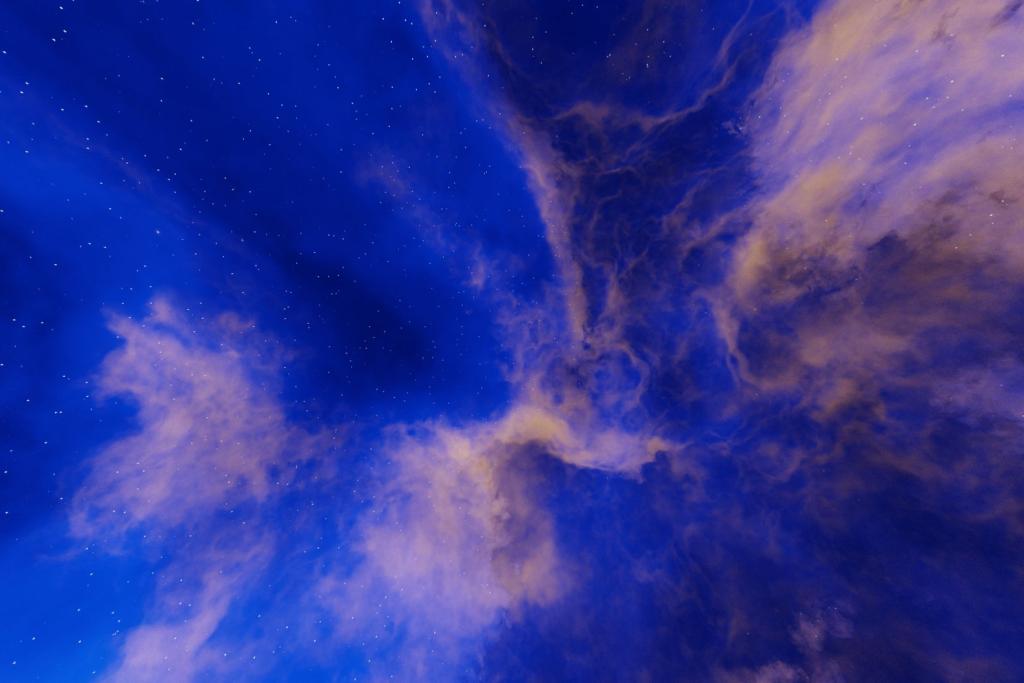
Webb water clouds just gave astronomers their first real look at weather changing on a world outside our solar system. The James Webb Space Telescope stared at a frozen, free-floating object called WISE 0855 and watched its clouds of water thicken and thin out in real time, according to the University of Arizona.
Yes, that is basically a weather report from seven and a half light-years away. And the forecast is stranger and more familiar than anyone expected.
What Webb actually saw
A team led by Brittany Miles of the university's Steward Observatory pointed Webb at WISE 0855 for eleven straight hours. Every fifteen minutes, the telescope captured a fresh spectrum of its light, which is a rainbow-style readout that reveals which molecules the light passed through on its way out.
The result is the most detailed time-series portrait ever taken of this icy world, per the university's announcement. It also delivered the first direct confirmation that water clouds on another body change in thickness over time, just like weather on Earth.
"This is the first time we've been able to confirm that water clouds are becoming thinner and thicker on a nearby world," Miles said. Her team found the high clouds grow and fade as the object spins, because different patches with different cloud cover and temperature rotate into view.
Meet the coldest brown dwarf
WISE 0855 is not a planet and not quite a star. It is a brown dwarf, an object too heavy to be a gas giant but too light to ignite like a sun. Astronomers sometimes call these objects failed stars, and they glow only with leftover heat from when they formed.
This one is a record holder. According to Mashable, it has cooled to about seventeen degrees Fahrenheit, colder than any other known brown dwarf. The University of Arizona puts it at roughly two hundred sixty-five Kelvin, which is chillier than Earth's surface on average.
It is also about the size of Jupiter but roughly twice as heavy, and it drifts alone with no star nearby to light it up. That lonely setup is a gift for researchers. With no blinding star next door, Webb can study the atmosphere without anything washing it out.
Clouds on top, a lava lamp underneath
The clouds were only half the story. The spectrograph also caught a rhythmic, wave-like pulse in two gases, carbon monoxide and phosphine, which is a compound of phosphorus and hydrogen. Heat from deep inside the brown dwarf keeps churning those gases upward, a bit like warm blobs rising in a lava lamp.
Planetary scientists know this kind of mixing from Jupiter, and it has been spotted on other brown dwarfs before. What is new is watching it rise and fall in real time, molecule by molecule.
"We're seeing water clouds getting thicker and thinner, and deep gases rising and falling, and we can actually watch them change in real time," Miles said.
Why the screen door matters
Co-author Mark Marley, who directs the university's Lunar and Planetary Laboratory, compares studying an atmosphere to looking through a screen door. "We're learning about the world on either side of the screen, but we also have to understand the screen itself," he said.
In this case the screen keeps moving. Clouds, chemistry and temperature all reshape the light that reaches a telescope, and older instruments could only blur them together. Miles points out that before Webb, scientists only had photometry, which lumps every effect into one brightness number. Now the signals can be pulled apart.
That matters because the Webb water clouds are a test case, and astronomers want to read the skies of far smaller and harder-to-see planets someday. If they misjudge the clouds, they risk misreading the whole world underneath. The study has been accepted for publication, and the paper is posted on arXiv for anyone who wants to dig in.
The big takeaway: weather is universal
Here is the part that hits for anyone who has ever checked a weather app. The same basic physics of convection, clouds and chemistry that shapes Jupiter appears to run this frigid, free-floating world too.
"Even though brown dwarfs are not true planets, they exhibit planet-like behavior," Miles said. "There is a spectrum of behaviors, not a hard line between brown dwarfs and planets."
If that physics really is universal, it should apply to the giant exoplanets Webb is now starting to study in earnest. Miles plans to log more Webb hours on the object to pin down its rotation and the three-dimensional movement of its atmosphere. For more on how scientists are probing strange worlds, check our science coverage.
The Webb water clouds on this tiny speck of cold gas are a reminder that skies everywhere are busy, shifting and worth watching. So the next time your forecast says partly cloudy, remember that somewhere seven and a half light-years out, a lonely ball of ice-cold gas is having its own cloudy day, and humans finally have the receipts.
Comments 0
No comments yet. Be the first to share your thoughts!
Leave a comment
Share your thoughts. Your email will not be published.