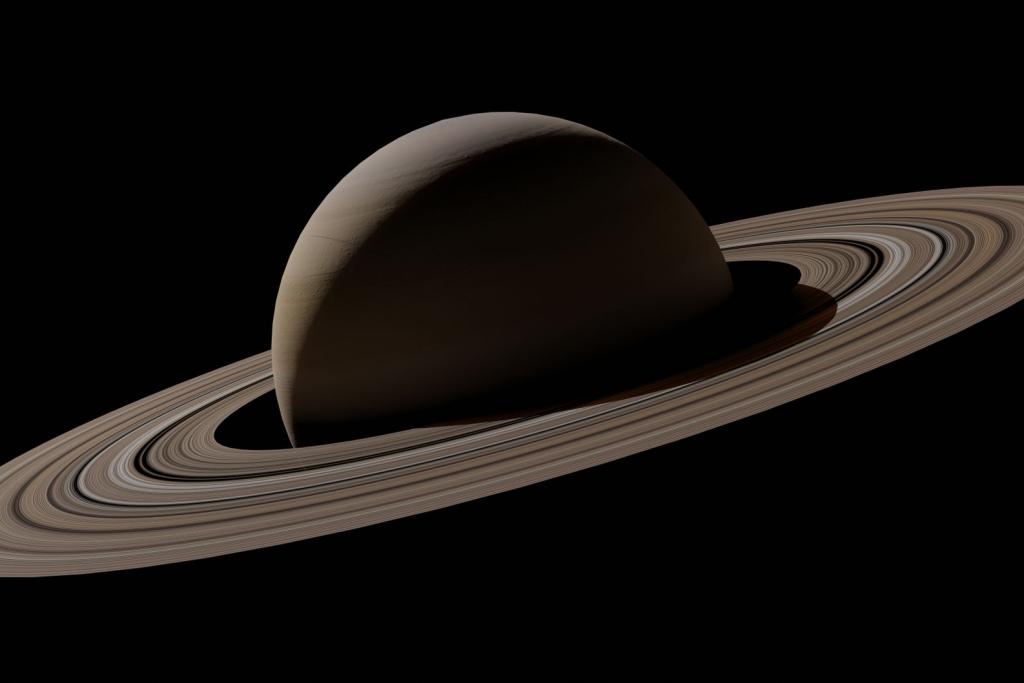
Every illustration of an alien planet draws a perfect circle. That assumption has finally cracked. Astronomers using the James Webb Space Telescope have produced the first map of an Alien World's True Shape, and the giant world they studied is lopsided, with its atmosphere stretching farther into space on one side than the other.
The world in question is a hot Jupiter catalogued as WASP-17b, a gas giant orbiting its star some 1,300 light-years from Earth. Intense heat from its star whips its atmosphere into powerful winds, and theory has long predicted that this should deform the atmosphere into an uneven shape. Until now, nobody could check. The new work, led by Cornell University and the University of Bristol and published this month in Nature Astronomy, is the first direct spatial measurement showing that an exoplanet's atmosphere really is asymmetrical, according to the University of Bristol's announcement of the findings.
A New Way to Read Starlight
The breakthrough is a technique called transmission strings, also described as transit mapping. When a planet crosses in front of its star, a thin sliver of starlight filters through the gas at the planet's edge, known as the limb. Molecules in that gas stamp telltale absorption marks onto the starlight, and astronomers have read those marks for years. Traditional analysis, however, averages the entire limb into a single uniform ring, blending the morning and evening edges, the equator and the poles into one spectrum.
The new method, developed at Bristol by astrophysicists Dr David Grant and Dr Hannah Wakeford, pulls the ring apart. It extracts separate spectra at multiple angles around the planet's edge, revealing how the atmosphere's reach changes with position. Earlier JWST work pioneered a related idea called eclipse mapping, which watches the planet swing behind its star; transmission strings instead studies the planet mid-crossing, capturing the composition of light around the limb from different angles.
Lead author Dr Lili Alderson, a Klarman Postdoctoral Fellow at Cornell who began the work during her doctorate at Bristol, said: "Rather than assuming your atmosphere is a circle with the same radius all the way around, our technique allows you to pull out different distances from the centre to the edge of the planet. We're able to go around the edge. So, we've gone from a ring to understanding where on the ring the gemstones are, so to speak."
The "gem" the team found sat exactly where models said to look. On the planet's evening side, fast equatorial winds ferry heat from the permanently sunlit dayside toward the permanently dark nightside, puffing that side of the atmosphere outward. The morning side, which has already cooled during its journey through the night, sits noticeably flatter. Measurements put the temperature swing between the two limbs at roughly six hundred fifty degrees, a divide that theory had predicted and that the mapping now confirms. The researchers also traced how chemistry and temperature shift from the equator to the poles and between the day and night faces, building one of the most complete three-dimensional portraits of an alien atmosphere yet.
Why an Egg-Shaped World Changes the Field
The result is more than a portrait of one strange planet. It is the first map of an Alien World's True Shape, and it is a proof of concept for a whole new method. More than six thousand exoplanets have been confirmed to date, and astronomers have been forced to model all of their atmospheres as simple circles. Now they have a verified method for pulling those circles apart and reading the weather inside them, starting with the puffiest, hottest giants and working toward smaller worlds.
Dr Alderson said the agreement with theory was the most satisfying part: "Theory predicts that the morning and the evening sides should have a strong temperature difference, and WASP-17b fits really nicely in that trend — pretty much bang-on what we thought it would be."
Co-author Dr Hannah Wakeford, Associate Professor in Astrophysics at Bristol, added: "Planets are temperamental, their atmospheres complex and chaotic. The fact that all of these numbers came together and showed us this very structured, dynamical picture of this giant world over a thousand light-years away was just really exciting."
For readers who follow the cosmic beat, the timing is rich. Astronomers are also hunting ghostly structures across the sky, like the starless hydrogen cloud that may be a nearly invisible galaxy, while our own farthest probe keeps drifting outward, as Voyager 1 approaches a full light-day from Earth. This mapping belongs to a new phase of astronomy where telescopes do not just detect distant worlds but dissect them.
The team plans to apply transmission strings to more candidates, the researchers reported in the journal. The method is already beginning to separate conditions across latitudes, not just day and night sides, which the authors describe as a first step toward mapping weather-scale patterns in exoplanet climates. The data came from the telescope scientist's guaranteed-time programme, and the work was funded by NASA, the UK's Science and Technology Facilities Council, and the Klarman Fellowship.
Somewhere out there, an alien sunrise is hotter on one side of the sky than the other. Every world mapped from here on will sharpen the picture, but this first Alien World's True Shape will always be the one that broke the circle.
Comments 0
No comments yet. Be the first to share your thoughts!
Leave a comment
Share your thoughts. Your email will not be published.