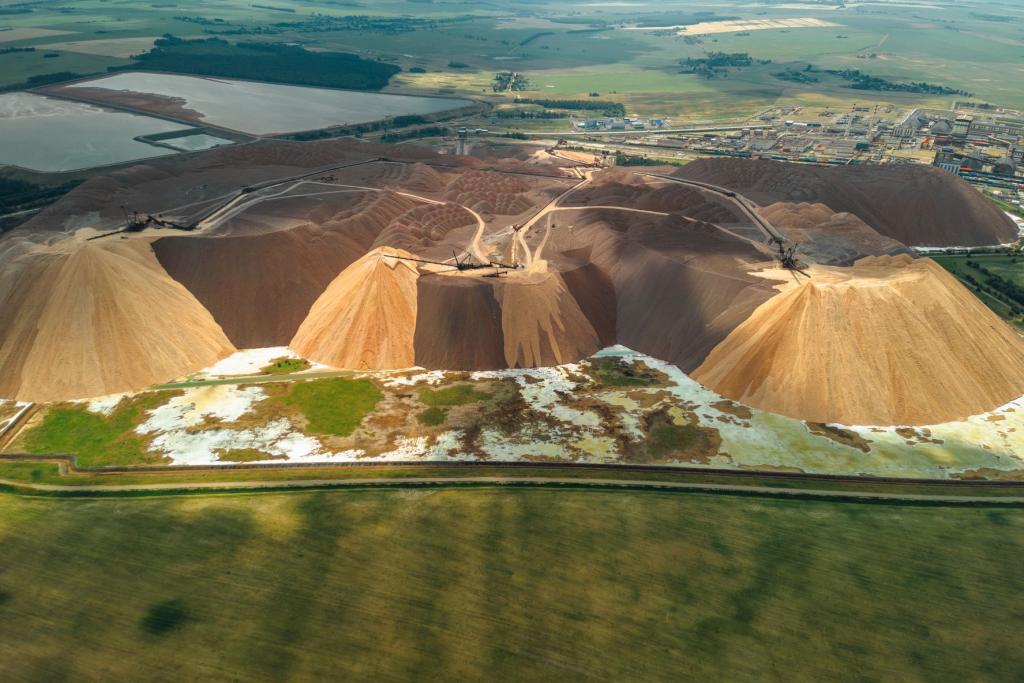
President Donald Trump has a new idea for loosening Canada's grip on the American fertilizer supply chain, and Saskatchewan is not impressed. On September 21, Trump announced on Truth Social that the United States is working on a "massive Deal" to buy potash from Belarus, writing that the pricing "would be for substantially less than we are currently paying to Canada" and that the arrangement would be "very good news for our Farmers and Ranchers," according to Reuters. Within hours, Saskatchewan Premier Scott Moe had a two-word reply for Trump's Belarus potash deal: blood potash.
Potash is a mineral that helps crops resist disease and improves yields, and Canada is the world's largest producer, with all of it dug out of Saskatchewan. The United States is Canada's biggest customer, buying the vast majority of its potash from its northern neighbor. That dependence is exactly why Washington exempted fertilizer from its tariffs on Canadian goods, and Canada now supplies about eighty-five percent of the potash American farmers use, according to reporting by the Globe and Mail cited by The Brief.
Moe calls it blood potash
Moe did not hold back. In a post on X on Monday, he wrote that more than forty countries, including Canada and its allies, have sanctions against Belarus for backing Russian President Vladimir Putin's invasion of Ukraine. "Buying blood potash from Belarus is supporting Russian aggression," Moe wrote, according to National Newswatch. "It's wrong and it doesn't make sense."
He also questioned the economics. "Does anyone believe Belarusian blood potash shipped through Russia is going to be more affordable, more sustainable or more ethical than potash shipped from Saskatchewan, right here in North America?" Moe wrote. Belarus is landlocked and lost its main export route when Lithuania shut its border crossings to Belarusian freight, so shipments bound for the United States would have to travel through Russia and across the Arctic, according to Reuters.
Other Canadian leaders piled on. Federal Conservative house leader Andrew Scheer said his party condemns the proposal, calling Belarus "a communist dictatorship" with "a terrible human rights record," and said the idea that Belarus would be a better trading partner than Canada is "ridiculous," according to Tdot News. British Columbia Premier David Eby said he stands with Moe in protecting Canadian workers and industries, noting that potash ships out of B.C. ports.
Analysts were equally skeptical. Erin Weir, an economist who studies potash and a former Saskatchewan member of Parliament, said Belarus does not have a stockpile of potash sitting around waiting for an American buyer, according to National Newswatch. Josh Linville, a fertilizer analyst at StoneX, told Reuters he doubts Belarusian potash will play a major role in American farm supplies or lower the prices farmers pay. "We have not struggled to find potash," Linville said. "We have more than enough to go around. It is phosphate and nitrogen that we need help with."
The view from Minsk
Belarus is not exactly holding the door open either. President Alexander Lukashenko, a close ally of Russia, said on September 11 that his country had resumed selling potash to the United States after Washington lifted sanctions, according to Reuters. He also said he wants the return of tens of millions of dollars he says is stuck in the American banking system.
Lukashenko added on Monday that Belarus has already promised most of its potash to other buyers, according to The Brief. With most Belarusian trade now flowing east and Europe still banning Belarusian potash, the volumes actually available for American farmers look thin. According to Reuters, the announcement signals Trump's willingness to use alternative suppliers as leverage in his trade disputes with Canada. Ottawa, for its part, keeps working to deepen defense partnerships beyond the United States.
Trump softens the message at the UN
By Tuesday, the tone had shifted. Asked about the proposed Belarus potash deal during a bilateral meeting with Ukrainian President Volodymyr Zelenskyy at the United Nations General Assembly, Trump told reporters the United States would keep buying from Canada, according to Reuters. "Belarus has a lot of potash, and our farmers need good prices," Trump said. "We'll continue to go with Canada, but Belarus would like to sell it for a much lower price."
Prime Minister Mark Carney, also in New York for the General Assembly, answered with a pitch of his own. He proposed that Canada and the United States build a partnership to become "self-sufficient" and "fertilizer independent," covering not just potash but all fertilizer ingredients, including ammonia, according to The Brief, which cited the Globe and Mail. Carney told reporters that Canada's potash is reliable and cost-effective and that both countries have an opportunity to grow the fertilizer industry together. "That would be good for Canadian farmers, it would be great for American farmers," Carney said, according to Europesays.
Moe, for his part, sounded unimpressed by the whole saga. Asked about Trump's latest comments, he told the CBC on Tuesday: "It was never realistic."
For now, American farmers will keep getting their potash from Saskatchewan. The Belarus detour lasted about a day, and it ended with Trump saying the United States will stick with Canadian supply after all. Read Reuters' report on the Monday announcement and its account of the Tuesday walk-back at the UN for the full timeline.
Comments 0
No comments yet. Be the first to share your thoughts!
Leave a comment
Share your thoughts. Your email will not be published.