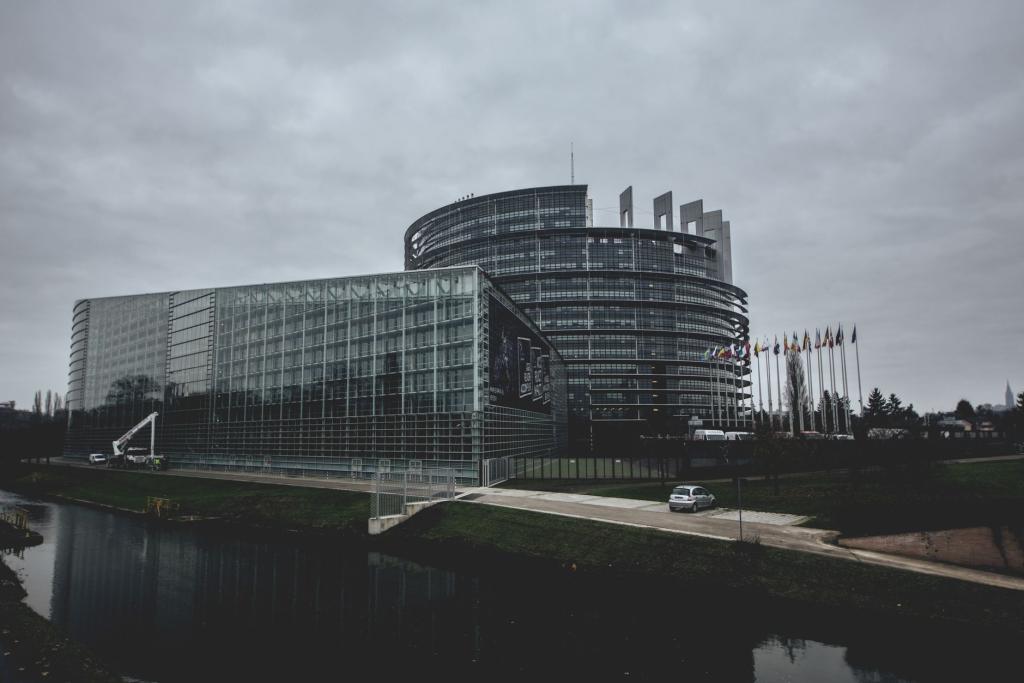
On Thursday, Canadian Prime Minister Mark Carney stood before the European Parliament in Strasbourg and said yes to an idea that did not exist until the day before: making Canada the bloc's first EU associate member.
The proposal came from European Commission President Ursula von der Leyen. During her annual State of the European Union address on Wednesday, with Carney sitting in the front row, she said she wanted to open the door for Canada to become the bloc's first associate member. The chamber answered with a standing ovation, and Carney rose to embrace her, according to the Associated Press. Le Monde noted that no non-European leader had ever been invited to attend the traditional address in Strasbourg before.
What associate membership would actually mean
The honest answer is that nobody knows what an EU associate member would look like yet, because the status does not exist. There is no such thing as associate membership in the EU's founding treaties, so the concept would have to be invented from scratch. Carney welcomed the EU associate member proposal while acknowledging the details remain to be defined, and he later told reporters he is not pursuing full EU membership.
What has been sketched so far is an "Alliance for the Future," a shared space for prosperity and economic security. Von der Leyen listed possible areas: intelligent manufacturing, a tech alliance, integrated defence industrial bases, a flagship Arctic project, energy, critical minerals, batteries, artificial intelligence, quantum, cyber and economic security, according to analysis from the Atlantic Council. Those building blocks would form the substance of any future EU associate member arrangement.
Reports suggest the package could also include Canadian access to the Erasmus+ student exchange program, EU-funded research grants and mutual recognition of professional qualifications. The two sides are not starting from zero: the EU-Canada trade deal, CETA, has been provisionally in force since 2016, and Canada became the first non-European country to join the EU's 150-billion-euro SAFE defence procurement program this year, the AP reported. If the talks advance, those ties would sit inside whatever EU associate member framework the two sides negotiate.
What Carney told the parliament
Carney used his speech to make the case for EU associate member status, calling for a sweeping strategic alliance and pitching joint work on critical minerals, AI, defence and trade. He framed the moment in stark terms, telling parliament that modern societies are being rocked by "new storms": climate-driven upheaval, the erosion of democratic norms, and trade used as a weapon, Reuters reported. That climate warning echoes reporting on how Europe's wildfires became the new normal for Gen Z summers.
"This is a ferocious storm. A single tree will come down in it. A forest will not," he said.
He laid out concrete areas for cooperation, including critical minerals, defence industrial capacity, AI and computing, energy security, space and payments, plus seamless digital trade in non-agricultural goods and a wide range of services. He presented those areas as the practical content an EU associate member deal could cover. He proposed deepening people-to-people ties so young people can live, work and study in Canada and Europe, and said Canada could contribute LNG and hydrogen at large scale to support Europe's energy security, including through new port infrastructure in the high north and on Canada's east coast.
On sovereignty, he was direct: Canada does not seek power to dominate others, he said. Instead, Ottawa is pursuing resilience so that no one can control its open markets, impair its sovereignty, threaten its territorial integrity, or undermine its freedoms, its democracy and its rule of law.
The reception was warm. Lawmakers approached him for handshakes and selfies, one parliamentarian wore a Canadian hockey jersey, and the chamber gave him a standing ovation when he finished, according to the AP.
Why this is happening now
The backdrop is the trade fight with the United States. Roughly 70 percent of Canada's exports go to the U.S., and Trump's tariffs, demands for economic concessions and repeated talk of making Canada the 51st state have pushed Ottawa to reduce its dependence on its neighbour and look for other partners. Canada has hit back with its own counter-tariffs on U.S. goods.
Carney has been making this argument for months. At the World Economic Forum in Davos in January, he warned that when countries negotiate alone with a dominant power, they negotiate from weakness and accept what is offered. The EU associate member offer is the clearest sign yet that other countries are willing to build around that idea.
Not everyone is cheering. Trump suggested the proposed EU associate member arrangement could be a "hostile act" and threatened heavy tariffs on Europe if he judged its intentions unfriendly, the AP reported. Asked about the comments, Carney answered that Canadians are united: nobody will tell them what language to speak, and no one will dictate their culture or their choice of international partners.
What happens next
There are real obstacles. Ten EU member states have still not ratified CETA, which keeps some of its investment provisions from taking effect. If Canada moved closer to the EU market as an EU associate member, hard questions would follow about what say Ottawa gets in Brussels, and whether it would end up following EU rules without a vote. Canada's business community is watching EU rules on carbon border taxes and new steel tariffs closely, the Atlantic Council noted.
The next milestone is already on the calendar. Carney will host EU leaders for a summit in Montreal on Oct. 29-30, where the two sides are expected to discuss the proposed EU associate member relationship in more detail. Carney said any enhanced partnership would be debated in Canada's Parliament and put to a final vote.
For now, EU associate member status is a headline in search of a legal definition. But the applause in Strasbourg showed both sides want to keep talking, and the Montreal summit will show whether the idea can survive contact with the details. Read the full highlights of Carney's speech via Reuters, the AP's report on the week in Strasbourg, and analysis of the proposal from the Atlantic Council.
Comments 0
No comments yet. Be the first to share your thoughts!
Leave a comment
Share your thoughts. Your email will not be published.