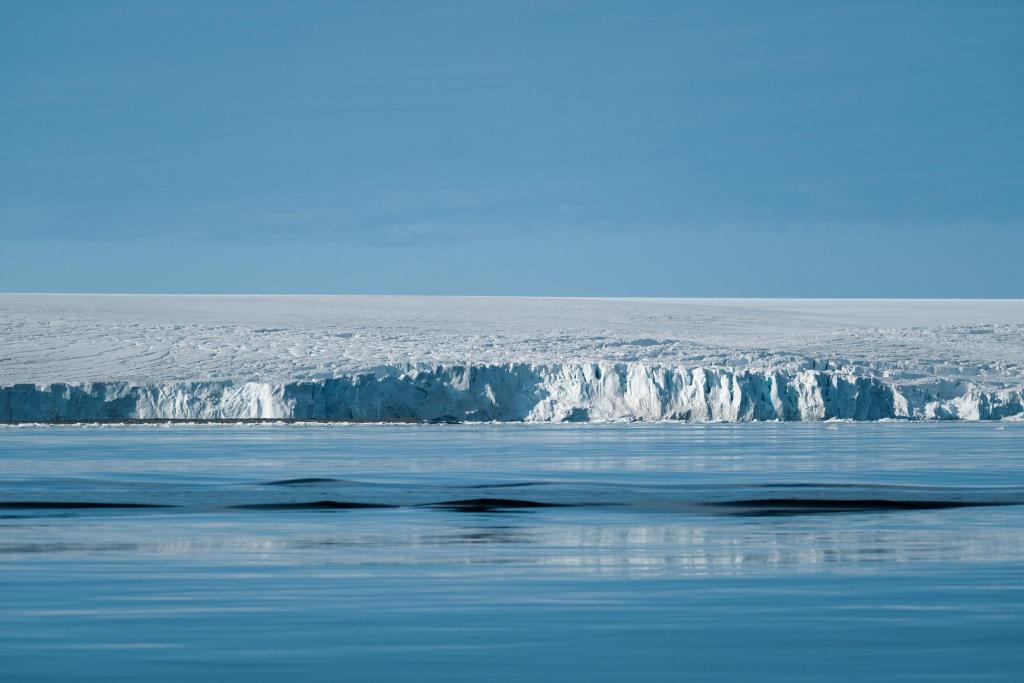
Thwaites Glacier, the Antarctic giant nicknamed the "Doomsday Glacier," just got two of the grimmest scientific check-ups yet. Two separate research teams published findings this week saying the glacier is locked into long-term ice loss, and that its contribution to rising seas may be bigger than anyone planned for.
Cooling the ocean will not save it
The first study comes from the British Antarctic Survey. According to the British Antarctic Survey, researchers ran a deliberately extreme experiment: they completely switched off the melting effect of the ocean beneath both Thwaites and its neighbour, Pine Island Glacier, in three independent computer models, then watched what happened over one hundred and fifty years.
The two glaciers behaved very differently. Pine Island Glacier did what scientists might expect. It thickened and began creeping back toward the position it held in the first half of the twentieth century. Thwaites did not. It kept losing ice for the entire simulation, although the rate of loss slowed over time as the glacier thinned.
Lead author Dr Rosie Williams, a glaciologist at BAS, put it bluntly: "These results show that past changes in ocean-driven melting have now committed us to unavoidable future ice loss from Thwaites Glacier. This ice loss cannot be undone or prevented by simply cooling the ocean." The paper appears in Geophysical Research Letters.
A second study doubles the sea-level estimate
The same day, a different team dropped an even more eye-catching result. According to Phys.org, glaciologists at the University of California, Irvine and NASA's Jet Propulsion Laboratory built a new ice sheet model that projects up to thirty millimetres, about one point two inches, of sea-level rise from Thwaites by the year twenty-one hundred. That is twice earlier estimates, and it holds even without additional climate warming.
Their trick was swapping an old assumption for a more realistic one. Models have long treated the point where ice leaves land and starts floating as a sharp, stable "grounding line." Satellite data shows something messier: a "grounding zone," sometimes kilometres wide, where warm seawater pushes deep under the ice. Using radar readings from the Finnish ICEYE satellite constellation, the team found seawater lifting the ice during tidal cycles and flushing it with warm water.
The result, published in Nature Communications, matches the glacier's observed decline since the nineteen nineties four times better than traditional models. "Most projections to date have struggled to match the rapidity of the mass loss because of missing physics," said co-author Eric Rignot.
The ridge that may not hold
One detail should get your attention. The main trunk of Thwaites is currently being held in place, at least temporarily, by an underwater feature called the Mouginot Ridge. Lead author Mattia Poinelli explained that once the ridge is unpinned, the glacier will keep retreating across a seafloor that slopes the wrong way, toward its next high point, the South Ridge.
Simulations that include a grounding zone four to six kilometres wide predict a sixty percent chance of unpinning the Mouginot Ridge by the end of the century. That is a coin flip tilted toward trouble.
Why a remote glacier matters to your life
Thwaites sits in the Amundsen Sea sector of West Antarctica, which accounts for roughly one third of the mass loss from the Antarctic Ice Sheet. The wider West Antarctic Ice Sheet holds enough ice to raise global sea levels by around five metres. BAS says a total collapse of Thwaites alone would add an estimated sixty-five centimetres.
Those are slow, long-range numbers, but coastlines are where huge populations live. Higher seas make storm surges worse, push saltwater into drinking supplies and raise insurance and infrastructure costs for cities from Miami to Mumbai. If you are in your teens or twenties, you are the generation that will be paying for and living with those decisions.
What is locked in and what is still up for grabs
The two studies are not saying the same thing in the same way. The BAS work is an illustrative thought experiment: the zero-melting scenario could never happen in the real world, because seawater beneath glacier ice always causes some melting. The point is that history has already pushed Thwaites into a state where it keeps shrinking on its own momentum.
Professor Paul Holland, an ocean modeller at BAS, said the ice loss "will be further exacerbated if we do not reduce and ideally reverse our emissions of greenhouse gases." He added that scientists do not yet know whether Antarctica's other major glaciers are moving into a similar state of committed change.
In other words, some of Thwaites' future is already written, while how bad the rest gets is still tied to emissions and ocean temperatures. For more on how a warming planet is reshaping the poles and coastlines, browse our climate emergency coverage. The researchers' message to policymakers is simple: plan for higher seas now, because waiting for certainty means waiting too long.
Comments 0
No comments yet. Be the first to share your thoughts!
Leave a comment
Share your thoughts. Your email will not be published.