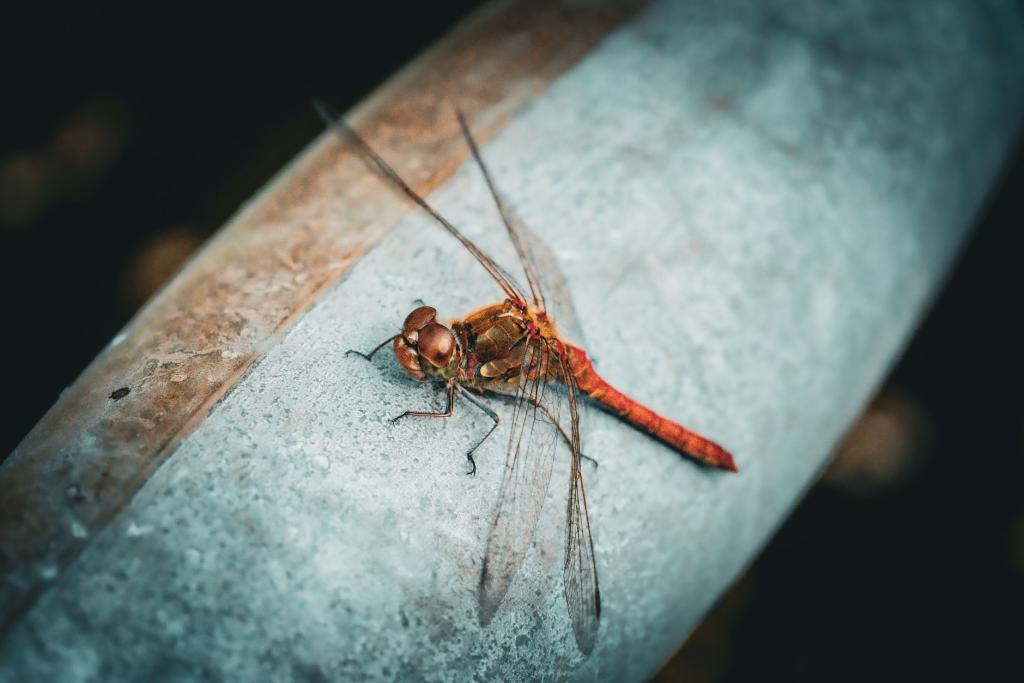
Insect wing evolution just got its biggest plot twist in a century. A new genome-and-fossil study says mayflies and dragonflies are close relatives, and that the wings of every flying insect, from your backyard fly to a dragonfly screaming over a pond, trace back to one origin that split into two very different designs, according to the Chinese Academy of Sciences.
The Century-Old Puzzle Scientists Finally Cracked
Biologists have argued for more than a hundred years over how the first winged insects branched into the groups that rule the skies today. The fight is nicknamed the Palaeoptera Problem. It matters because insects are the most species-rich animals on Earth, with more than one million formally described living species, and the arrival of flight is one of the most transformative events in the history of life on land.
The study was published in the journal PNAS on October thirteenth. It was led by Professor Cai Chenyang's team at the Nanjing Institute of Geology and Palaeontology and Professor Zhou Changfa's team at Nanjing Normal University, according to the EurekAlert release.
Three Rival Family Trees
Three competing ideas dominated the debate. The first, the Palaeoptera hypothesis, says mayflies and dragonflies share a common ancestor and together form a sister group to all insects that can fold their wings back over their bodies, a lineage called Neoptera. The second pairs dragonflies with a group of mayflies plus wing-folders. The third pairs mayflies with wing-folders and leaves dragonflies on the earliest branch.
Each idea implies a different story about how wings were built and how they moved. That is why settling the question has been such a big deal for anyone trying to redraw the insect tree of life.
How the Team Got an Answer
The researchers sequenced sixteen new genomes from mayflies collected in China, a group that earlier studies had barely sampled. They combined that with genomic and transcriptomic data from more than one hundred insect species, then built two large datasets from genes that appear exactly once in each species.
Instead of trusting one method, they stress-tested the result with several. They used approaches that pool all genes together and others that compare individual gene trees, tried multiple evolutionary models, ran formal tests and ran simulations. Every approach pointed the same way: mayflies and dragonflies are sister groups, and together they sit opposite the wing-folding insects.
The team also explains why the answer stayed hidden for so long. During the rapid early burst of winged insects, a mix of incomplete lineage sorting and gene tree estimation error affected approximately forty percent of the gene trees, which created noisy and contradictory signals. Different analyses handled that noise differently, so earlier studies landed on different answers.
What It Means for How Insects Learned to Fly
Here is the twist. Mayflies and dragonflies cannot fold their wings flat, which made them look more primitive. The new result suggests otherwise. Both the stiff, non-foldable wings of mayflies and dragonflies and the foldable wings of Neoptera appear to be new traits that evolved independently from an ancestral winged insect. The study also concludes that insect wings evolved only once.
Using molecular clocks calibrated with thirteen fossil reference points, the team estimates that the group of all living winged insects began in the Early Devonian, while the mayfly and dragonfly lineage arose in the Late Devonian. Think of it as one invention followed by two rival upgrades.
For anyone curious about the bigger picture, this is a rare case where insect wing evolution moves from a shouting match to a working answer. The researchers describe the result as largely resolving the problem rather than closing the book, and they say the same recipe of dense genome sampling, careful testing and fossil dating could help untangle other deep branches of the tree of life where fast ancient radiations scrambled the genetic evidence. Some of those debates are just as old as this one.
Two Wing Designs, Two Different Lives
The folding trick relies on the rotation of a tiny skeletal piece at the wing base called the third axillary sclerite, which lets the hindwings tuck over the abdomen. According to the researchers, that gave wing-folders a huge ecological advantage and fueled an explosive radiation after the Carboniferous, because insects that can fold up can squeeze into vegetation and other tight spaces.
Mayflies and dragonflies went the other way. They developed rigid wing bases built for gliding or high-speed predatory flight, trading flexibility for raw aerial performance. That is why a dragonfly can hunt mid-air with ridiculous precision while a beetle can park its wings under a shell and crawl underground.
The work was funded by the National Key R&D Program of China, the National Natural Science Foundation of China and the China Postdoctoral Science Foundation. For more discoveries like this, check our science coverage. The big takeaway is simple: a question posed generations ago finally has a strong answer, and the insects buzzing around you have a more dramatic family history than anyone assumed.
Comments 0
No comments yet. Be the first to share your thoughts!
Leave a comment
Share your thoughts. Your email will not be published.