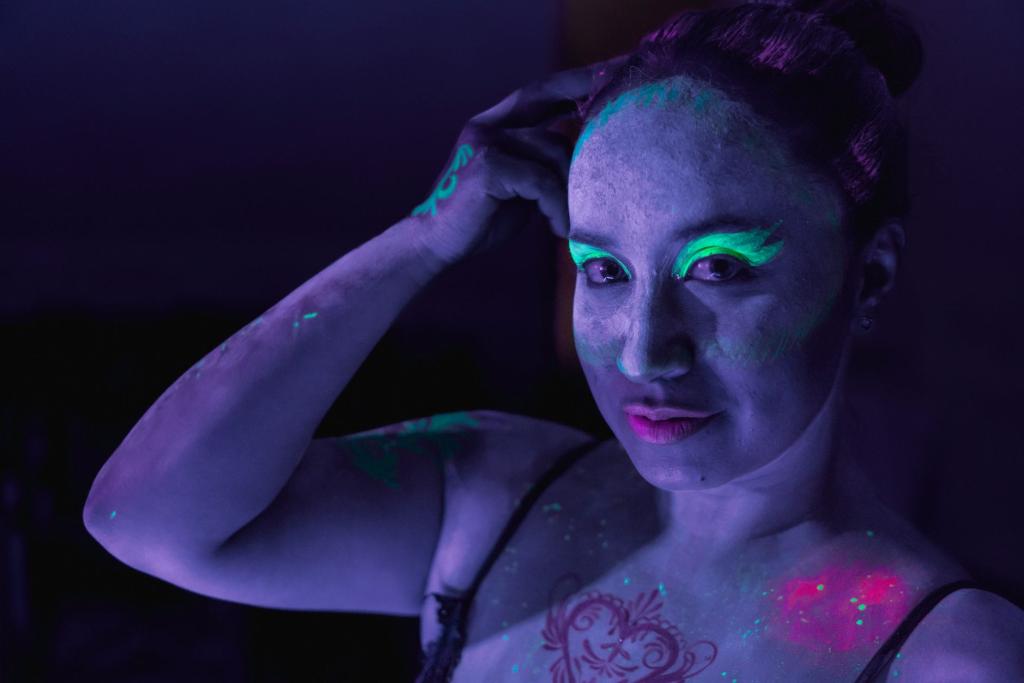
An invisible tattoo that switches on under ultraviolet light sounds like movie prop tech, but chemists at the University of Colorado Boulder have now built it. The ink, named PhotoTat, stays nearly undetectable under ordinary light and bursts into vivid color when hit with UV, then fades back to nothing when the light is gone. The research was published in 2026 in the Cell Press journal Matter & Light, and the lead scientist behind it tested the stuff on his own leg.
PhotoTat comes from the lab of Carson Bruns, a chemist at the University of Colorado Boulder who has spent years tinkering with light-responsive body ink. He previously developed a UV-reactive magenta ink called Magic Ink, which he and collaborators commercialized through the startup HYPRSKN in 2024. The new work takes the idea much further: instead of one color that only appears under blacklight, his team made three base dyes that can be mixed into a wide palette of glowing designs.
How an Invisible Tattoo Switches On
Each invisible tattoo made with PhotoTat holds three photochromic dyes — blue, magenta, and yellow — sealed inside microscopic spheres of PMMA, a clear plastic similar to the acrylic used in medical implants. Under ordinary visible light the dyes stay colorless. But 365-nanometre ultraviolet light triggers a molecular reaction that reshapes the dye molecules and makes them snap into full color within seconds, according to New Atlas. Combined, the three channels can generate roughly sixteen colors and hundreds of shades, so designs can be multicolored rather than a single novelty hue.
Turning the tattoo off is just as controllable. Once the UV source is removed, the colors drift back toward invisible over several hours on their own. Exposing the skin to bright visible light, such as a strong LED lamp, speeds the fade dramatically. That two-way control is what makes the invisible tattoo behave less like body art and more like a display: the same patch of skin can show different images at different times, using patterned UV light, stencils, or projected designs to rewrite what appears.
The team proved the concept on silicone skin models and on excised pig skin, writing multicolored images that sat hidden in normal light and lit up under UV. Bruns also volunteered as his own guinea pig, tattooing his leg with a black outline of fish scales and filling the scales with the new inks. A flash of light turns those scales red, orange, blue, and other colors, which he likens to magical mermaid scales, as reported by Phys.org. In that single human trial, the three color channels kept responding to light for between one and two years after tattooing, according to Nature.
Why an Invisible Tattoo Could Change Medical Marking
The most promising use may have nothing to do with fashion. Many people undergoing radiation therapy for cancer receive small permanent tattoos that help clinicians aim the beams at exactly the right spot. Those marks stay with patients long after treatment ends, and for some they become an unwanted reminder of a hard chapter. According to Phys.org, Bruns argues that an invisible tattoo could stay hidden in everyday life and appear only in the clinic when the care team needs it, which could reduce the psychological weight of the mark. His team showed the same idea working for biopsy-site marking.
An invisible tattoo that appears only on demand also answers a different kind of everyday pressure: the job interview, the family gathering, the client meeting. Conventional UV or blacklight tattoos already exist, but they are static — they glow whenever they catch the right light and you cannot switch them off at will. PhotoTat flips that control to the wearer, letting one tattoo hold multiple designs and stay hidden by default.
The Safety Caveats You Cannot Skip
Enthusiasm should stay tempered, because the safety picture is far from complete. The specific dye formulations have not yet gone through independent testing for toxicity, sterility, and purity, and the only living-skin evidence comes from a single volunteer — the researcher himself. That is a long way from ink that a tattoo artist could responsibly use, so you will not find PhotoTat in parlors any time soon.
There is also a daylight problem. Sunlight carries UV, so an invisible tattoo worn outdoors can drift toward a half-visible state, meaning full invisibility may depend on sunscreen or UV protection. The researchers additionally found that the effect weakens as skin pigmentation increases, although the marks stayed detectable in the darkest skin models they tested. For now, the invisible tattoo is a working prototype with a compelling medical story — one that still has to earn its way through the long road of human-safety testing. For more on light-responsive medical research, see our coverage of optogenetic gene therapy (Blind Patients Detect Objects After Optogenetic Gene Therapy), and browse the latest coverage in science.
Comments 0
No comments yet. Be the first to share your thoughts!
Leave a comment
Share your thoughts. Your email will not be published.