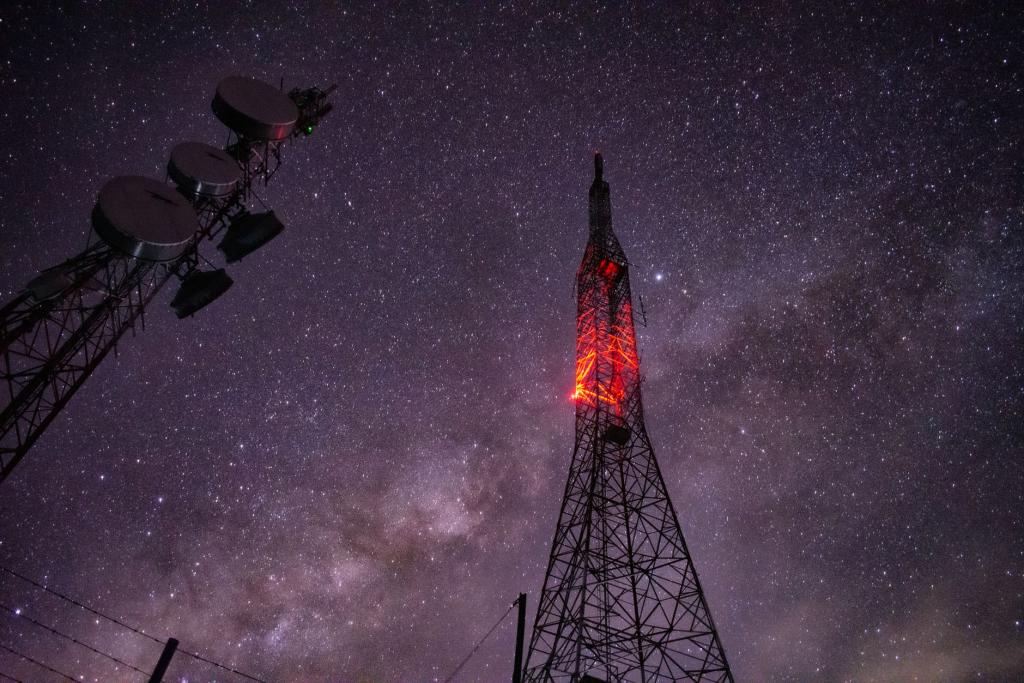
Astronomers have traced the most distant fast radio burst ever detected to its home galaxy, using the James Webb Space Telescope to pinpoint a cosmic flash that traveled for more than 10 billion years before reaching Earth. The burst, designated FRB 20240304B, was first spotted by South Africa's MeerKAT radio telescope in March 2024. Now, Webb's infrared eyes have located the tiny, star-forming galaxy it came from, pushing the frontier of these mysterious signals to a time when the universe was only about 3 billion years old.
Fast radio bursts are among the strangest phenomena in astronomy. They last only milliseconds yet release enormous amounts of energy, and their origins remain uncertain. Most are seen only once, which makes them devilishly hard to study. What makes this fast radio burst special is its distance. It more than doubles the previous record for a precisely located burst, giving astronomers a powerful new probe for studying both how galaxies evolved and the vast, invisible matter spread between them.
The discovery was led by Dr. Manisha Caleb and Dr. Themiya Nanayakkara at the University of Sydney and is published in the journal Science. The MeerTRAP project, which hunts for these bursts using the MeerKAT array, detected the flash and measured a dispersion signature that immediately suggested an extreme distance. But confirming that distance required finding the host galaxy, and the galaxy was invisible to even the largest ground-based telescopes. That is where Webb came in.
A flash from the universe's rowdy youth
According to the research team, Webb's Near-Infrared Camera finally revealed a faint galaxy near the burst's position, and its Near-Infrared Spectrograph measured the galaxy's redshift at 2.148, a value NASA says corresponds to a distance of about 10.63 billion light-years. The burst went off roughly 3 billion years after the Big Bang, during an era astronomers call cosmic noon, when star formation across the universe was at its peak.
The signal itself was almost absurdly brief. The intrinsic flash lasted only about a millisecond, though its journey through the matter between galaxies stretched and smeared it to several milliseconds by the time it arrived. Scientists measured a dispersion of 2,458.20 parsecs per cubic centimeter, a fingerprint of just how much free-floating matter the radio waves pushed through. That smearing is not just noise. It is data, letting researchers weigh the otherwise invisible gas threading the cosmos across most of cosmic history.
This is an extraordinary glimpse into the distant universe, Caleb said in a statement from the Sydney Institute for Astronomy. We have caught a fast radio burst from a time when the universe was only about 3 billion years old, and we have used that brief flash of radio light to learn about the matter it has traveled through over billions of years.
Why a tiny galaxy is a big clue
The host galaxy turned out to be a surprise. Instead of a big, mature spiral, Webb found a low-mass, clumpy dwarf galaxy actively forming stars, with a stellar mass of only about 10 million suns and a star-formation rate of roughly 0.2 solar masses per year. Its chemical makeup runs at just 10 to 20 percent of the sun's metallicity. The team calculated a 97.5 percent probability that this faint smudge of light, sitting about 0.3 arcseconds from the burst position, is the true host.
That youth matters for one of astronomy's biggest open questions: what causes fast radio bursts in the first place. A leading suspect is the magnetar, a young, hyper-magnetic neutron star. Because this burst came from a young, star-forming galaxy, its source could plausibly be something that forms quickly after stars are born, rather than a process needing billions of years to develop. The South African Radio Astronomy Observatory, which operates MeerKAT, said the results point toward a young neutron star known as a magnetar as the likely source, though the exact cause of this particular burst is not settled.
The finding also shows how modern astronomy works as a team sport. A radio telescope in the Karoo desert caught the flash. The world's most powerful space telescope found the galaxy. And the combination did what neither could do alone. As the researchers noted, the burst doubles the redshift reach of localized fast radio bursts and lets scientists probe ionized matter across roughly 80 percent of the universe's history.
What comes next
This record will probably not stand forever. New ultra-sensitive radio telescopes, including the Square Kilometre Array now taking shape, are expected to catch many more of these distant flashes. Each precisely located burst becomes another beacon for mapping the cosmic web, the invisible scaffolding of gas and dark matter that connects galaxies.
For now, FRB 20240304B stands as a reminder of how much the universe still hides. A millisecond of radio static, caught by antennas in the South African desert and traced by a telescope a million miles from Earth, has opened a window onto the universe's rowdy youth. The next flash could come from even further back. Astronomers will be listening.
Source: reporting linked here.
Comments 0
No comments yet. Be the first to share your thoughts!
Leave a comment
Share your thoughts. Your email will not be published.