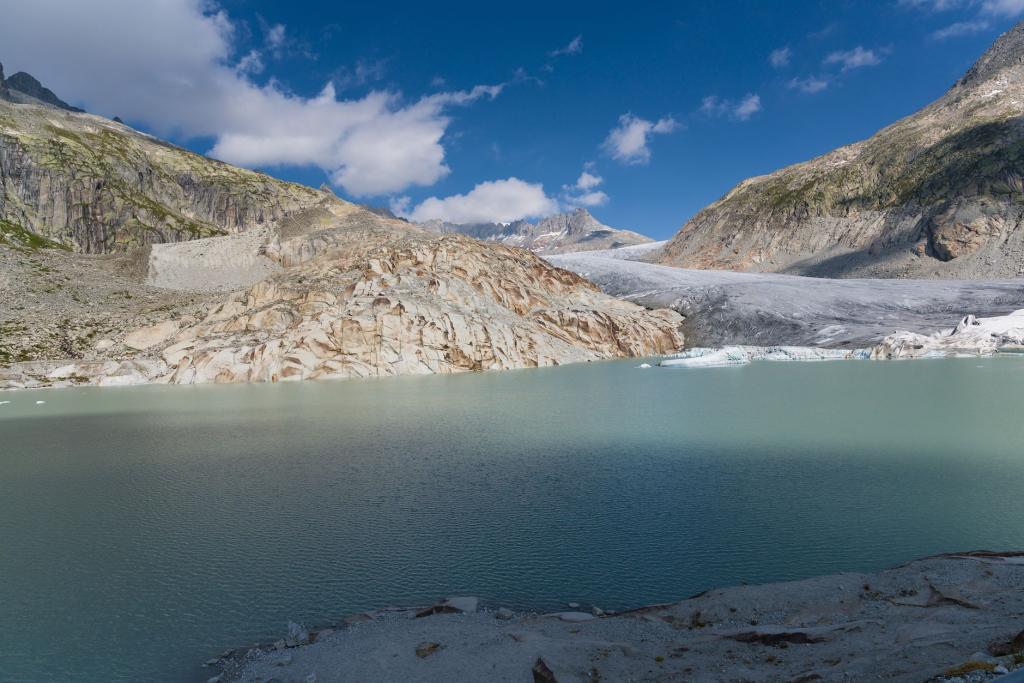
Switzerland's glaciers have suffered one of the worst melting seasons ever recorded, according to data released Thursday by the Swiss Glacier Monitoring Network (GLAMOS) and the Swiss Commission for Cryosphere Observation of the Swiss Academy of Sciences, in a Reuters dispatch from Les Diablerets. The country's glaciers lost 5.5% of their total ice volume in 2026, making it the second-biggest annual melt on record.
The damage compounds fast. Over the past five years, Swiss glaciers have shed nearly a fifth of their ice mass. The melt rate across that five-year window ran more than twice as high as in any earlier five-year period ever monitored, and roughly twenty-seven percent of the country's ice has disappeared in the past decade, compared with about ten percent across the nineteen-nineties.
Two forces drove this year's extreme loss. Winter brought far too little snow, leaving glaciers without their usual protective blanket months early. Then summer delivered record heat: June, July and August were each the hottest such months recorded in Switzerland since measurements began in 1864, according to the Swiss Federal Office of Meteorology and Climatology. With no snow shield in place, bare dark ice absorbed the sun and melted faster through the long season.
A catastrophic year on the ice
GLAMOS director Matthias Huss described the season as "a catastrophic year," saying the country's glaciers had lost "enormous quantities of ice." Standing on the Scex Rouge glacier at Les Diablerets, at nearly three thousand metres above sea level, Huss pointed to a four-metre aluminium measuring stake driven into the ice in late July. By September, more than three metres of it stood exposed above the grey surface, meaning about that much ice had vanished there in August and September alone. The findings were reported by the AFP on Thursday.
"This is a glacier that isn't surviving," Huss said, adding: "There will be probably no ice in 10 or maybe 15 years." He said his team was not surprised, since they track the retreat closely, but the sight of the mountains had shaken him. "But to see the colours of the mountains where there is no snow left, there is just these rocks and these dark glaciers that are a relic from the past ... it's just incredible," he said.
The damage was not confined to small glaciers. The Aletsch, Switzerland's largest glacier, suffered its biggest-ever melt this year, while the Tsanfleuron glacier lost more than four metres of average thickness. That scale of loss would have been unthinkable a few years ago, Huss said. Still, this year did not quite surpass the all-time record set in 2022, when dust clouds drifting up from North Africa darkened the snowpack and accelerated melting.
Why it matters beyond the peaks
The numbers are measured, not modelled. GLAMOS based its findings on detailed September readings at twenty-three reference glaciers, then extrapolated the results across the nearly thirteen hundred glacial formations still found in Switzerland. Scientists calculate that between July and September alone, the glaciers released around 2.2 trillion litres of water, more than four times the annual drinking water consumption of Swiss households.
That torrent is both a symptom and a warning. Glaciers act as frozen reservoirs, feeding rivers and reservoirs through the dry summer months, and their retreat threatens water supplies for farms, towns and hydropower across the Alps. Huss said extreme years now arrive almost every year, calling it "a really worrying situation."
There is a short-term upside: the extra meltwater helps ease summer water shortages downstream, according to the Reuters report. But it is borrowed water. Once the ice is gone, the reserve it held for dry summers goes with it. With nearly a fifth of the mass lost in five years and small glaciers now measured on timelines of years rather than centuries, the cushion Switzerland counted on is draining away.
The network's researchers return to the reference glaciers each September, so next year's measurements will show whether the extreme-melt streak is now simply the norm. Either way, Swiss glaciers are no longer holding their ice through the summer, and the trend shows no sign of slowing on its own.
Comments 0
No comments yet. Be the first to share your thoughts!
Leave a comment
Share your thoughts. Your email will not be published.