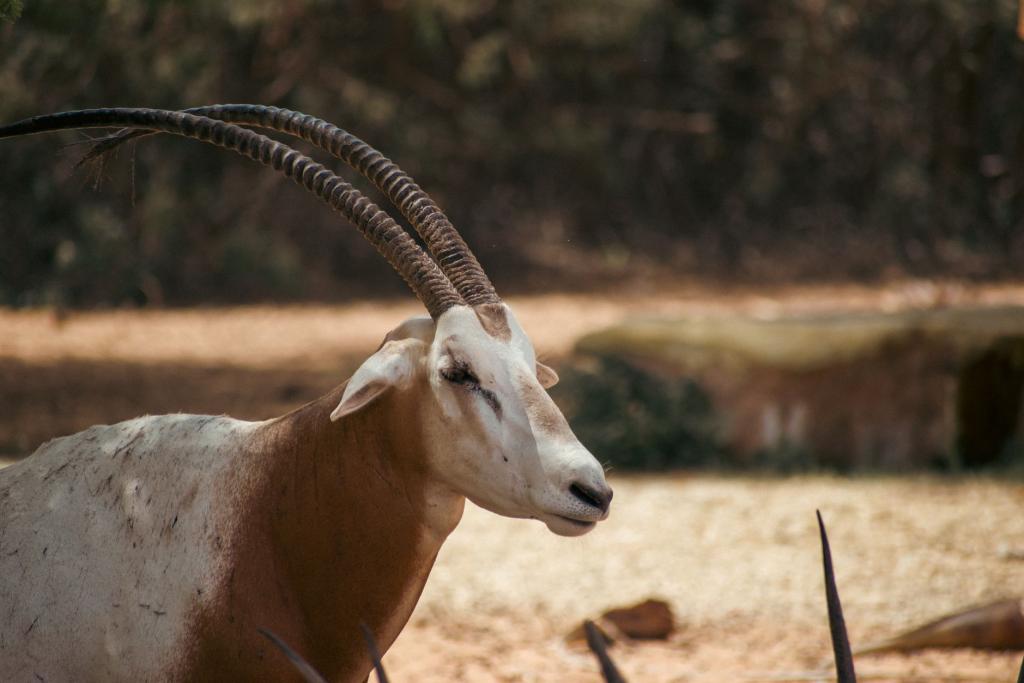
In the year two thousand, the International Union for Conservation of Nature made a grim entry in its Red List: the scimitar-horned oryx, a desert antelope that once roamed the grasslands fringing Africa's Sahara Desert in abundance, was declared functionally extinct in the wild. Just over two decades later, the scimitar-horned oryx comeback is a measurable thing. A herd of roughly six hundred fifty to nine hundred of the animals now roams central Chad, and most of them were born in the wild, in Chad.
The turnaround began with a captive breeding herd managed by the Environment Agency-Abu Dhabi. Starting in twenty sixteen, close to three hundred fifty oryx were released into the Réserve de Faune de Ouadi Rimé-Ouadi Achim, a protected area roughly the size of Maine, according to a report by Georgia Jiang in Maryland Today. The first group to go out numbered only twenty-one animals, dropped into a landscape that held no social world for them at all. Since then, the union has decisively reversed its assessment and downlisted the species to endangered.
Can zoo-born antelope learn to be wild again?
That is the question now pulling in researchers from the University of Maryland and the Smithsonian's National Zoo and Conservation Biology Institute. Around twenty twenty-two, research ecologists Jared Stabach and Katherine Mertes began working with Distinguished University Professor of Biology Bill Fagan and his group to find out whether animals that have spent generations in captivity can reconstruct a wild life. Postdoctoral researcher Marron McConnell, who studies how the herd rebuilt its social bonds, told Maryland Today the animals "had to construct a society from scratch," and her analysis of field observations, genetic kinship records, and collar data found the reintroduced oryx to be a particularly gregarious species. Instead of forming fixed herds, they move through what ecologists call fission-fusion dynamics, constantly mixing, splitting apart, and reforming into new groupings.
Doctoral student Gayatri Anand is chasing the harder puzzle: migration. Historically, the oryx is believed to have followed seasonal green waves, pulses of vegetation growth that move north along the Sahara as the rainy season arrives. But in hoofed mammals, migration is culture rather than instinct. Anand told Maryland Today that knowledge of migratory routes passes from parent to child, so when a population goes locally extinct, the map disappears with the last animal. Her early findings, reported by Maryland Today, suggest the Chad herd is drawing the map again from scratch. "It looks like there is a learning process going on between these newer generations of oryxes," she said, "now that the earliest batch has gained more experience tracking resource waves."
A dataset a decade in the making
Every release since twenty sixteen carried GPS collars, and the result is one of the richest movement records for any reintroduced large mammal. A study reported in Frontiers in Ecology and Evolution in June, tracking the scimitar-horned oryx comeback from above, drew on more than one and a half million recorded collar locations from two hundred sixty-two tagged animals, showing how the oryx weigh food against human activity when choosing where to roam across the seasons. The dataset keeps growing, and McConnell told Maryland Today it could eventually flag early warning signs of disease events as well as reveal social structure and adaptive behavior.
The same reserve is stacking up other wins. The Smithsonian's National Zoo reports that the oryx are following greening vegetation over long distances, doing exactly what they need to survive, and two or three females from the research herd could soon move to the zoo's Africa Trail habitat, so visitors may come face to face with the species by next summer. A growing addax population shares the reserve, up from fifteen released animals at the start of the decade to more than one hundred fifty, and a dama gazelle group founded by just three animals has grown past thirty.
The comeback has rare company. McConnell told Maryland Today that only a few comparable cases exist of a large mammal brought back from extinction in the wild: the Arabian oryx and Przewalski's horse. The species is still listed as endangered, and the pressures that wiped it out, poaching, drought, and human disturbance, have not gone away. But the Chad herd is proof of something the internet's doom feeds rarely show: a full system response, with governments, zoos, geneticists, and field teams in four countries, that put an extinct-in-the-wild mammal back on the map.
It also joins a run of head-turning science stories this month, from NASA's giant moon crater find to a virtual cell that lets researchers test drugs in software and the first observation of a quantum jump of sound. The UMD team says the oryx lessons reach further than one antelope. The same methods could serve as a roadmap for reintroducing other species in seasonally variable landscapes, Anand said, "potentially bringing back other functionally extinct animals from extinction." The animals are relearning the wild, and this time science is taking notes.
Comments 0
No comments yet. Be the first to share your thoughts!
Leave a comment
Share your thoughts. Your email will not be published.