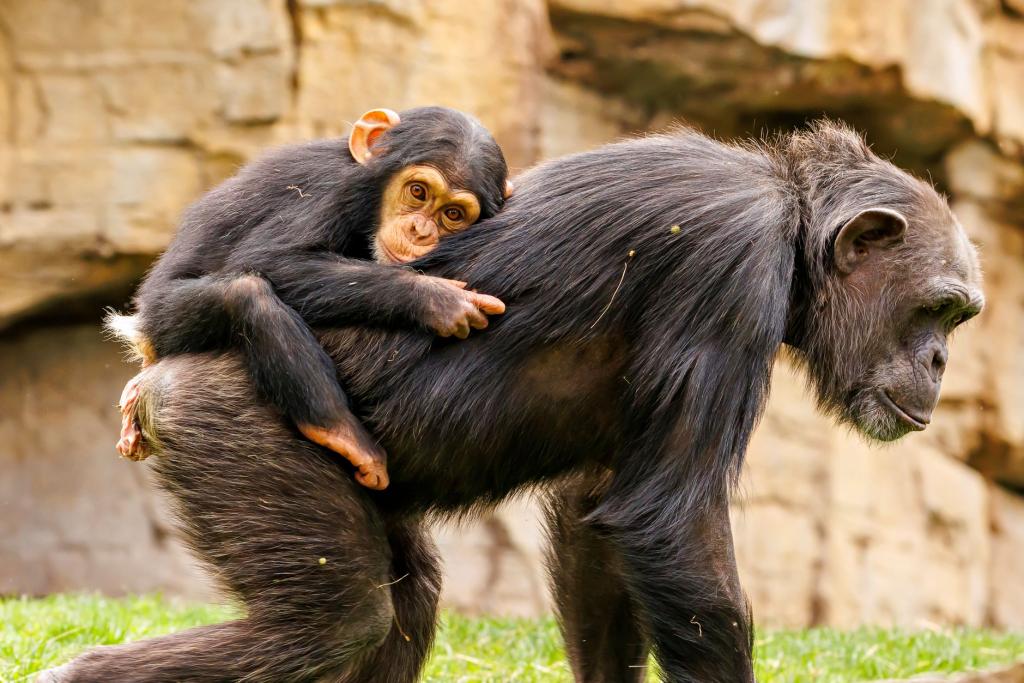
Chimpanzees are skilled tool users, and chimpanzee tool use is well documented: they use sticks to fish for ants and algae, craft sponges from leaves and moss, and shape simple spears for hunting. Scientists have long debated how the animals acquire these skills. Now camera trap footage from Senegal offers an answer: adults hand tools and food directly to the young, in a way that meets the working definition of teaching, according to a study published September 15 in the journal Frontiers in Psychology.
The research team, led by primatologist Andreu Sánchez-Megías of the University of Barcelona and the Jane Goodall Institute Spain in Senegal, analyzed nearly fifteen hours of footage recorded between 2017 and 2025. The cameras had been set at 14 locations in the Dindefelo Community Nature Reserve where wild western chimpanzees, a subspecies listed as critically endangered by the IUCN, were known to use tools. Another 30 minutes of footage came from 11 rocky sites where the chimpanzees pound baobab fruit against stationary stone anvils.
What the footage revealed
In total, the authors recorded 33 instances of one chimpanzee handing a tool to another, plus four cases in which fruit changed hands. Most transfers happened during ant dipping, which accounted for 58 percent of them; algae fishing and termite fishing made up about three in ten and roughly one in eight respectively. Most of the original tool owners were adults, especially females, while infants were the largest group of recipients. The majority of transfers went from one relative to another, and of 27 transfers in which both animals could be identified, 16 were between relatives, including eight from mother to offspring.
The researchers compared the behavior of the tool's original possessor and the recipient before and after each handover. After giving up a tool, the original possessor spent a significantly lower proportion of time using tools and made fewer insertions per second, while the recipient spent a significantly higher proportion of time using tools and made more insertions and mouthfuls per second. Most transfers were recoveries or tolerated takes, the authors found, and all but one of the voluntary handovers appeared to happen at the recipient's initiative. In a few cases, tools and fruit were stolen outright, and the possessor sometimes hit the thief or grabbed the object back. Across the footage, chimpanzee tool use flowed mainly from older, experienced animals to infants still learning, rather than spreading evenly through the group.
Some scenes read like deliberate instruction. In one observation, a juvenile male appears to teach an infant named Fotti how to crack open a baobab fruit, according to reporting in Smithsonian Magazine. In another, described by earth.com, a mother stopped dipping for ants, left her stick standing in the nest, walked over to her wandering daughter, and brought her back to it; the daughter pulled the stick out, ran it through her hand, and ate the ants clinging to it.
Why it counts as teaching
"This study demonstrates that chimpanzees teach tool use to younger individuals, expanding our understanding of the learning strategies of our closest relatives," said lead author Sánchez-Megías, in an audio clip released with a university statement.
Sánchez-Megías said receiving food and tools from experienced individuals, which the team calls "food or tool transfer," may help chimpanzees learn to use technology to extract foods that are difficult to access. "Tool transfers thus appear to be a form of teaching, together with observation and supervised practice. It appears that mothers are the main models and teachers for young chimpanzees in this manner," he said.
The study also highlights how local some chimpanzee culture is. Ant dipping and termite fishing occur in communities of all four chimpanzee subspecies across Africa, but algae fishing and baobab pounding are known only from western chimpanzees in Senegal, Mali and Guinea, the authors report. The Dindefelo chimps are not used to people, which is why the researchers relied on cameras rather than direct observation over the eight years of the study.
The paper is "Savanna chimpanzee tool and fruit transfers facilitate the transmission of technological behaviours at Dindefelo, Senegal," published in Frontiers in Psychology (doi:10.3389/fpsyg.2026.1868894). Detailed reporting is available from phys.org and Smithsonian Magazine. Related science coverage on the site includes researchers priming oak trees to fight disease faster and an AI model that lets scientists test drugs on a virtual cell.
Comments 0
No comments yet. Be the first to share your thoughts!
Leave a comment
Share your thoughts. Your email will not be published.