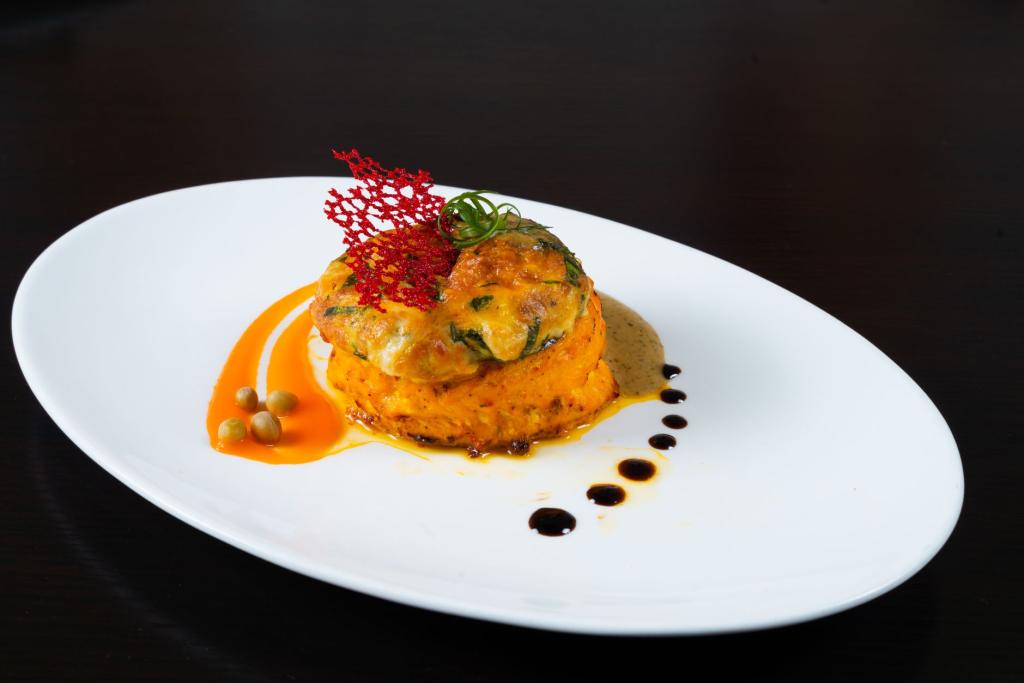
Sauce placement may be doing more work on a plate than most diners realize. In a new study from Tokyo, researchers found that the same dish was judged healthier when the chef kept sauces in tidy, separate pools instead of drizzling them across the food, even though the recipe never changed. The result suggests that a quick visual scan of the plate, before the first bite, can steer how virtuous a meal feels, according to the phys.org coverage of the study.
The work was led by Kosuke Motoki of the Faculty of Business and Commerce at Keio University, with collaborators from the Institute of Science Tokyo and Miyagi University and a professional chef. The team ran the experiment inside a real working restaurant at the Gastronomy Innovation Campus Tokyo, a collaborative space where researchers, chefs, and industry partners test culinary ideas side by side. Motoki explained that bringing together an academic team, a working chef, and a live dining room let the group study chef designed plating in the conditions where diners actually encounter it. Their findings were published in Volume 15, Issue 17 of the peer reviewed journal Foods, reported in a second write-up of the findings.
A total of 57 diners took part, each eating two versions of the same sturgeon fritter dish prepared with chef Tatsuya Noda, whose restaurant holds a Michelin Green Star. In the minimal plating condition, the sauces sat in neat pools apart from the food. In the drizzle condition, the same sauces were distributed across the plate and around the dish. Every participant experienced both versions, which let the researchers compare each person's responses directly.
What the diners rated
Before tasting, the diners rated expected tastiness, perceived healthiness, intention to eat, overall liking, artistic presentation, and willingness to pay. The tidy minimal layout came out at 4.65 out of 7 for perceived healthiness against 4.05 for the drizzle version, a gap that stayed significant after correction for multiple comparisons. None of the other measures showed a significant difference before tasting. The healthiness gap was the only pre tasting difference that cleared the statistical bar, which makes it the central finding of the experiment rather than one signal among many.
After the meal, the minimal presentation also earned higher scores for overall liking and intention to eat more, but those differences faded once the researchers corrected for multiple comparisons, so the team treated them as preliminary rather than conclusive. As for why the healthiness gap appeared, the researchers offered two possibilities: the minimal plate may simply look less visually dense, which can read as simpler or more natural, and sauces set apart from the food hand the diner more control over how much sauce actually lands on each bite. The team stressed that it did not measure those mechanisms directly.
What chefs and home cooks can take from it
The study gives restaurants a rare bit of evidence to lean on when they design a menu. Plating is usually treated as a matter of taste and craft, and before this experiment sauce placement barely registered in the published literature on dining psychology, even though sauces do double duty as flavor and as visual decoration on the plate. This experiment shows that small layout choices can shift a first impression in a measurable way. For home cooks, the takeaway is similarly plain: spoon the sauce into a corner of the plate or a small dish on the side, and the meal in front of your guests may read as lighter, even when nothing about the cooking changes.
There is a sustainability angle tucked into the choice of fish as well. Sturgeon farming is geared almost entirely toward caviar, so the meat is rarely given a starring role. Using it more fully, the researchers note, makes better use of the resource, which is part of why the experiment centered on a sturgeon dish in the first place.
One warning comes with the result. Looking healthier is not the same as being nutritionally healthier, and the researchers emphasize that distinction. They also say the work needs to be repeated across different foods, plating styles, and dining rooms before anyone treats minimal plating as a rule. For now, it stands as a small, well measured reminder that the eyes get the first vote.
Comments 0
No comments yet. Be the first to share your thoughts!
Leave a comment
Share your thoughts. Your email will not be published.