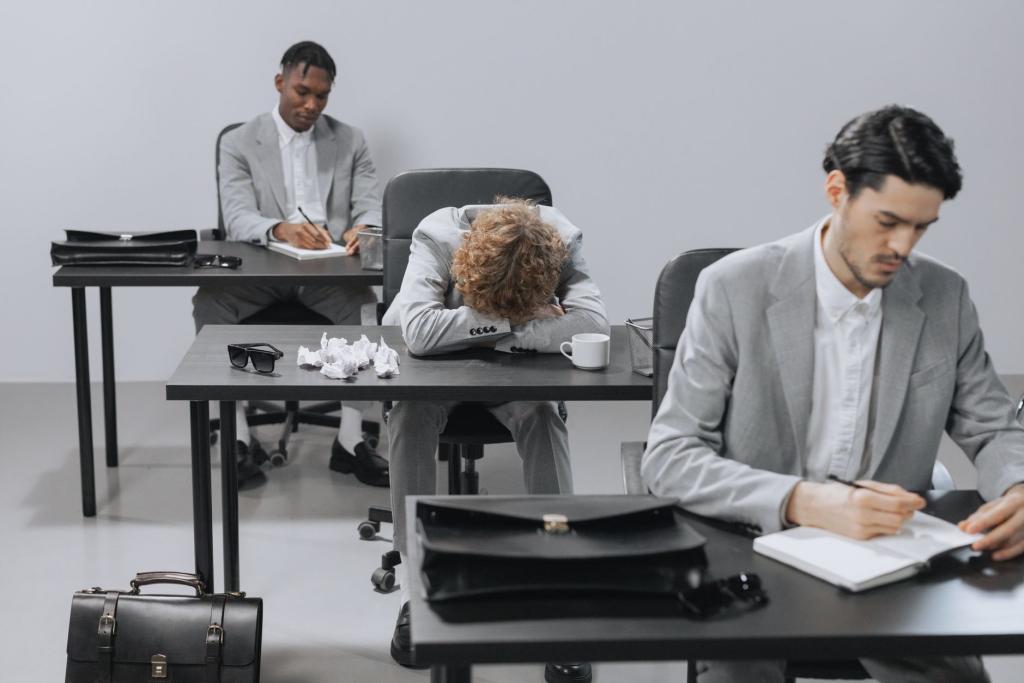
Presenteeism Is the Real Workday Thief, and it just got a price tag. U.S. workers lose an average of 63.4 productive days a year to poor physical and mental health, according to new research from Vitality and RAND Europe, and the vast majority of that loss never appears in any absence record.
The breakdown is what startles. Just 9.5 of those lost days come from workers actually being absent. The other 53.9 days vanish while employees are logged on, sitting in meetings, or answering messages from their desks — physically present but unable to do their best work. The index converts missed time and reduced on-the-job performance into full working-day equivalents, which means more than four-fifths of the damage is invisible to any manager watching sick-day counts.
That makes the United States an outlier in the wrong direction. The five-market average across the U.S., the United Kingdom, Germany, Japan, and Singapore stands at 54.8 lost days, while Germany alone ranks higher at 69.3. Researchers surveyed 2,079 American workers from late February to mid-March as part of a 9,206-person poll, so the figures reflect this year, not a pre-pandemic baseline.
Employers are tracking the smaller problem
Absence records capture only a fraction of health-related productivity loss, the research team argues, yet most companies still treat the sick-day spreadsheet as the whole story. The cost is not small: poor workforce health drains an estimated 2.33 trillion dollars in lost U.S. productivity each year, the largest economic impact of any market in the study. For context, that is a drag measured in trillions, not a line item for the benefits department.
There is a caveat worth stating plainly. Vitality sells health engagement programs to employers and health plans, so findings that point to an enormous, under-measured problem serve its commercial interests. The analysis was conducted with an independent research organization, which gives the numbers outside scrutiny — but the sponsor is still worth knowing. A skeptical read is the healthy one here: the incentive is real, and so, apparently, is the gap.
For workers, the takeaway lands closer to home than any macro number. The culture of powering through illness, burnout, and bad sleep is not heroic; it is the biggest source of lost output in the data. And because presenteeism is harder to see than an empty chair, it rarely earns the sympathy — or the policy fix — that a flu day gets. Companies that measure only absence are, in effect, managing a minority of the problem. The same mismatch shows up in AI-era work: tools free up hours, yet employees report doing more, not less.
Presenteeism Is the Real Workday Thief: what actually helps
The study's sponsors point to behavior-change programs as the lever, and there is at least some independent backing for the claim. Vitality says members who reached the higher tiers of its reward framework recorded 15 percent lower risk-adjusted claims costs, a result independently endorsed by the Validation Institute. The company's Google Cloud-backed platform, it says, recovers an average of 4.4 productive days per employee each year, translating to savings of roughly a thousand dollars per worker, according to figures the company reported this fall.
Some of the evidence is harder to argue with. In 2025, the company's screening incentives produced an estimated 23,302 additional cancer screenings, which led to 219 early detections. And since this summer, more than 210,000 people in the U.S. have received an AI-driven personalized health action through the platform, with over half completing at least one recommended step. Preventive care, in other words, moves the needle in ways a wellness poster never will.
None of that erases the structural point. When the typical American worker loses the equivalent of three working months a year — mostly at their desk, not at home in bed — the fix is not another attendance policy. It is rest, sleep, and health support that people can use without guilt. Even small changes in daily routine can shift health outcomes, and rest is starting to get the cultural credit it deserves.
Presenteeism Is the Real Workday Thief because it steals in daylight, in full view of everyone, and nobody writes it down. The research puts the first hard number on the habit — now the question is whether employers will start measuring the hours people are unwell at work, not just the days they call in. The biggest productivity problem in America, it turns out, is not absence at all.
Sources: Business Wire via Morningstar, reporting the recent research release; Human Resources Director, which analyzed the survey methodology; Vitality's partnership announcement on its AI-driven health platform.
Comments 0
No comments yet. Be the first to share your thoughts!
Leave a comment
Share your thoughts. Your email will not be published.