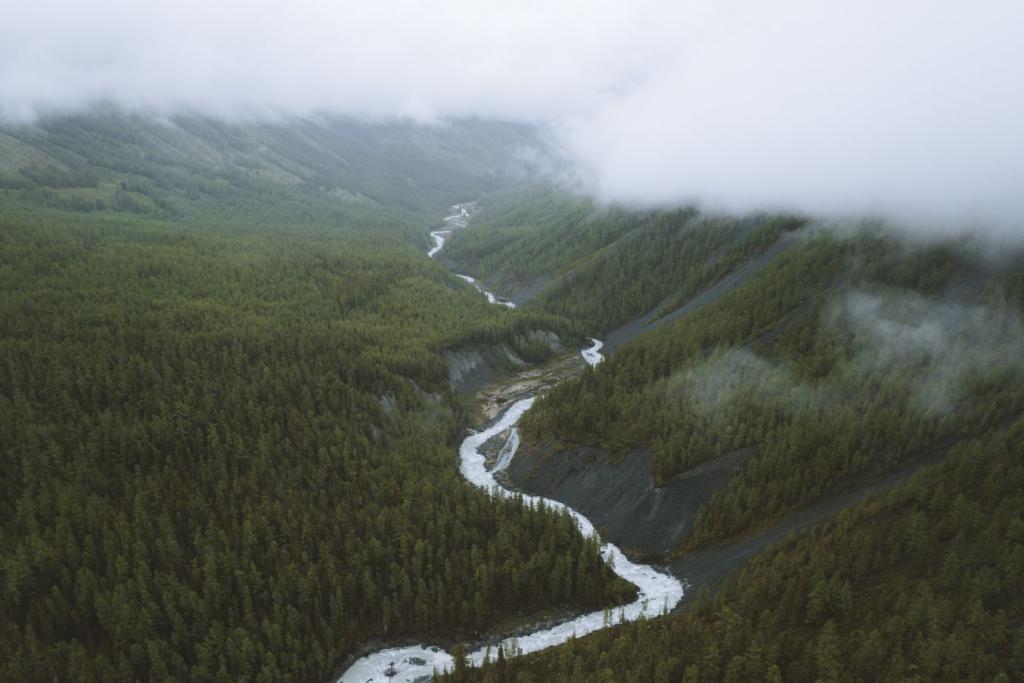
Permafrost detachment slides sound like a niche science term, but new research out of Canada's North shows they can reshape a valley in days. Two enormous landslides in the Northwest Territories moved millions of cubic metres of earth, and scientists now say wildfires set the whole thing in motion roughly two decades earlier.
What actually happened in the N.W.T.
The slides struck the Johnson River in August 2017 and the Redstone River in August 2018, in the Sahtu and Dehcho regions of the Mackenzie River basin, according to CBC News. Researchers call them permafrost detachment slides, a failure style that stands apart from other thaw-related collapses.
The numbers are wild. The Redstone River slide pushed about four and a half million cubic metres of ground into the river basin. The Johnson River slide moved about eighteen million cubic metres, which is enough to fill roughly seven thousand two hundred Olympic swimming pools, as reported by Canadian Press coverage on Your Space Hamilton.
Why this thaw works from the bottom up
Most permafrost landslides come from the top down. Warm air and rain melt the surface layer over decades, and the slope slowly gives way. Permafrost detachment slides are different, because the frozen ground fails about twenty metres below the surface and the whole slab collapses from the bottom up.
Lead author Joseph Young, who worked on the study as a PhD student at the University of Alberta, put the speed in perspective. According to the reporting, these slides can move an amount of material that would take standard permafrost failure a few decades to shift, and they can do it in a matter of days. The study was published last month in Geophysical Research Letters.
Wildfire lit the fuse decades ago
The trigger was fire. Young said severe wildfires in the area in 1995 started the process that ended in the slides. Co-author Steve Kokelj of the Northwest Territories Geological Survey explained that the fires wiped out organic material, which immediately affected the top layer of permafrost.
Then came the long wait. Kokelj said the larger disturbances start to appear within old burn areas about fifteen to twenty years after a fire, which is about how long it takes for the heat to permeate twenty metres into the ground. That warming effect from the fire stacked on top of a warming climate.
Seeing it from the air
Eric McLeod flew over the region four times a year until about 2021 and watched the Johnson River slide change the landscape. In May 2017 he saw a huge portion of land had already slid into the river. A helicopter pilot told him it had gone all the way down the hill and blocked the river, creating a lake.
McLeod said the land looked like it had stretch marks. After landing at the site later that year, he compared some of the displaced chunks of earth to the size of houses. Imagine a hillside peeling off like a sticker and landing in a river valley.
The silver lining for northern communities
There is one piece of good news. Young and Kokelj said that for these particular slides there are warning signs that show up over about twenty years after a fire, including slow downslope movement of the slopes. As Young put it, that is the silver lining, because it does not just happen overnight.
That matters for anyone building roads, pipelines or communities in the North, where fire seasons keep getting bigger. If monitoring picks up slow creep on burned hillsides, crews could spot trouble years before a slope lets go. It is a reminder of how tightly fire and thaw are linked on a warming planet, a theme we keep tracking in our climate emergency coverage.
Why Gen Z should care
Permafrost holds a huge amount of ancient carbon and stabilizes huge stretches of the Arctic. When it fails, rivers get dammed, ecosystems get buried and the ground people rely on stops behaving the way maps say it should. The story is a ten-year-old event, but the science is brand new.
The takeaway is simple. Fires today can set up landslides for the next generation, and the North is already living in that timeline. Understanding permafrost detachment slides is one more way scientists are trying to get ahead of a climate that is moving faster than the ground beneath it.
Comments 0
No comments yet. Be the first to share your thoughts!
Leave a comment
Share your thoughts. Your email will not be published.