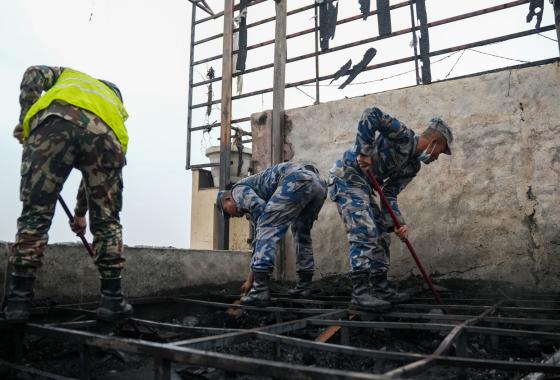
On the morning of August 26, a glacier high in the Himalayas on Nepal's border with China collapsed, sending a tsunami-like wall of water, rock and mud thundering down the Trishuli river valley. In minutes, the surge buried hydropower stations, washed away homes and roads, and swept through towns and trekking routes packed with workers, pilgrims and tourists. The Nepal floods that followed are already one of the worst disasters in the country's modern history.
Three weeks later, the scale of the catastrophe is still coming into focus. Nepal's National Disaster Risk Reduction and Management Authority (NDRRMA) reported on September 11 that at least 1,385 people have been killed and another 5,130 remain missing, making it the country's deadliest natural disaster since the April 2015 earthquake that claimed nearly 9,000 lives. The United Nations confirmed that grim milestone, with UN spokesperson Stephane Dujarric telling reporters that more than 10,000 people have been rescued so far, including 252 foreign nationals.
Among the dead and missing are hundreds of hydropower workers who were inside the region's power projects when the flood struck. According to the Independent Power Producers' Association of Nepal, at least 900 workers were unaccounted for at 12 damaged hydropower projects in the Rasuwa and Nuwakot districts, and roughly 500 were believed to be trapped inside the giant water-control tunnels, which one geoscientist described as big enough to drive trucks through, reported by the Associated Press.
A nine-day miracle underground
Against those staggering numbers, rescue teams found a glimmer of hope in early September. As reported by AFP, two hydropower workers were pulled alive from the Trishuli 3A tunnel on September 4 after spending nine days trapped underground, covered in mud. They were taken to hospital in stable condition, encouraging crews to keep digging. Experts from India, China, Australia and South Korea have been assisting Nepali rescue teams in the search, and Nepal's army has used controlled blasts, excavators and searchlights to clear water and mud from blocked tunnels, according to army spokesperson Raja Ram Basnet.
The government initially believed more than 100 workers could still be alive inside several blocked tunnels. But as the days passed, officials privately acknowledged the fading odds. "We don't have an update yet, but the work goes on," Basnet told AFP on September 5.
The human toll extends far beyond Nepal. Chinese state media reported 31 people killed and 531 missing on the Chinese side of the border, bringing the combined death toll to 1,325 at that point. Hundreds of bodies, many unidentified, were buried in shallow graves as they began decomposing in the humid plains weather after being swept down the mountains by the torrent. The missing include tourists from more than two dozen countries; among 583 foreign nationals reported missing were 177 from India, 63 from the United States, 34 from Australia, 33 from Britain and 25 from Canada, according to official figures cited by Indian news agency ANI.
A country mobilized, a region on alert
Nepal has mounted its largest disaster response in a decade. The government deployed 21,022 security personnel, including 8,844 Nepal Army soldiers, 7,975 police officers and 4,203 Armed Police Force members, and declared a flood emergency in 15 municipalities. Authorities say 13,676 people have been rescued and 37 holding centres are sheltering the displaced, with Nuwakot alone hosting 2,615 people, echoing the mass-displacement crises unfolding in other parts of the world this year. A temporary bridge installed at Devighat in Nuwakot is now operational and expected to improve access to cut-off areas, in a statement from relief authorities.
India has sent eight Indian Air Force flights carrying more than 130 tonnes of humanitarian relief to Kathmandu since August 26 and deployed 54 experts to assist with rescue, relief and forensic operations, India's Ministry of External Affairs said. Meanwhile, the International Organization for Migration appealed for 20.5 million US dollars to help 43,000 people, warning that emergency shelter is urgently needed as winter approaches.
The humanitarian picture is severe. According to the United Nations, 65,000 people need emergency water, sanitation and hygiene supplies, more than 22,000 children need protection, and 19 schools have been damaged, including nine completely destroyed. Roads remain passable only as far as Nuwakot, with sections of highway linking Kathmandu to the hardest-hit areas completely blocked.
Why scientists saw this coming
What triggered the disaster was a chain of events familiar to glaciologists: a glacial collapse high in the Himalayas sent large amounts of rock, ice and meltwater into valleys below, triggering the powerful floods downstream. Scientists have warned for years that the Himalayas, which are warming faster than the global average, hold thousands of glacial lakes at risk of sudden outburst floods, and that disasters like the Nepal floods are becoming more likely as the climate changes. It is the same pattern of intensifying climate extremes behind the wildfires now defining European summers.
The event was not a slow-rising monsoon flood but a sudden, violent outburst. Witnesses described a huge gush of mud coming straight at them. Verified videos showed crushing masses of water and debris sweeping away dozens of people at a border crossing in Gyirong, with homes, roads and power projects washed away in both Nepal and China.
What happens next
For Nepal, the road ahead is long. Prime Minister Balendra Shah told the country that "thousands of citizens have lost their homes, families, loved ones and property," and pledged government support for rehabilitation. Recovery will mean rebuilding roads, bridges, health facilities and schools across eight districts where bodies are still being recovered, from Chitwan, which recorded the highest fatalities at 364, to Nuwakot, Rasuwa and Dhading.
For the wider world, the disaster is a stark warning about the Himalayan cryosphere, the frozen water towers that feed rivers relied upon by nearly two billion people. Glacial lake outburst floods are difficult to predict and almost impossible to stop once they begin, and experts say early-warning systems and tighter monitoring of high-risk glaciers are urgently needed. As one rescue coordinator put it, the priority now is finding every missing person, but the lesson of August 26 will be studied for years: in a warming world, the mountains themselves are changing, and the consequences flow downhill.
Comments 0
No comments yet. Be the first to share your thoughts!
Leave a comment
Share your thoughts. Your email will not be published.