The most distant fast radio burst ever pinned to a home galaxy just got a face, and it is tiny. Astronomers say the flash, which lasted about a thousandth of a second, left its galaxy when the universe was only about three billion years old, and it has been travelling toward us ever since.
A Flash That Outlived Earth and the Sun
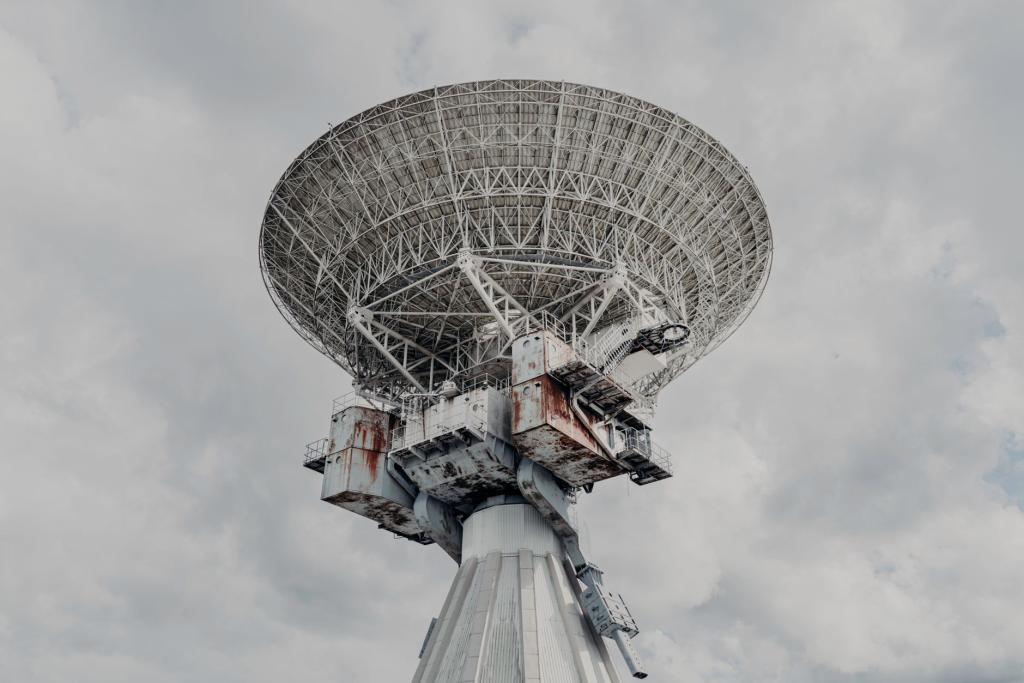
The signal was caught by South Africa's MeerKAT radio telescope in March of 2024 through a system called MeerTRAP, which hunts for fast-changing signals in real time. The result was published in the journal Science, according to ScienceAlert.
That timing is wild. When the burst left its galaxy, neither Earth nor the Sun existed. The radio waves then crossed roughly eighty percent of cosmic history before landing in a South African dish.
It more than doubles the distance of the previous record for a localized fast radio burst. Until now, most of the hundred or so bursts with confirmed host galaxies sat far closer to home.
Why Webb Had to Step In
MeerKAT could point to the spot on the sky with great precision, but the host galaxy stayed hidden. Ground telescopes looked as deep as they could, and the team says there was simply nothing to see, as UC Santa Cruz astronomer J. Xavier Prochaska put it in the ScienceAlert report.
So the researchers called on the James Webb Space Telescope and its infrared eyes. According to NASA Science, Webb found the faint host and measured its distance, which let the team place the event at a redshift of about two point one.
The Keck Observatory also contributed. Its team spent an hour of imaging time on the patch of sky, and Keck Observatory notes that the galaxy proved surprisingly small and young.
A Small Galaxy With a Big Surprise
Lead author Manisha Caleb of the University of Sydney said the team expected a big, nicely formed galaxy full of stars. Instead, in her words, it was a little dwarf galaxy, although it was actively forming stars.
The host is about a thousand times less massive than researchers expected, and ninety percent of its stellar mass formed in the last thirty million years. It is also metal-poor, meaning it has few elements beyond hydrogen and helium.
That recipe points toward a magnetar, a neutron star with the strongest magnetic field known. Magnetars can form within a few million years of a massive star dying, which fits a galaxy this young.
How Scientists Pinned Down the Distance
Distance in astronomy comes from redshift, the stretching of light as space expands. Webb split the galaxy's light into a spectrum, and the glow from oxygen and hydrogen showed exactly how far that light had been stretched.
That measurement let the team trace the galaxy back to cosmic noon, the era when stars were forming faster than at any other time. Researchers estimate a ninety seven and a half percent chance that this little galaxy really is the burst's home.
The finding also shows that these bursts were already firing in the early universe, not just in the calmer, older galaxies nearby. That gives scientists a new tool for studying how galaxies grew up, using nothing but a flash that lasts less than a blink.
Because the signal is so old, the galaxy has since drifted much farther away. Universe Magazine reports that it now sits about seventeen and a half billion light-years from us, which is possible because space itself kept expanding while the waves travelled.
What It Means for the Mystery
Scientists have chased the origin of every fast radio burst since the first was found in 2007. Prochaska noted that theorists have come up with nearly a hundred models, and observers can only rule them out one at a time.
The rival idea, two neutron stars colliding, looks shaky here. Those pairs usually spiral together over billions of years, which does not fit a galaxy only a few million years into its star-making burst.
The burst also worked like a cosmic flashlight. As it travelled, its signal was warped by an unknown galaxy group and by the Virgo Cluster, giving researchers a rare way to weigh the invisible gas between galaxies.
NASA says MeerKAT may soon localize several bursts a year from even earlier times. For anyone who likes space news, this fast radio burst is a reminder that the loudest clues sometimes come from the smallest places. More like this lives in our science coverage.
Comments 0
No comments yet. Be the first to share your thoughts!
Leave a comment
Share your thoughts. Your email will not be published.