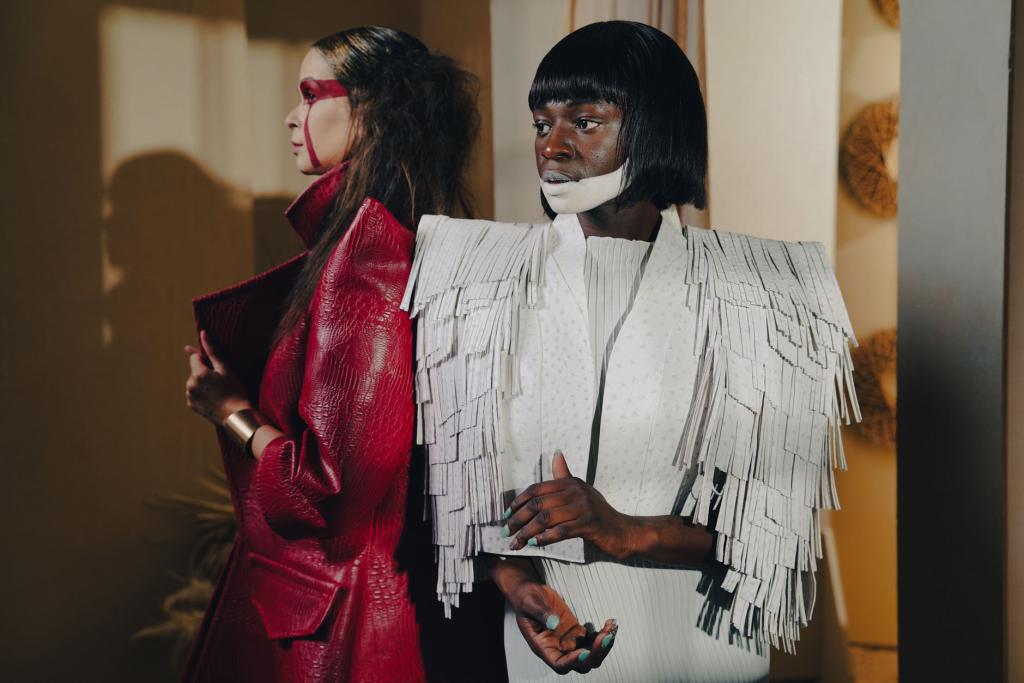
Maxhosa Africa became the first South African brand to stage a full runway show on the official Paris Fashion Week calendar on Monday, with creative director Laduma Ngxokolo using the milestone to celebrate pan-Africanism and homegrown manufacturing. The show took place in the gilded rooms of the South African ambassador's residence in France, where models paraded on a catwalk of woven straw mats. Ngxokolo said he wanted the collection to highlight his country's diversity, beauty, and business successes.
"That's the Africa that we all want to live in, where the economy thrives, where the crimes become less, where politically it's less corrupt — that's the Africa that we're trying to showcase here," Ngxokolo told journalists after the show, as Reuters reported. He added that he has been fighting for a seat at fashion's table for 16 years, saying the African continent remains underrepresented.
The collection stayed true to the label's signature knitwear while pushing its range. One standout featured multi-coloured knitted labels bearing the names of African countries, a motif also worn by South African musician and rapper Sjava, whose singing provided the show's soundtrack. Women wore brightly patterned bra tops with wavy hems paired with flowing midi skirts, or matching geometric-patterned knit ensembles of pleated skirts and button-down shirts in lilac and grey. Some sported glasses by Kenyan artist Cyrus Kabiru, who creates eyewear from waste. Menswear ranged from a blue and red double-breasted suit in checkerboard knit covered in beaded symbols to more casual streetwear looks of baggy shorts and polo shirts in bright diamond patterns.
While the label's geometric patterns evoke traditional Xhosa beadwork, Ngxokolo said his inspirations also included Missoni, Gucci, and Louis Vuitton — a signal that the house sees itself competing with Europe's luxury giants rather than sitting in an "African design" niche. The business behind the show is deliberately local, and it is where Maxhosa Africa distinguishes itself from most runway labels: the brand owns two knitting factories, one in Johannesburg and one in East London in the Eastern Cape province where the wool for its knitwear is also sourced. Ngxokolo said he aims to boost the country's textile industry and prove it can produce high-quality luxury goods.
A long road to the official calendar
The Paris slot caps a long road for the designer, who founded Maxhosa Africa in 2011 and built it into one of Africa's best-known fashion exports. The Spring 2027 schedule marks a busy season for the French capital's fashion calendar: nine labels are returning to the runway, and creative-director debuts are set at Courrèges and Carven this week, according to schedule reporting from La Forma. Against that backdrop, the first official show by a South African house stands out as a structural milestone — not just another designer debut, but the opening of a door for an entire industry.
Ngxokolo had originally hoped to bring other African designers to Paris with him, but said he lacked the resources to do so. The admission underscores a real tension in the industry's diversity conversation: visibility moments are celebrated, yet the money to sustain them remains concentrated in European houses. For a continent whose designers often show on the margins of fashion weeks or depend on sponsors, an official calendar slot carries weight because buyers, press, and luxury groups treat it as a credential.
Why this matters beyond the runway
The economic framing of the show is what separates it from a purely aesthetic debut. South Africa's textile sector has struggled with cheap imports and factory closures for decades, and a luxury brand manufacturing at home with its own factories is a counter-example to the offshoring playbook. Every piece of knitwear in the collection was produced at one of the brand's two factories, keeping the full production chain — from Eastern Cape wool to finished garment — inside the country. For Gen Z shoppers who increasingly weigh where and how clothes are made, that supply-chain story is arguably as compelling as the designs themselves.
The cultural politics matter too. The pan-African theme arrived at a moment when the global fashion industry keeps insisting it wants new voices from the Global South, while calendar power and capital stay in Paris, Milan, and London. Ngxokolo's blunt comment about sixteen years of fighting for a seat puts numbers on a process that is usually talked about in vague terms. If the Maxhosa Africa show leads to orders from major retailers, it could become the proof of concept that other African designers cite when pitching buyers. If not, it risks remaining a symbolic first — a pattern the industry has repeated before. The next few months of wholesale numbers and retail placements will tell which version wins.
Fashion's gatekeeping is being tested across the board this season — from how luxury houses approach new creative directors to the blockbuster celebrity runway moments dominating the week. Explore more coverage on the Fashion topic page.
Comments 0
No comments yet. Be the first to share your thoughts!
Leave a comment
Share your thoughts. Your email will not be published.