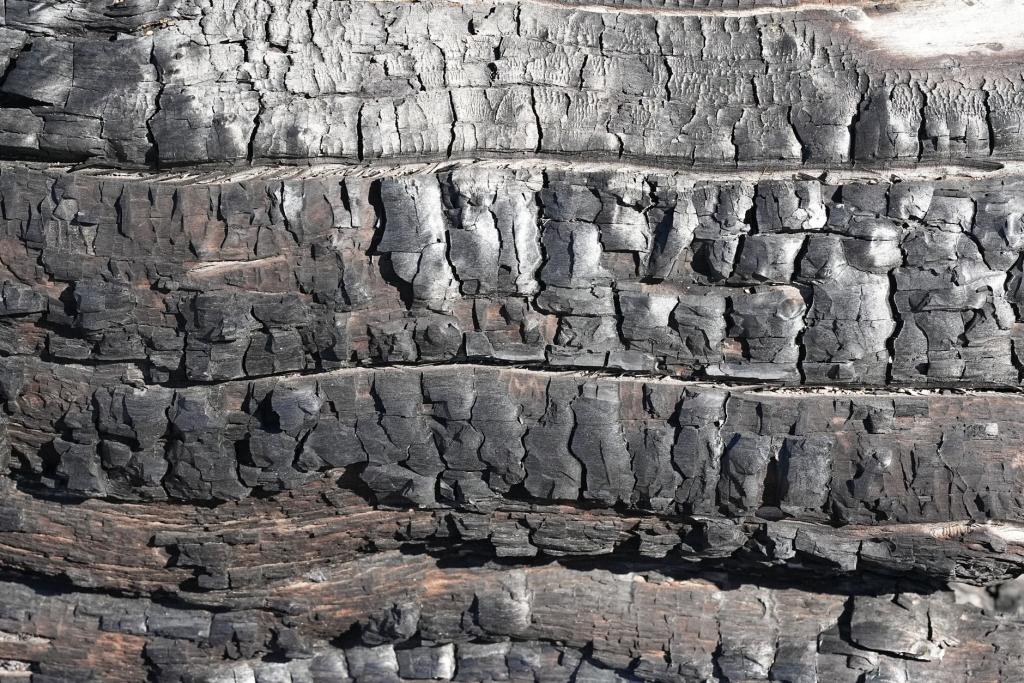
Deep inside Italy's National Library of Naples sit hundreds of papyrus scrolls that no one has ever read. They were charred to a crisp when Mount Vesuvius erupted in 79 CE, and they are so brittle that unrolling one would reduce it to black dust. Now, scientists who deliberately burned their own replicas of these Herculaneum scrolls say a chemical quirk in the ancient ink could finally open them.
The finding comes from a study published September 16 in the journal PLOS One, led by Douglas Seiler, a research volunteer affiliated with the University of California, Berkeley. His team reports that even minuscule amounts of lead in the ink make the letters readable by X-ray tomography, the imaging technique researchers use to scan the scrolls without touching them. Lead absorbs up to 25 times the X-rays absorbed by charred papyrus, according to Berkeley News, so leaded letters stand out clearly in the scans while the rest of the page stays dark.
"The scrolls are really just like a brick of charcoal that you buy for your barbecue. There's not a lot of difference," Seiler told CNN. "It's just carbon, and that's what the problem has been in reading these things. The ink is made from soot."
Recreating a Roman library fire
To reach that conclusion, Seiler's team did something unusual: they burned their own scrolls first. Seiler sourced papyrus and reed pens from Egypt and traditional lampblack ink from Japan, then paid a group of high school students to inscribe the papyrus. Their texts were not classical poetry. The students copied lines from Star Wars and the Bible, plus a quote from The Outer Limits, the 1960s science fiction TV show.
Seiler, an affiliate of Berkeley SETI, then rolled up the papyrus, sealed it in a container, and fired it in a high-temperature furnace until it carbonized. The procedure was meant to replicate what happened to more than a thousand papyrus scrolls in a private library in the Roman town of Herculaneum, when Vesuvius buried the town under an estimated 65 to 70 feet of rock and ash and the eruption's heat turned the collection into brittle husks. That library is the only intact library from antiquity ever found.
He made several versions with inks containing different amounts of lead, then ran them through X-ray CT scanners. The result confirmed the hypothesis. In scrolls with no metal in the ink, the writing was nearly impossible to detect. As Seiler explained to CNN, artificial intelligence struggles because the image is essentially "dark carbon on dark carbon." But where the ink contained lead, the letters lit up in the scans, and the AI could pick out the text.
Lead lights up the text
The discovery of lead in the ink is not new. Researchers had already found traces of it in the letters of some fragments of the ancient collection. What the new paper does is quantify the effect: even tiny lead content makes an enormous difference in visibility, and the X-ray measurements can be taken quickly.
The next step, according to the study's authors, is to run the real Herculaneum scrolls through a scanner to see which ones contain lead. "If they took these scrolls one by one to a facility, they could find out in a matter of minutes whether or not they had lead in them," Seiler told CNN. "A lead signal is very strong." The idea is to triage the collection, flagging the scrolls most likely to yield readable text for the slow, painstaking process of virtual unrolling.
So far, only a few of the genuine scrolls have been virtually unrolled. The handful of Herculaneum scrolls that scholars have managed to open and read have already revealed previously unknown writings by Epicurus and other ancient thinkers. Most of the collection, though, has sat unread for nearly two thousand years.
Which scrolls get scanned next
The work sits inside a larger race. Researchers and volunteer programmers have spent years combining X-ray imaging and machine learning to peer inside the carbonized rolls, and every new trick for distinguishing ink from papyrus brings the unread majority of the library a little closer. A lead test could quietly sort the collection into scrolls worth months of compute time and scrolls that will stay dark.
For Seiler, the project was personal enough to involve a furnace and a stack of student handwriting about science fiction. If the lead screening works on the real collection, the payoff could be new works from authors whose names we know and authors whose names history forgot. The Herculaneum scrolls may also be the only surviving copies of texts lost everywhere else, which is why each successful unrolling matters beyond the novelty.
For now, the plan is simple. Take the scrolls to a scanning facility, check for lead, and start with the ones that glow. The world's oldest unread library may finally start talking, one X-ray at a time. If you want more ancient-world finds, read about the Roman camp uncovered over 3,000-year-old tombs in Egypt's Nile Delta and the new fragment of the Kadesh peace treaty found in Turkey.
Comments 0
No comments yet. Be the first to share your thoughts!
Leave a comment
Share your thoughts. Your email will not be published.