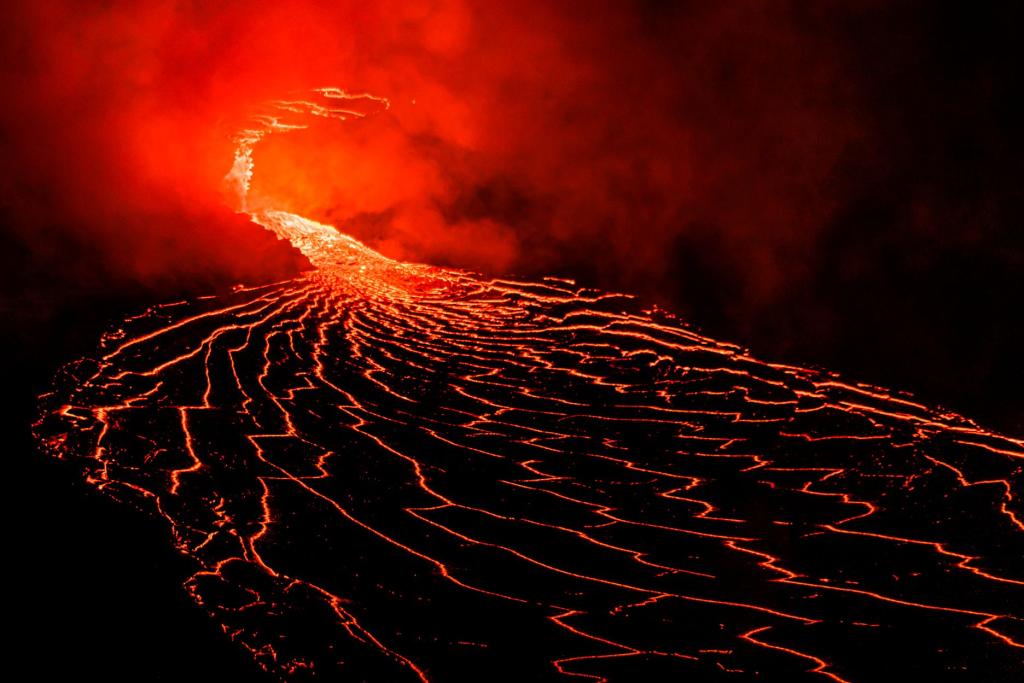
For almost two years, Kilauea has been running on a rhythm. Magma collects beneath the summit, the ground swells, and eventually lava fountains burst out of the same vents inside Halemaʻumaʻu crater. That rhythm broke this week. On the evening of September 14, new vents tore open along the northwest wall of the crater, and lava started spilling from cracks the scientists watching the volcano had not predicted, according to the U.S. Geological Survey's Hawaiian Volcano Observatory.
The Kilauea new vents are the first to open away from the established vent complex in this eruption sequence, and their run-up looked familiar at first. Between September 7 and September 12, the volcano produced more than a hundred short lava overflows from its north vent, the longest stretch of that kind of low-level activity since this eruption sequence began back in December 2024, as detailed in the week's volcanic activity roundup. Then, on September 13, a short-lived swarm of shallow earthquakes shook the summit. The next evening, at 8:36 p.m. local time, the first new vent opened. Four more followed over the next two days, all of them on or near the base of the crater's northwest wall, north of the established vent complex.
A 40-foot cone in the middle of the crater
None of the new vents produced the dramatic lava fountains that made Kilauea famous on social media. Instead, the lava oozed out, feeding small flows across the crater floor. Meanwhile the north vent kept up a steady spatter, and that spatter piled into a cone about 40 feet tall, roughly 12 meters, with a 12-foot-wide opening at the top. All of the activity stayed confined to the summit region inside Hawaiʻi Volcanoes National Park, and the volcano alert level held at Watch, the second-highest rung on the four-level scale, with an Orange aviation color code.
The stranger part of the story is what the observatory cannot tell you right now. Kilauea's episodes used to arrive on a schedule scientists could read from tiltmeters, instruments that measure how much the ground swells as magma refills the shallow reservoir below the crater. This time the ground swelled past the level that preceded the last big fountaining episode, and no fountain came. Part of the problem is physical. Nearly two years of fountaining have thrown so much rock and ash into the air that the fallen debris built a tephra field deep enough to cut off the route to several summit monitoring stations. Some of those instruments, including a tiltmeter, are now offline, and the observatory has said its old inflation-based forecast models no longer work. Forecasts are leaning on direct observation instead.
In its September 18 update, the USGS reported no active lava on the ground at all, just glowing vents, minor spatter, and a summit that had started to reinflate slightly.
Why a volcano story belongs on your climate feed
Volcanoes are one of the planet's most underrated climate forces. A major eruption can hurl sulfur dioxide high into the atmosphere and cool the planet for a year or two. Kilauea's current activity is nowhere near that scale, but every new vent is a reminder that the systems moving heat and gas between the Earth and the sky are live, restless, and occasionally unpredictable. And Kilauea is not the only place where the planet is making itself hard to ignore, which is part of why young climate activists have turned pressure on leaders into a full-time job.
There is also a deeper story here about how the Earth reshapes itself when nobody is watching. Scientists are still finding scars from ancient planetary violence, like the lunar crater recently discovered that is wider than the Colosseum, and volcanoes are the version of that process happening in real time.
The observatory says the summit remains highly pressurized, and it laid out a few possibilities for what comes next. The new vents could settle into continuous eruption, they could shut down and hand activity back to the established vents, or additional vents could form elsewhere in the caldera. No significant activity has shown up along the East Rift Zone or the Southwest Rift Zone. Visitors to the national park can watch from designated overlooks, and the story has already crossed into the mainstream feed, with NBC's Nightly News on September 19 featuring fresh footage of the eruption.
According to the observatory's daily updates, the Kilauea new vents are the first significant break in the eruption's pattern since the sequence began. Volcanoes do not keep schedules. Kilauea spent almost two years training scientists to expect a certain sequence, then this week it opened five new vents in a part of the crater that had been quiet, piled up a 40-foot cone of its own debris, and kept going. Whatever performs next at the summit, and whenever it performs, the people watching will be doing it mostly with their eyes.
Comments 0
No comments yet. Be the first to share your thoughts!
Leave a comment
Share your thoughts. Your email will not be published.