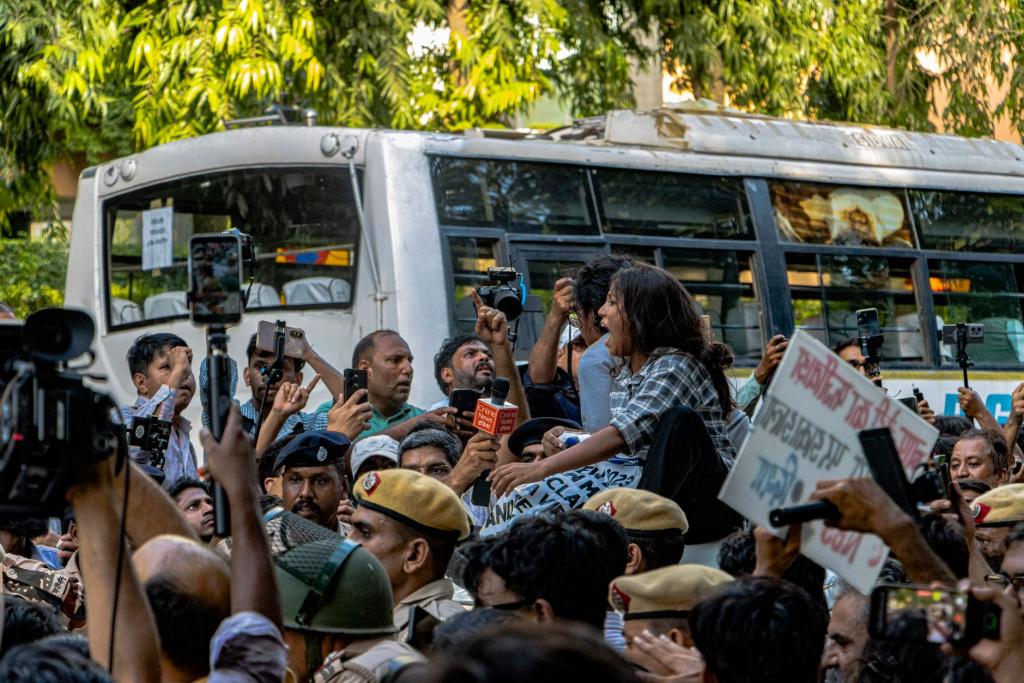
A youth-led Cockroach Movement has pushed India's capital into one of its most dramatic protest crackdowns in years. Thousands of young demonstrators demanding fair voter rolls have been detained, metro stations shut and trains canceled, in a confrontation that is turning into the biggest youth challenge yet to the country's election establishment.
The unrest erupted in early October 2026 as supporters of the Cockroach Janta Party, a rapidly growing youth organization, tried to converge on Jantar Mantar, the capital's historic protest ground. According to AFP's reporting on the protests, police intercepted activists at checkpoints, deployed anti-riot vehicles and barricaded central Delhi before the demonstrations could even begin. Reported counts of detentions rose from the hundreds to the thousands over the weekend, and several regional outlets put the cumulative nationwide figure far higher as preventative house arrests compounded the total.
The scale of the security operation was staggering. Between twenty thousand and forty thousand police and paramilitary personnel were deployed across the capital. Dozens of metro stations closed, more than two hundred fifty trains were canceled, and Delhi Police detained the movement's founder and two senior leaders aboard their plane as it arrived. The Supreme Court had warned that the transport restrictions appeared to be overreaching.
One Hundred Thirty Million Names Gone
At the center of the storm is the Election Commission's Special Intensive Revision of electoral rolls, a nationwide verification exercise that began last year. More than one hundred thirty million names have been struck from draft rolls during the process, a number larger than the entire population of Japan, according to figures cited by Amnesty International and multiple news outlets.
The commission says most of the removals are routine cleanup: roughly twenty-eight million people had died, about sixty-three million had relocated, and some thirty million could not be traced. Officials insist the exercise targets duplicate and ineligible entries, not legitimate voters, and say anyone wrongly deleted can re-enroll.
Protesters and opposition parties do not buy it. They argue the scale of the purge creates a real risk that eligible citizens are being wrongly excluded, and they say the deletions land hardest on poorer citizens, religious minorities and women, who face the steepest hurdles producing documentation. Opposition leader Rahul Gandhi of the Congress party called the growing unrest a fight to defend the constitution, telling reporters in New Delhi, "We will not back down."
The standoff escalated in mid-October when hundreds of opposition lawmakers and supporters marched to the Supreme Court to submit a petition alleging irregularities in the revision, after the chief justice declined their request for a meeting and suggested they file instead. The demonstrators, including left-wing student groups and opposition politicians, are demanding the resignation of chief election commissioner Gyanesh Kumar, who they say has overseen a biased process.
A Movement That Grew Up Online
What makes this confrontation different is who is driving it. The Cockroach movement began as an online phenomenon and has ballooned into street protests across major cities, drawing students, civil society groups and opposition leaders alike. The Christian Daily International, which has tracked the crackdown, reported that the movement's leaders were detained at Jantar Mantar and that hundreds of supporters were held in a stadium during the day of heaviest arrests.
Religious leaders have also weighed in. The Rev. Vijayesh Lal, general secretary of the Evangelical Fellowship of India, wrote on his personal blog that the day of mass detentions was "unprecedented and shameful," a comment that ricocheted across Indian social media.
The government and the ruling party offer a sharply different account. The commission has denied favoring any political party, and the governing Bharatiya Janata Party has accused its rivals of trying to undermine the country's democracy by wrongly questioning legitimate electoral processes. Prime Minister Narendra Modi, speaking at a Bloomberg New Economy event, described India as the "mother of democracy," framing the revision as routine administrative work rather than a political weapon.
Why should this matter to young readers far from Delhi? India is the world's largest democracy, and the fight over who gets on the voter list is really a fight over whose voice counts. The Cockroach Movement shows how a digitally native generation can turn memes and group chats into mass street action, a playbook that young activists everywhere are watching closely. If the movement keeps growing, it could become one of the most serious political challenges to Modi's twelve years in power.
There is also a lesson closer to home. Voter rolls get updated in every democracy, including the United States, and disputes about purges and eligibility follow the same script: administrators say they are cleaning the lists, while critics say eligible voters are being quietly erased. Whatever you think of the Indian government's claims, the episode is a reminder to check your own registration status early, not after an election is already on the calendar.
What happens next depends on the courts. The opposition's petition is now before the Supreme Court, and the movement says it will keep trying to rally at the historic protest ground. For now, the missing names stay off the rolls, the leaders remain in custody, and the capital's security barricades are a daily reminder that in the world's biggest democracy, the simplest question — who gets to vote — is still an open fight.
For more on how young people are reshaping politics and power, read how justice landed in the case of the murdered surfers in Mexico. To see another story where ordinary people confront huge systems, check out Tropical Storm Rachel's rare battering of the Southern California coast.
Comments 0
No comments yet. Be the first to share your thoughts!
Leave a comment
Share your thoughts. Your email will not be published.