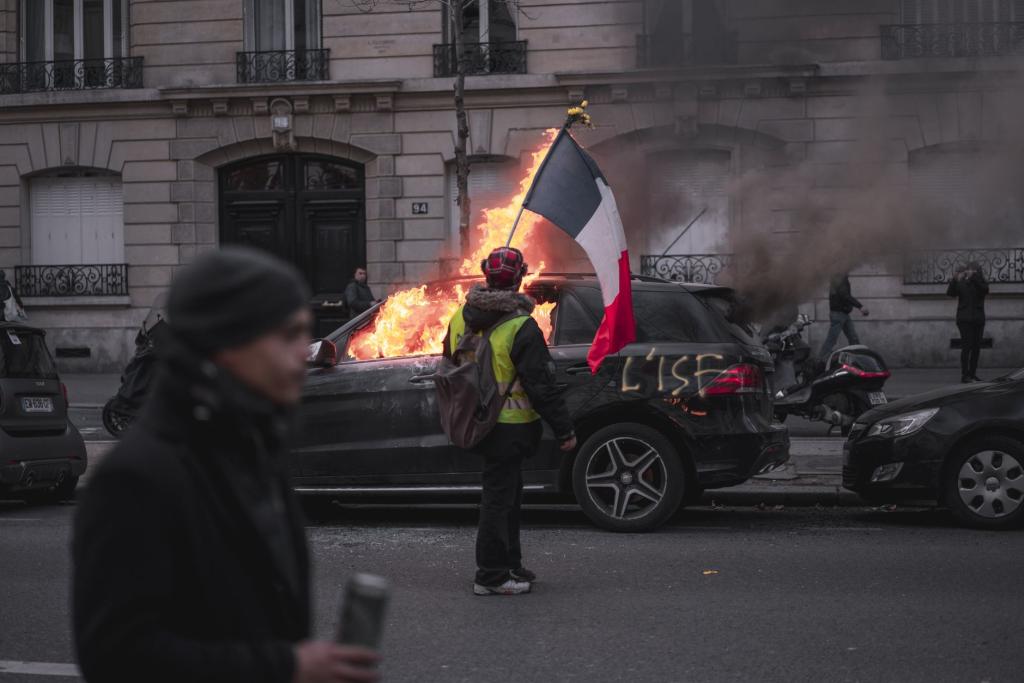
The France high school protests that began as a schoolyard movement over crowded classrooms and missing teachers have turned into a major outbreak of youth unrest. Nearly 1,950 people were arrested on Thursday alone as demonstrations spread from blockades at school gates to burning barricades in city streets, according to France's Interior Ministry figures reported by Le Monde.
The scale of the mobilization stunned officials. More than one thousand high schools were affected by strikes or protests on Thursday, including 222 blockades, the Education Ministry said. That means roughly one in four high schools in the country saw some form of action, up sharply from earlier in the week. Smoke from burning trash bins rose over several major cities as viral videos of the clashes spread across social media.
The human cost has been steep. Education Minister Edouard Geffray said that 170 students and 65 education staff members have been injured since the movement began. Several schools suffered severe damage. Part of the entrance hall of the Nelson-Mandela high school in Nantes was burned, and principals and teachers have been harassed or assaulted at high schools in multiple regions, according to regional education authorities cited by Reuters.
Behind the numbers are teenagers who say they simply want a functioning school day. Kesia, 15, demonstrated in the Paris suburb of Pantin and told Reuters her classroom holds 35 students per class, adding that students do not have enough chairs and get too little time at lunch for everyone to eat. Her complaint echoes the original grievances of the movement, which started at the Saint-Exupery high school in Creteil: teacher shortages, overcrowding, and buildings in disrepair.
From blockades to street battles
Thursday marked a turning point, and officials are no longer describing the situation as a student protest. After an emergency meeting of government ministers, the prime minister's office said the movement had shifted toward urban violence. Justice Minister Gerald Darmanin warned that the unrest could continue through the weekend, telling reporters on Friday that France had moved from student protests to a question of public order.
France's intelligence services briefed the government that the wave was initiated by hard-left politicians, Reuters reported, citing a person close to the prime minister. The readout of the crisis meeting described the protests as an operation organized by La France Insoumise (LFI) and its proxies on the far left. LFI leader Jean-Luc Melenchon denied responsibility for the violence, even as Marine Le Pen accused the party of playing a direct role in the unrest and called for a new anti-rioters law.
Student representatives have tried to draw a line between their demands and the destruction. Nathanael Combary, of the student union Renouveau Lyceen, told reporters after a meeting with the education minister that his group disassociates itself from the urban violence. He called for non-violent protests to continue, saying the people burning trash cans were not there to champion the students' demands. The head of the SNPDEN-UNSA union of school principals, Bruno Bobkiewicz, said he was sick to his stomach over the situation, telling French media that while the unions share some of the students' demands, some young people are only there to break things.
What comes next
The movement is now spreading beyond high schools. From this week, several universities have joined the protests, with the Union Etudiante saying that around 30 campuses in Paris, Strasbourg, Marseille, Lyon, Reims, Poitiers and Nanterre were blocked or disrupted. The organization described it as an expansion of the youth movement into higher education.
Nationwide union-led protests in support of the high schoolers are planned for Tuesday, reported by CNN, with SNES-FSU, CGT Educ'action and SUD Education calling on education workers to stand alongside the students. Geffray, the education minister, has faced criticism for his handling of the crisis and for telling school principals in an internal note to keep their schools open amid the unrest.
The unrest is also becoming a political fight months before France elects a successor to Emmanuel Macron in May. Melenchon denounced the government's response as repressive and framed himself as the students' defender, while Le Pen wrote on X that the protests were no longer about high schools but about riots organized by professionals. With opinion polls putting Le Pen as the frontrunner, the battle over who owns the narrative of France's angry youth has become inseparable from the campaign itself.
Readers can follow the latest reporting on the escalating unrest in Le Monde's coverage of the spreading protests and CNN's account of the police clashes and school closures.
Comments 0
No comments yet. Be the first to share your thoughts!
Leave a comment
Share your thoughts. Your email will not be published.