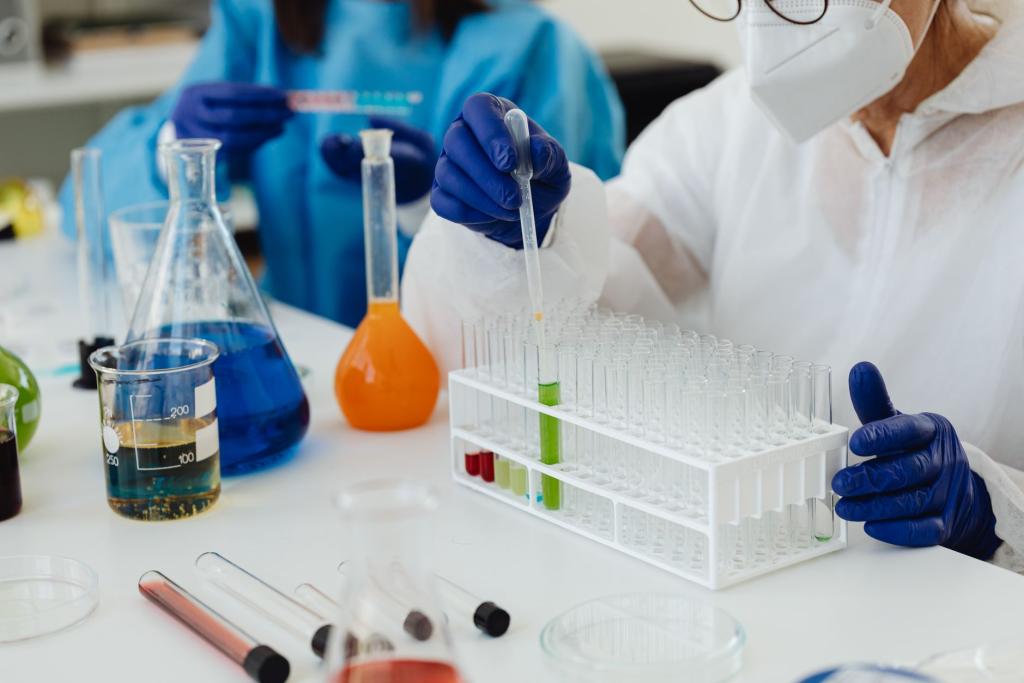
A DNA computer just did math in a test tube with no plug, no battery and no silicon chip, and the internet is fascinated. Researchers at Maynooth University in Ireland built the DNA computer and described it in the journal Nature, according to SciTechDaily, which republished the university's account this week.
What the DNA computer actually does
Picture a tiny droplet of water and salt holding short pieces of DNA plus one long DNA scaffold. Heat gets the mixture started, then it cools, and the strands settle into their most stable arrangement. That final arrangement is the answer.
Dr Abeer Eshra, who ran many of the experiments, put the scale this way: "A small droplet of liquid contains billions, and sometimes trillions, of DNA strands. These strands interact with one another to produce a result."
Professor Damien Woods, who leads the team at the Hamilton Institute, explained the trick. "The molecules interact, form a structure and that structure is the answer," he said. "One key innovation is that the system naturally finds that answer without needing continuous energy inputs."
How fast is it, really?
Do not expect to game on it. A simple sum of ten plus three took thirty seconds. A far bigger job, adding numbers in the range of about eleven million to thirty-four million, took up to fourteen hours.
The team ran ten programs in total, including multiplication, division and one-hundred-bit computations. The system was also reusable, handling up to twenty-five different calculations in a row.
Eshra was upfront about the tradeoff. "The reaction happens fast in the test tube, but not as fast as silicon, nor is it intended to be," she said. "But compared to other DNA computers, ours is the fastest." The Nature paper is titled "A thermodynamically favoured molecular computer," and its abstract, listed on PubMed, says the method needs no error correction or precise kinetic control.
Why anyone should care
The big pitch is energy. Woods noted that twenty-three percent of Ireland's electricity goes into computing and data storage, and said researchers have been "blinkered by only seeing one type of computer," when other examples, including the brain, are all around us.
The researchers say the work points to long-term data storage, energy-efficient computing and, eventually, molecular systems that could work inside cells to spot disease. That last part is a long way off, and Woods himself called it "blue skies science."
The effort is backed by a four million euro European Innovation Council grant for a project called DISCO, which aims to compute and store data using DNA. You can follow more breakthroughs like this on our science page.
What comes next for molecular computing
Molecular computing has been a niche corner of science for decades, and this project builds on earlier work from the same lab, including a 2019 Nature paper on reprogrammable DNA self-assembly, as Physics World reported in its coverage of the new system.
The difference this time is the approach. Instead of fighting to keep errors out with constant energy input, the team designed short DNA tiles that compete to bind along the scaffold, so the most stable arrangement encodes the answer. It is a bit like water finding the lowest point in a bowl.
That idea could matter well beyond arithmetic, because it suggests that some problems might be solved by physics itself rather than by pushing electrons through billions of switches. Skeptics will point to the speed gap, and they have a point, since silicon remains vastly faster for everyday work.
The Gen Z takeaway
Your phone and the data centers behind your streaming and chatbots burn a huge amount of power. A computer that does its thinking by letting molecules settle into place is a wild contrast, even if it is currently slower than a calculator from the nineties.
Think of this DNA computer less as a replacement for your laptop and more as proof that computing can look very different. The team is five people, including an undergraduate researcher, Janet Adio, who is listed among the paper's authors.
Whether molecular machines ever leave the lab is an open question, and the researchers do not claim otherwise. For now, the headline is simple: water, salt, DNA and a little heat can add, multiply and divide, and that is a pretty cool thing for a test tube to do.
Keep an eye on the DISCO project. If the team can scale this DNA computer up, the next papers could show whether storage and computing in a droplet are practical or just a beautiful experiment.
Comments 0
No comments yet. Be the first to share your thoughts!
Leave a comment
Share your thoughts. Your email will not be published.