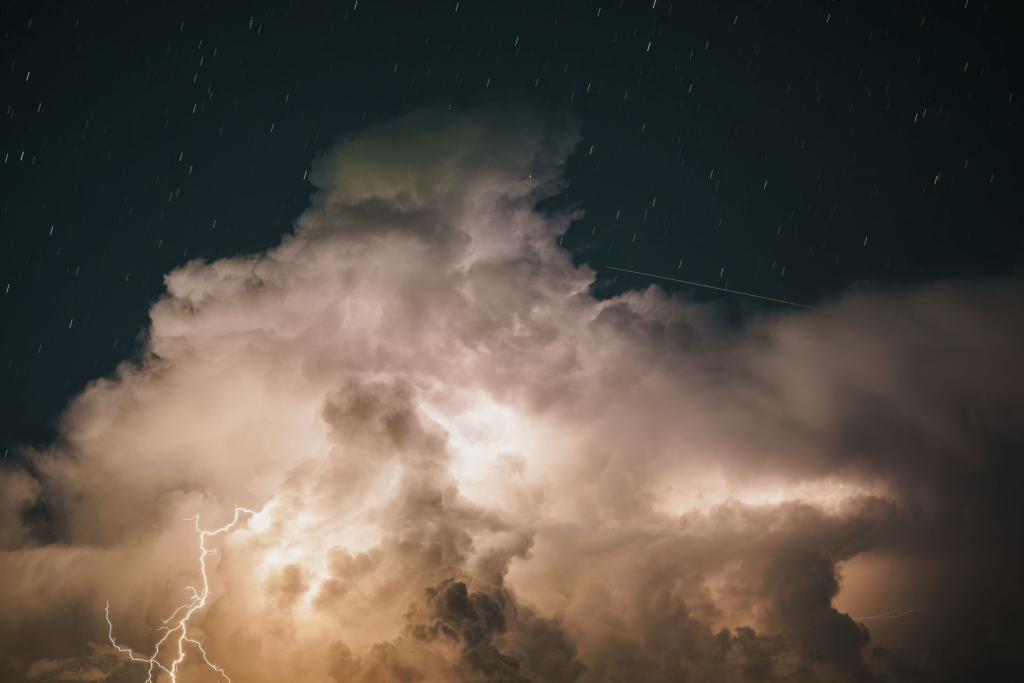
An instrument built to study particles from outer space has accidentally become one of the best tools ever invented for studying thunderstorms. The GRAPES-3 muon telescope in Ooty, India, was designed to catch cosmic rays, but physicists have found that the same particles can probe the enormous electric fields inside thunderclouds, fields so powerful they dwarf anything ever measured directly. According to reporting by Phys.org, a new study in the Journal of Cosmology and Astroparticle Physics explains one of the telescope's strangest results: it sees far more storms to its east than to its west.
Cosmic rays are a continuous rain of extremely high-energy particles arriving at Earth from outer space, mostly protons. Because they carry electric charge, Earth's magnetic field bends their paths. When they slam into the atmosphere, they trigger showers of secondary particles, including muons: short-lived, electrically charged particles that travel near the speed of light and penetrate deep into the ground. "The cosmic rays we detect at ground level consist predominantly of muons," explains Sunil Gupta of the Tata Institute of Fundamental Research (TIFR) in Mumbai, India, one of the study's authors. "They're highly penetrating particles."
The GRAPES-3 telescope, with a 560-square-meter muon detector, records around 4 billion muons every single day. Normally that data is cosmic-ray science. But physicists realized the muons could do double duty as a probe of thunderstorm electricity, because electric fields inside a storm act on positive and negative muons in opposite ways. "Muons are actually an ideal gift for doing these kinds of studies," Gupta says. "They are like an electric current flowing through the atmosphere."
Gigavolts in the clouds
Inside a thundercloud, separated charges build up intense electric fields and enormous potential differences. As muons cross those regions, the fields slow positive muons while accelerating negative ones. If equal numbers of each existed, the effects would cancel out and the telescope would notice nothing. But because primary cosmic rays are mostly positively charged, positive muons are also more abundant in the atmosphere, and that imbalance means storms leave a small but measurable fingerprint in the muon flux.
Physicists describe the imbalance with the muon charge ratio, the ratio of positive to negative muons, which is normally greater than one. "If nature provided equal numbers of positive and negative muons throughout the field of view, we wouldn't be able to observe the thunderstorm phenomenon with the current setup," explains Hari Haran Balakrishnan of TIFR, the study's first author. Because the imbalance exists, GRAPES-3 can infer the electrical potential inside a thundercloud from the ground, something direct instruments can only do by flying into the storm.
An earlier study by the same team produced a startling measurement: a thunderstorm potential of 1.3 gigavolts. The idea that thunderclouds could reach such voltages is not new; physicist Charles Thomson Rees Wilson, a 1927 Nobel laureate, suggested it as early as the 1920s. But direct measurements had only ever reached around 130 million volts, more than ten times lower. If the muon measurements hold, storms are far more electrically violent than anyone has directly confirmed.
The east-west mystery
That earlier study also turned up a puzzle. Between April 2011 and December 2020, GRAPES-3 detected 487 thunderstorm events. Of those, 81.5 percent appeared in the eastern part of its field of view and only 13.7 percent in the west, a difference of almost six to one. Were storms around Ooty simply clustering to the east? The researchers checked with an independent array of instruments that monitors the atmospheric electric field and confirmed that real thunderstorms showed no such preference.
The answer turned out to be a century-old piece of physics. Because charged particles are deflected by Earth's magnetic field, positively charged cosmic rays can reach the atmosphere more easily from some directions than others; lower-energy positive particles arriving from the east are filtered out more strongly than those from the west. This directional threshold, known as the geomagnetic cutoff, varies significantly across GRAPES-3's field of view. Computer simulations showed the muon charge ratio is about 1.37 in the east and 1.14 in the west.
"It's not that the voltage is different," Gupta explains. Thunderstorms to the east are not necessarily more powerful. Instead, the larger imbalance between positive and negative muons in that direction makes GRAPES-3 more sensitive to their electrical effects. When the direction-dependent ratio is included in the simulations, a strong east-west asymmetry emerges, matching the observations; when the same ratio is imposed in both directions, the asymmetry disappears.
Why it matters
Directly measuring the electrical potential inside a thundercloud is notoriously difficult: it generally requires instruments carried by aircraft or weather balloons into or near active storms, which makes it hard to sample a large, fast-evolving phenomenon. Cosmic ray muons offer a fundamentally different approach. They stream through the atmosphere continuously and can be monitored from the safety of the ground, around the clock, over huge areas of sky. Understanding the east-west effect is essential to turning that stream into a reliable instrument, and the new study provides exactly that calibration. That calibration makes cosmic ray muons a practical window into storms that were previously out of direct reach. For now, the cosmos keeps doing what it has always done: raining particles down through our storms. Scientists have just learned how to read the weather in them.
GenZ NewZ covers space and physics research regularly, from the health toll of long spaceflights on astronauts to the new science on brain metastasis prevention.
Comments 0
No comments yet. Be the first to share your thoughts!
Leave a comment
Share your thoughts. Your email will not be published.