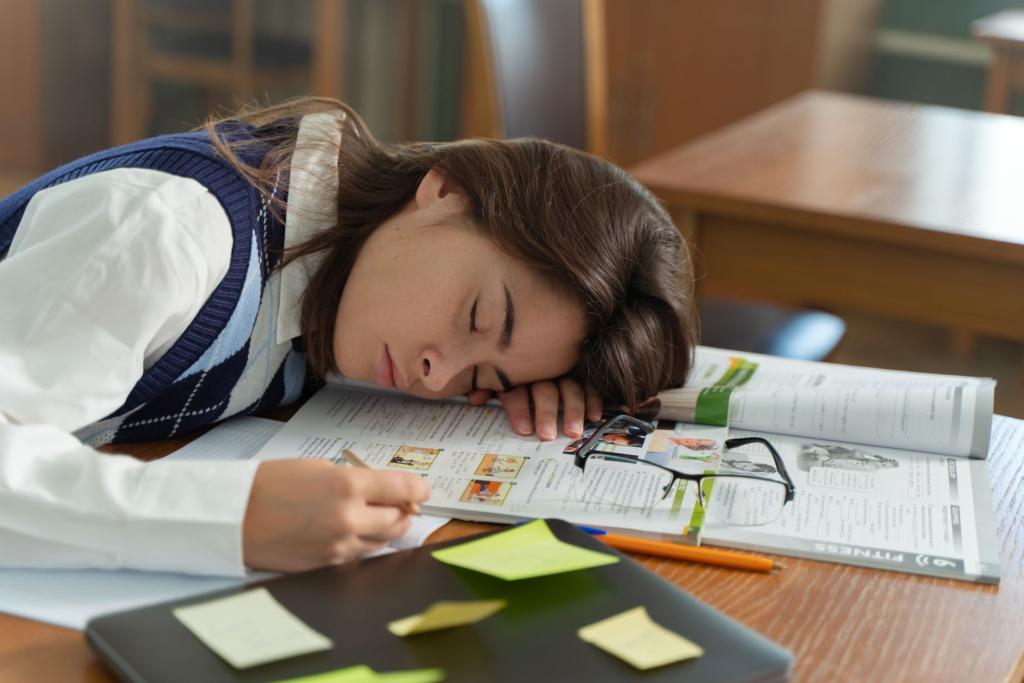
Caffeine timing is not just a question of whether coffee after lunch is a bad idea. Its effects depend on dose, how soon you plan to sleep and how your body responds. For late study or night work, the useful clock may be the time until sleep—not the hour on the schedule.
Half-life explains why timing matters
A caffeine half-life is the time it takes for the amount in the bloodstream to fall by about half. According to an NIH-hosted pharmacology chapter, the average is about five hours in healthy people, with a broad reported range of roughly 1.5 to 9.5 hours. As a simplified illustration, about half a dose may remain after five hours and about a quarter after ten. That estimates caffeine still present; it is not a countdown to when someone will feel alert or fall asleep.
Someone with faster clearance may have less caffeine left at bedtime than someone who processes it more slowly, even if both drank the same amount at the same hour. According to the FDA's consumer guidance, caffeine sensitivity and elimination vary widely, so a general daily figure cannot identify an individual's sleep cutoff.
Metabolism is only part of the story. A review by pharmacologist Astrid Nehlig describes genetic differences in CYP1A2, an enzyme involved in caffeine metabolism, and ADORA2A, a receptor targeted by caffeine. Hormones, smoking and some medications can also matter. These factors help explain why one person may sleep normally after afternoon coffee while another notices a later bedtime or lighter-feeling rest; they do not provide a simple genetic test for a personal cutoff.
Research points to dose as well as the clock
A 2023 systematic review and meta-analysis of 24 studies found caffeine was associated, on average, with 45 minutes less total sleep, a 9-minute longer time to fall asleep and 12 more minutes awake after sleep began. Its dose-based model estimated that a coffee serving with about 107 milligrams would need to be consumed at least 8.8 hours before bedtime to avoid reducing total sleep time; for a 217.5-milligram pre-workout serving, the estimate was 13.2 hours. These are modeled estimates from varied studies, not a safe-window guarantee for an individual.
A newer randomized crossover trial by Gardiner and colleagues shows why dose matters. Healthy men aged 18 to 40 who were moderate caffeine consumers received 100 or 400 milligrams at different intervals before bedtime. The researchers found no significant sleep effect for 100 milligrams compared with placebo, while a single 400-milligram dose affected sleep when taken within 12 hours of bedtime; participants also rated sleep quality lower when the larger dose was taken four hours before bed. The trial excluded women and shift workers, so its controlled sample cannot settle how the full range of doses affects sleepers.
There is a counterpoint to any neat cutoff chart: feeling rested may not capture every change. In that trial, measured and self-reported sleep did not fully align. FDA guidance that up to 400 milligrams a day is not generally associated with negative effects for most adults is a broad daily figure, not a promise that sleep will be unaffected. According to the FDA, regular brewed coffee can contain roughly 113 to 247 milligrams per 12 fluid ounces, so serving size and product strength also matter.
Making the numbers relevant to late study or work
For a student facing an evening deadline, no caffeine after 2 p.m. may not fit if bedtime is much later—or if sleep follows an overnight shift. Thinking backward from intended sleep makes the evidence easier to interpret: note the planned sleep window, caffeine-containing drinks or products, and roughly how much each contains. Coffee, tea, energy drinks, some supplements and certain foods can all contribute, with amounts varying by product.
On repeated shifts or study nights, a brief record may help someone notice whether their own pattern differs between earlier and later caffeine, without assuming one rough night proves a cause. Someone protecting a daytime sleep window might compare a lower-caffeine or earlier-in-shift routine with their usual one, while considering the job's safety demands and need to stay alert. Research does not establish one cutoff across schedules, and caffeine is not a substitute for adequate sleep.
The practical takeaway is to consider caffeine timing and amount alongside the sleep window that follows. Half-life helps explain why caffeine can linger; metabolism and sensitivity help explain why the same timing can feel different. For late work or study, bedtime and the dose in the cup matter more than a fixed afternoon rule. GenZ NewZ’s explainer on sleep efficiency covers a related but different question: how sleep quality and time asleep fit together.
Sources: NIH Bookshelf, Pharmacology of Caffeine; U.S. Food and Drug Administration, Spilling the Beans: How Much Caffeine is Too Much; Nehlig, Interindividual Differences in Caffeine Metabolism and Factors Driving Caffeine Consumption, Pharmacological Reviews; Gardiner et al., systematic review and meta-analysis, Sleep Medicine Reviews; Gardiner et al., randomized crossover trial, Dose and timing effects of caffeine on subsequent sleep.
Comments 0
No comments yet. Be the first to share your thoughts!
Leave a comment
Share your thoughts. Your email will not be published.