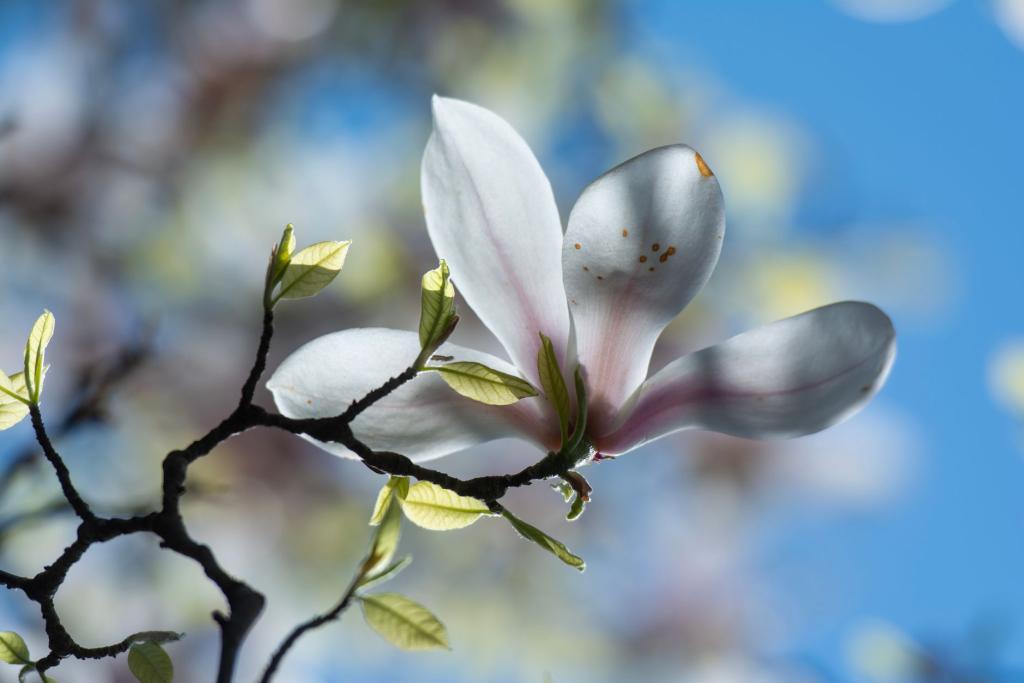
The clouds sit so low on Lomburr Mountain that you can walk straight through them. It was up there, in the misty primary forest of Lam Dong Province in southern Vietnam, that botanists found a tree doing something its relatives never do: growing its flowers in pairs and packing eleven petals into each bloom where its cousins stop at nine. Hoang Thanh Truong and colleagues described the tree, a rule-breaking magnolia, as a new species, Magnolia tienii, in the journal PhytoKeys in 2026, volume 277, naming it for Dr. Tran Van Tien, a Vietnamese botanist whose work on magnolias made the discovery possible, according to the paper's abstract.
The team behind the description works out of Dalat University, alongside researchers from the Vietnam Academy of Science and Technology and the Vietnam Academy of Forest Sciences. The story was picked up by scienmag, which reported that the discovery began not on the mountain but in a herbarium drawer. The lead author and colleagues first noticed dried specimens collected at Ba Na in Da Nang, filed as Poilane 7264 and gathered nearly a hundred years ago, that looked like the known species Magnolia praecalva but with details that did not line up.
What makes this rule-breaking magnolia different
What makes this rule-breaking magnolia unusual is written into its flowers. Magnolias do not have true petals and sepals. They have tepals, layered petal-like structures that give the blooms their sculptural look, and the species this one belongs to almost always grows a single flower at the tip of each twig with nine tepals. Magnolia tienii grows paired terminal flowers, two blooms side by side at the twig tip, and each carries eleven tepals in three whorls: three outer ones, long and spoon-shaped in cream white, with eight more tucked inside. The leaves are elliptic, nine and a half to ten and a half centimeters long and three to three and a half wide, and the tree can reach twenty meters tall with a trunk up to zero point eight meters thick. It flowers from May to June and fruits from June to July, the paper reports.
DNA evidence backed up the anatomy. A barcode from the rbcL gene places the tree firmly in its section of the genus, differing from its closest relatives by a single nucleotide, while quantitative differences in leaf area and stomatal density added a second line of proof, scienmag reported. The authors note that more genetic markers and wider sampling could sharpen the picture, but the paired flowers, eleven tepals and leaf shape already set this rule-breaking magnolia apart from Magnolia praecalva and Magnolia sinica, its nearest known kin.
A paper trail nearly a century old
To verify what they were seeing in the herbarium, the researchers went back to the places where related specimens had been documented. They revisited Ba Na in Da Nang, the collection site of the historic Poilane specimens, and Kon Ha Nung in Gia Lai, where another old specimen had been preserved, and found no living individuals at either site. The breakthrough came at Kon Chu Rang, roughly fifty kilometers from Kon Ha Nung, where three trees of the rule-breaking magnolia were standing in primary forest between thirteen hundred and fourteen hundred meters above sea level.
The new magnolia is not the only Vietnamese plant that refuses to follow the rules of its family. The so-called demon flower of Thailand feeds on fungi instead of sunlight, a strategy botanists are still unpacking, and the giant Victoria colombiana waterlily turned up in an Instagram selfie before science caught up with it. Read those earlier GenZ NewZ reports here: Thailand's demon flower feeds on fungi, not sunlight and the giant waterlily spotted in an Instagram selfie.
Fewer than five trees on one mountain
The conservation picture is sobering. An extensive field survey found fewer than five mature individuals, all in a single localized population on Lomburr Mountain, occupying an area of under two hectares. Following the IUCN Red List Categories and Criteria, the authors provisionally assessed Magnolia tienii as Critically Endangered on the basis of its critically small population size. They strongly recommend more fieldwork, both to monitor the known trees and to search for other populations of the rule-breaking magnolia that nobody has found yet.
Magnolias belong to one of the most ancient lineages of flowering plants, a family that was already blooming when the dinosaurs were still around, as scienmag noted. That deep history is part of why a new branch gets attention: every lineage that survives this long has weathered more change than most. For now, the newest one is a rule-breaking magnolia on a single misty Vietnamese mountain, flowering in pairs each spring, with a name honoring the botanist who spent his career studying the family. The full description is available in the PhytoKeys paper and summarized in scienmag's coverage of the discovery.
Comments 0
No comments yet. Be the first to share your thoughts!
Leave a comment
Share your thoughts. Your email will not be published.