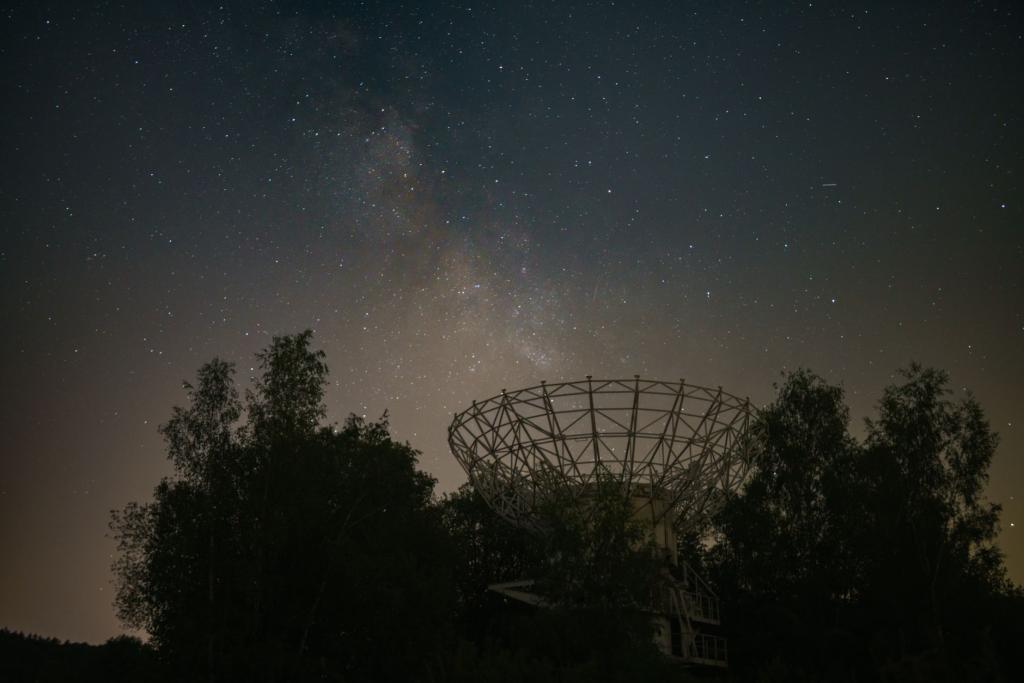
A flash of radio light that left its home galaxy before the Sun existed has just become the most distant of its kind ever traced. The Farthest Fast Radio Burst ever detected traveled for more than ten billion years before washing over Earth, and astronomers have now pinned down exactly where it came from. The finding, published this week in the journal Science, more than doubles the previous distance record for these mysterious cosmic flashes.
The signal, designated FRB 20240304B, was caught on March 4, 2024, by a radio telescope in South Africa taking part in a survey that hunts for brief, bright cosmic events. It lasted only a few thousandths of a second, a spike in a stream of computer data that nobody could hear or see. But that blip had been traveling toward us since the universe was roughly three billion years old, meaning the light began its journey long before our planet or star had formed. When the biggest ground-based telescopes stared at the patch of sky it came from, they found nothing at all, so the team turned to a much sharper eye in orbit.
According to the University of Sydney, whose researchers led the study, the burst's home galaxy was found using infrared observations from the James Webb Space Telescope. The university reports that the space telescope's cameras picked out a surprisingly small, metal-poor galaxy in the middle of an intense burst of star formation, and follow-up spectroscopy measured its distance with a redshift reading of 2.148.
How astronomers caught a ten-billion-year-old flash
Fast radio bursts are among the strangest phenomena in the sky. Each one packs as much energy into a few milliseconds as the Sun puts out over months or years, then vanishes. Since the first was spotted in 2007, researchers have catalogued more than ten thousand of them, yet nobody can say for sure what produces the flashes. Some repeat; some fire once and go silent. The leading guess involves magnetars, neutron stars with magnetic fields so extreme they defy easy comparison, but the case is far from closed.
What made this detection special was the teamwork across the electromagnetic spectrum. The South African array caught the radio pulse first. Then the orbiting infrared observatory, with vision far sharper than anything on the ground, located the faint galaxy responsible. Its instruments split the galaxy's light into a spectrum, and the stretching of that light by the expansion of the universe gave away the distance. The host galaxy turned out to be an unexpected source, small and chemically primitive compared with the mature galaxies that host most known bursts, and it was forming stars at a furious rate.
"This is an extraordinary glimpse into the distant universe," said Dr Manisha Caleb of the Sydney Institute for Astronomy, one of the study's lead researchers. "We have caught a fast radio burst from a time when the universe was only about three billion years old, and we have used that brief flash of radio light to learn about the matter it has traveled through over billions of years."
Why a millisecond matters
The real prize here is not the burst itself but what it passed through on the way here. Radio waves slow down and smear as they cross the thin gas floating between galaxies, so a signal that has crossed most of cosmic history carries a fingerprint of all the invisible matter it encountered. Astronomers can read that fingerprint to weigh matter that emits no light of its own, effectively using the flash as a probe to count the universe's missing atoms. The farther the burst, the longer the baseline, and the Farthest Fast Radio Burst on record gives researchers a measuring stick stretching back through roughly four-fifths of all time.
That matters because the census of ordinary matter in the cosmos has never quite added up. Models of the Big Bang predict a certain amount of normal matter, and for years astronomers could only account for part of it. Distant bursts like this one offer an independent way to find the rest, drifting in the vast spaces between galaxies. Each new record-holder sharpens the tool.
There is also a galaxy-evolution story hiding in the result. The host is young, small, and poor in heavy elements, the kind of galaxy common in the early universe but hard to study in detail. Catching a burst from such a place shows that these events were already happening when the cosmos was young, and it hints that they may have been far more common in the universe's early chapters than they are today.
The mystery that will not go away
For all the precision of the distance measurement, the central question remains open. "The galaxy hosting this burst is surprisingly small, metal-poor and undergoing a very active episode of star formation," said co-author Dr Laura Driessen, describing a birthplace that does not obviously match any single theory of what makes the flashes. If magnetars are responsible, astronomers still need to explain how they form in such primitive environments. If something else is, the answer is still waiting to be found.
That uncertainty is part of what makes the field so lively. Phys.org reports that the discovery gives astronomers a powerful new way to study both the evolution of galaxies and the unseen matter between them, and the team expects more distant bursts to turn up as surveys get more sensitive. Nearly two decades after the first flash was found, the phenomenon that started as a curiosity has become one of the sharpest tools in cosmology.
The timeline tells the story of modern astronomy in miniature: a split-second radio detection, a painstaking follow-up with the world's most powerful space telescope, and a result published this week that rewrites the record books. For anyone who looks up and wonders what is out there, the Farthest Fast Radio Burst is a reminder that the universe is still sending us messages from before our solar system existed, and we are finally learning how to read them. Readers hungry for more cosmic news can revisit Japan's mission to touch a Mars moon for the first time, the wandering black hole that gave itself away by shredding a star, and Sky at Night's full breakdown of the discovery.
Comments 0
No comments yet. Be the first to share your thoughts!
Leave a comment
Share your thoughts. Your email will not be published.