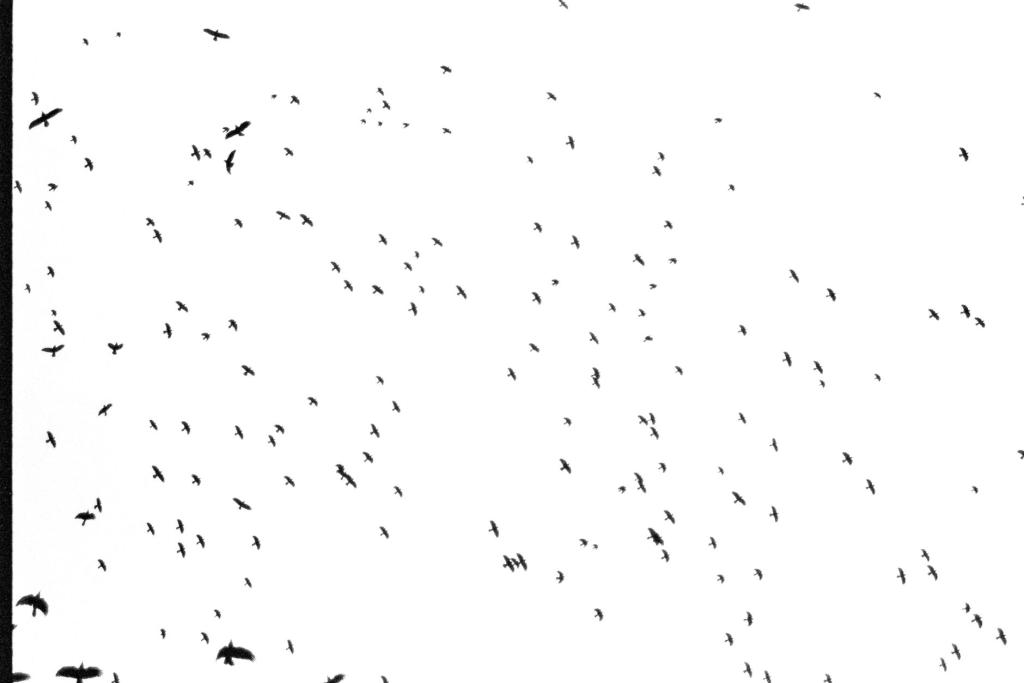
A batch of newly declassified UFO Videos just got a very ordinary explanation. According to a new analysis by a team of scientists, six glowing dots filmed by an American military infrared sensor over the Middle East were probably not exotic craft at all — they were a flock of birds, beating their wings in the dark.
The footage was released on September 18 as part of a government disclosure program, and the accompanying mission report described the targets as a cluster of small spherical objects flying together with what looked like unusual agility. The observer on board estimated the objects were racing along at hundreds of miles per hour. That speed estimate is exactly what ruled out the obvious explanation. It was also, the new analysis suggests, probably wrong.
The scientists, led by Jacob Haqq-Misra of Blue Marble Space, went through the infrared recording frame by frame and found a rhythmic tell. The brightness of each dot pulsed steadily, about seven times per second, and each dot pulsed on its own independent schedule. That pattern is the signature of a flapping wing: a bird's warm body changes the heat it radiates as its wings move, making it brighten and dim with every stroke. For birds in cruising flight, flap rates run from roughly two and a half beats per second in the largest birds to more than ten in small songbirds, right in the range the team measured.
The method has a neat advantage: it does not depend on knowing how far away the targets were. The Pentagon's speed estimate did depend on that distance, and distance is exactly the number a military sensor release is most likely to withhold. If the birds were much closer to the camera than the reported numbers assumed, they could have been flying slowly or even hovering in place while appearing to streak across the screen at an impossible clip.
A flock can look smarter than a drone
The most striking part of the case is not the wingbeats alone but the formation. The dots moved in a tight, coordinated swarm that the mission report called agile, with sudden changes in direction. That coordination is what made the alien-technology question feel worth asking. But flocks of birds have been coordinating tighter maneuvers than any human-built drone for millions of years, and infrared cameras turn them into anonymous glowing orbs that lose all their birdlike features.
Harvard physicist Avi Loeb, a co-author of the analysis, has been arguing for years that the search for genuinely unknown phenomena should start with rigorous identification of the known kind. In a recent essay describing the new findings, he wrote that the study changed an officially declared unidentified phenomenon into a candidate identified one: flying animals. He also noted that more than eight percent of the analyzed videos in the same declassified collection showed similar periodic brightness variations, meaning the birds may be only the first of several ordinary explanations waiting in the set.
The researchers were careful to state the limits of their conclusion. Because the military has not released the aircraft's location, altitude, or full sensor telemetry, the bird identification cannot be fully locked in. In a detailed review of the case, an independent assessment put it plainly: the paper offers the strongest current explanation, but the objects being birds is likely rather than certain until the withheld platform data becomes available. Science at its most honest says "probably" when the evidence stops.
Why this matters more than one video
This single case is a template for how the whole disclosure era will work. The September release included dozens of videos spanning well over half a century of records, and each one arrives with partial context: footage without telemetry, estimates without error bars, phenomena without metadata. The wingbeat trick gives investigators a tool that works even with thin data, since brightness rhythms are baked into the pixels themselves.
It also sets a bar for future claims. One of these UFO Videos may look impossible on screen, but the mundane options have to be tested first — and this week the mundane option turned out to be a flying animal. Skeptical physics recently turned up in fusion research too, where a neat-sounding shortcut came with a clearly flagged catch. Good science names its caveats; hype does not.
The episode is a useful reminder that the universe is full of real mysteries that survive debunking. A rover on Mars just outdrove a legend, and new lab work suggests microplastics may be chemically nastier than anyone thought. There is no shortage of genuine unknowns. But the fastest way to find the real ones is to clear out the birds first, one wingbeat at a time.
Comments 0
No comments yet. Be the first to share your thoughts!
Leave a comment
Share your thoughts. Your email will not be published.