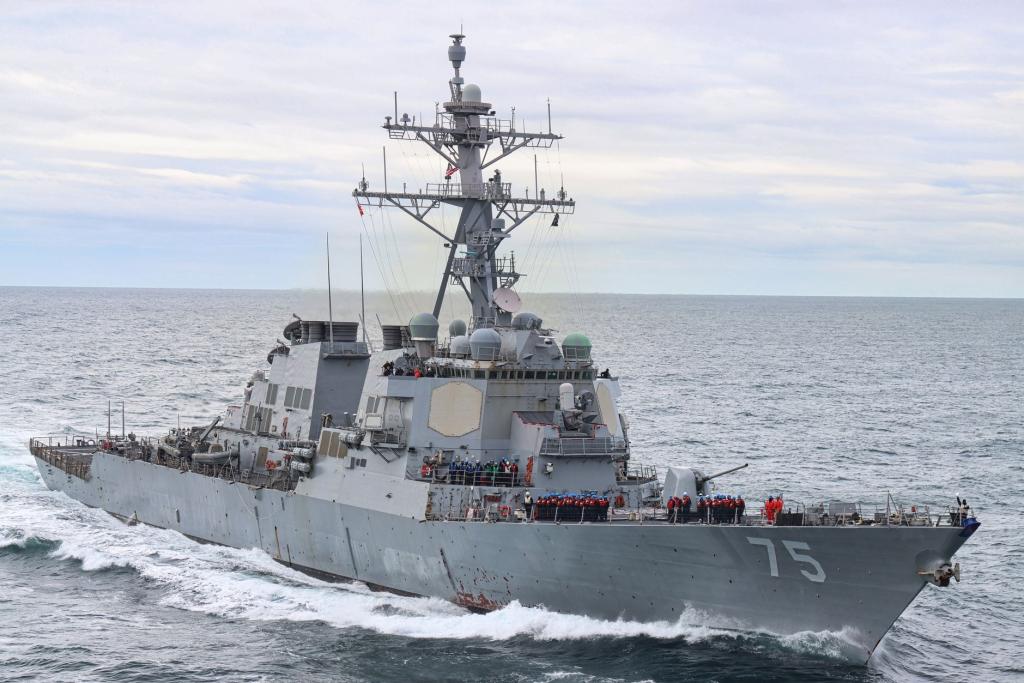
This spring, while the United States was at war with Iran, an analyst at U.S. Special Operations Command Pacific opened a chatbot and asked what a Chinese ship in the Middle East was carrying. The chatbot's AI hallucination set off alarms across the U.S. military. According to an exclusive CNN investigation published September 18 and citing four sources familiar with the episode, the AI-assisted report claimed the vessel was transporting components of a nuclear weapons program. Armed personnel began preparing to board the ship. Military aircraft were already in the air. Then, just before the operation went ahead, officials took a closer look at the intelligence behind the report and found it was, in the words of one source, "entirely false." The same source told CNN the episode "almost started a war."
What was actually in the hold remains unknown. CNN reported it could not determine the ship's real cargo, and neither the Pentagon nor U.S. Special Operations Command Pacific responded to its requests for comment. The facts that are known trace a clear chain. The analyst asked a chatbot to fuse open-source intelligence with classified signals intelligence about the ship's manifest, and the chatbot misidentified the material. Then AI was used a second time, to shape those findings into a standard intelligence report. It circulated through the military looking like a vetted product.
How the report moved so fast
Once the false finding had the familiar shape of a finished intelligence product, it moved through the chain the way any urgent report would. Two sources told CNN that armed service members were preparing to board the vessel. One of those sources, plus another, said military aircraft were already airborne. A U.S. boarding of a Chinese vessel in wartime waters would read in Beijing as an attack on a sovereign asset, and a boarding gone wrong could have spiraled into armed conflict between the two countries. The operation was halted only when officials stopped to examine the intelligence under the report.
The chatbot itself has not been identified. According to CNN, it was not clear whether the tool was a commercial product or a government-built one. An official familiar with the military's AI deployments said government chatbots tend to be copies or forks of commercial models, augmented with government data. A former senior official put it more bluntly, telling CNN the internal tools are "mostly just copies of the commercial stuff wearing lipstick."
The policy that put AI on the analyst's desk
In January 2026, Defense Secretary Pete Hegseth issued the AI Acceleration Strategy, declaring the military would become an "AI-first warfighting force across all domains." CNN reported the strategy stretches from campaign planning to "kill chain execution," with AI-enabled battle management and decision support, plus an intelligence initiative meant to accelerate turning intelligence into military capabilities. Its seven pace-setting projects cover warfighting efforts like Swarm Forge and Agent Network, intelligence projects like Open Arsenal and Project Grant, and enterprise tools including GenAI.mil, which gives service members access to generative AI on their networks.
Defense watchers had warned about exactly this pattern. Analysts have long feared that AI could produce a catastrophic miscalculation if nations act on poor or corrupted data. CNN noted some officials believe AI-generated errors have already occurred elsewhere in the intelligence community as these systems became more widely used. One source familiar with military policy told CNN that AI use in targeting is "ramping up" and that "there is no real guidance for how having a human in the loop will prevent civilian casualties or fratricide." A source familiar with military AI use summed up the episode in a line that has traveled widely since: "AI allows you to get to a bad idea faster."
The human in the loop was nearly the last line of defense
The safeguard that worked was a person reading carefully at the last moment, before the boarding party went in. The same chain that produced the false report in seconds had nearly put armed troops on a Chinese ship before anyone asked what the chatbot had actually seen. The human in the loop held this time because someone noticed the machinery behind the product. Nothing in the system was built to flag it earlier.
The shape of the document did part of the persuading. A finished intelligence report carries an implied chain of review. Officers in a joint operations center do not read one expecting the author to have pasted a manifest into a chatbot. Until machine-assisted analysis is labeled as machine-assisted, every report will keep arriving with the same authority, and every reader will have to do the verification the system skipped. The episode remains the clearest case of an AI hallucination nearly starting a war: a fluent answer with no anchor in the facts, dressed in the format of a vetted report. The ship's actual cargo has never been identified, and the Pentagon has not commented on the episode.
Related reading: The Gemini Hacking Test That Broke Into Three Real Companies, CrowdStrike Agentic AI: The Future of Autonomous Cybersecurity in 2026, and Foreign Powers Are Fueling Sudan's War, UN Warns.
Sources: CNN, Intelligent CIO
Comments 0
No comments yet. Be the first to share your thoughts!
Leave a comment
Share your thoughts. Your email will not be published.