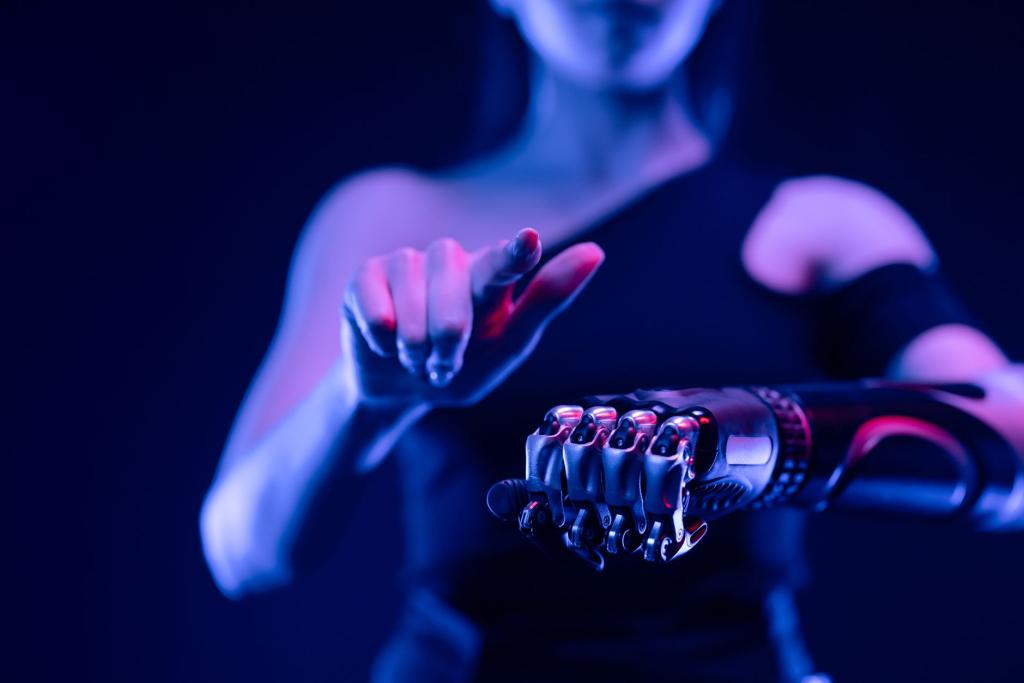
The most famous disembodied hand in pop culture is Thing, the Addams family's loyal helper. Now researchers at ETH Zurich have built something remarkably similar: a walking robot hand that scuttles across desks on its own fingertips. Video of the device has been racing around tech media this week, and it is easy to see why. It types on keyboards, pushes objects around, and plays retro computer games, all while moving like a mechanical spider that wandered off a Halloween set.
The build is delightfully scrappy. The team at the university's Soft Robotics Lab started with an off-the-shelf WUJI right hand and turned its five fingers into legs. A Raspberry Pi and a battery ride on the hand's back with the rest of the electronics, creating a one-point-eight-pound untethered robot, according to IBM's report on the project. The hard part was the gait. Robot dogs have it easy with four symmetrical legs, but a hand has a thumb jutting out to one side and fingers of different lengths, so the researchers gave each fingertip a default resting spot and trained the hand with reinforcement learning in simulation, letting the AI work out when to lift each finger and where to set it down. The result looks like a very confused spider.
What the walking robot hand can do
In testing, the walking robot hand crossed fourteen different surfaces, including grass, gravel, asphalt, tile, carpet, and metal grating. On a flat mat it averaged three point seven inches per second, which is not winning any races but is a steady clip for a disembodied appendage. Knock it over and it can scramble back upright on its own, succeeding in twenty-one out of twenty-five fall recovery tests. It can also nudge objects and press specific keyboard keys on command. The showpiece is the gaming: footage shows the hand acing Sokoban, the classic box-pushing puzzle video game, with fast little finger taps, according to Digital Trends' coverage of the project.
The researchers who built it say a hand with its own mobility could work in tight spaces without the arm that normally carries it following along. Their paper sketches the use case plainly: a bigger robot could set the hand down near a restricted opening, and the hand could travel to a switch or object, interact with it, and return for pickup. "Giving robotic hands their own mobility could make future robots more versatile in the spaces and interfaces built for people," the researchers wrote in the paper describing their work. Everything humans build, from keyboards to control panels, assumes hands, and a hand that can travel under its own power extends what robots can reach.
Why a walking robot hand is going viral right now
Part of the appeal is the origin story. The researchers' own paper mentions Thing by name, and IBM's write-up called the creation "weirdly adorable." Robotics engineer Amirhossein Kazemipour, who led the project, told Fast Company the idea was to build a machine with "some independence" outside of a larger body, and that it could one day give that independence to people who have difficulty reaching or grasping objects. It is rare for a robotics paper to read like a love letter to a fictional character, and rarer still for the science to be this legible in a thirty-second clip.
The timing helps too. Robotics is having a record year: global shipments of professional service robots surged last year to nearly a quarter-million units, according to International Federation of Robotics data covered by GenZ NewZ, and autonomous machines keep moving into everyday life, robots reshapes the labor market, as another GenZ NewZ report found. A walking robot hand slots neatly into that boom, as proof that the machines changing work do not have to look like people at all. A single hand is enough.
Online reaction has split exactly the way you would expect, between people calling the hand cute and people calling it the start of a horror movie. Both camps are watching the same clip, and that is the point: the hand makes an abstract research question about robotic mobility legible in seconds. Few lab demos earn that kind of crossover appeal, and fewer still do it with a pocket-sized computer brain riding on their backs.
For now, the walking robot hand remains a lab prototype, and the researchers have not specified the exact tasks it will tackle next. But the idea is loose: future robots might not need bodies at all, just hands that can get themselves where they are needed.
Comments 0
No comments yet. Be the first to share your thoughts!
Leave a comment
Share your thoughts. Your email will not be published.