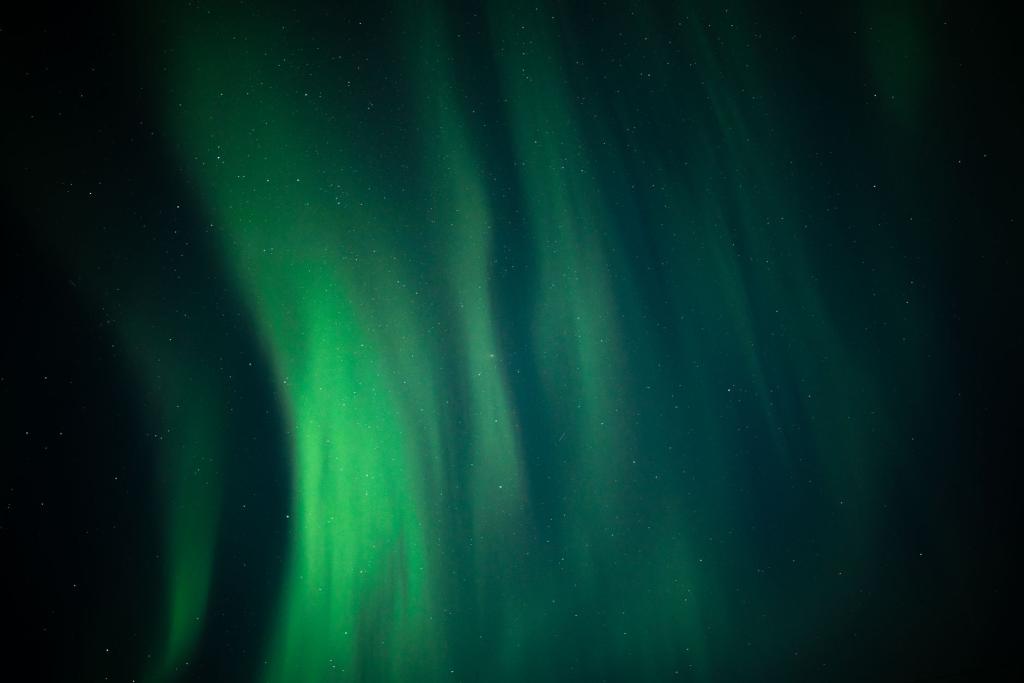
The Northern Lights are staging an encore over the British Isles. After a powerful solar storm painted green and pink ribbons across the night sky from October 10, 2026, into October 11, 2026, forecasters say the Northern Lights could return for two more nights, giving skywatchers in Britain a rare back-to-back celestial show.
The display was triggered when a massive burst of charged particles from the sun slammed into Earth's magnetic field on October 10, 2026. Solar wind speeds rocketed to roughly nine hundred kilometers per second, driving what scientists rank as a strong geomagnetic storm. The disturbance pushed the auroral oval far south of its usual haunts, and photographers captured shimmering curtains of light over Dunstanburgh Castle on the Northumberland coast and as far south as Kent and Surrey.
The Storm Behind the Northern Lights
The sequence began days earlier. On October 7, 2026, and October 8, 2026, the sun hurled at least two coronal mass ejections into space. Those clouds of magnetized plasma crossed the gulf between the sun and Earth in a matter of days, and the interplanetary shock wave reached the near-Earth spacecraft stationed at the L1 point at around half past two in the afternoon on October 10, 2026. From there, conditions escalated fast.
Solar wind speeds first jumped past five hundred kilometers per second, then surged to a peak just above nine hundred kilometers per second at about six in the evening. The density of particles spiked to more than one hundred per cubic centimeter, and the interplanetary magnetic field climbed to a peak of forty six nanoteslas. Crucially for Northern Lights watchers, the field tilted sharply southward, reaching a southward reading of twenty nine nanoteslas. That alignment opened a channel between the solar wind and Earth's magnetosphere, funneling energy straight toward the poles and setting the stage for the lights.
The sun, meanwhile, stayed restless. A large and complex sunspot region unleashed a powerful M-class solar flare that peaked in the mid-afternoon on October 10, 2026, causing a moderate radio blackout over Brazil. The same eruption launched another fast coronal mass ejection, estimated at roughly nine hundred and thirty kilometers per second, and forecasters have not ruled out a glancing blow to Earth late on October 12, 2026, as reported by EarthSky.
When and Where to See the Northern Lights Tonight
The outlook for the coming nights is promising. The Met Office said the Northern Lights could be visible in the United Kingdom again on Sunday and Monday night, according to indy100. Met Office forecaster Greg Dewhurst said the Northern Lights could be a little weaker on Sunday night, making sightings most likely across Scotland, Northern Ireland and northern England, but added that they may strengthen again on Monday night and reach further south into central areas.
Even if the aurora stays faint to the naked eye, cameras can pick it up. Dewhurst noted that long-exposure camera shots may reveal the lights each night a little further south than the visible-by-eye forecast. That was already the case over the weekend, when observers reported that the spectacle often appeared brighter through a phone camera than through the naked eye.
For the best chance, head away from city lights, give your eyes time to adapt to the dark, and look north toward the horizon. The aurora is usually most active between ten in the evening and two in the morning. Set a phone camera to night mode or a long exposure of several seconds, rest it on something steady, and even a faint glow can resolve into color.
There is one catch: the weather. The same unseasonably warm spell that has brought temperatures near twenty degrees to parts of England has also carried patchy low cloud, mist and fog overnight, which can hide the display even when solar conditions are perfect. Met Office meteorologist Chris Snell said there were sightings from top to tail across the country after the storm, but forecasters caution that clear spells are the deciding factor for any given spot on any given night.
Why 2026 Is a Banner Year for Northern Lights Hunters
This autumn is an especially good season for the show. The Northern Lights tend to appear most often around the spring and autumn equinoxes, when the tilt of Earth's magnetic field lines up more directly with the solar wind. On top of that, the sun is in an unusually active phase of its current cycle, throwing off flares and eruptions at a pace that keeps geomagnetic activity elevated for days at a time.
The science behind the colors is straightforward. The sun constantly emits a stream of charged particles known as the solar wind. When a surge of those particles interacts with Earth's magnetic field, they are funneled toward the magnetic poles. As the energetic particles collide with gases in the upper atmosphere, they release energy as light. Oxygen produces green and, at higher altitudes, red, while nitrogen creates blue and purple hues, the Met Office explained.
Looking ahead, forecasters expect the stormy mood to linger. A high-speed stream of solar wind from a coronal hole is expected to become geoeffective late on October 12, 2026, likely keeping geomagnetic activity at minor to moderate storm levels through October 13, 2026, with even a slight chance of stronger intervals. Northern Lights watchers at higher latitudes may therefore get yet another night under the lights before the disturbance finally fades.
The same physics lights up other worlds, too. Astronomers have recently detected the first radio signal from an exoplanet that originates in its own magnetic field, driven by the same kind of auroral processes seen over Earth, and the story is worth a read in the science section alongside coverage of the discovery. For now, though, the best aurora in the solar system is playing out right above Britain, and tonight could be the night to look up.
Comments 0
No comments yet. Be the first to share your thoughts!
Leave a comment
Share your thoughts. Your email will not be published.