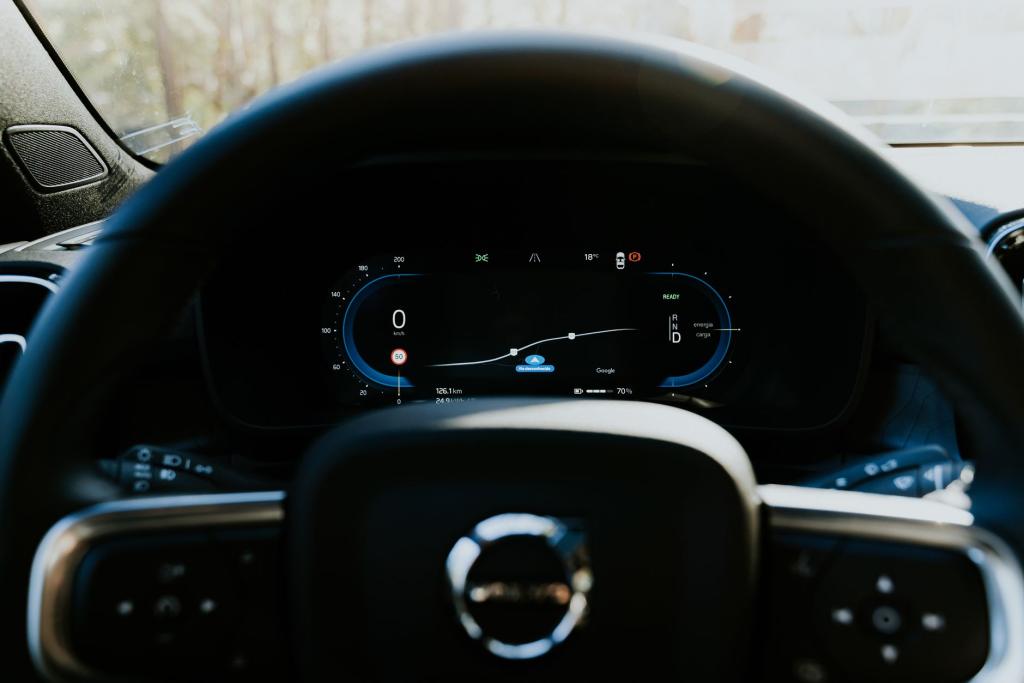
Volvo is handing the wheel over — almost. The Swedish automaker announced on Thursday that it will build its next generation of automated driving around Nvidia hardware and software, expanding a partnership that has run for nearly a decade. The plan is for Volvo's Hands-Free Driving system to carry a car from one address to another on its own, handling busy urban streets, highways, and parking by 2030, according to TechCrunch.
The system keeps the driver in the seat but lets them take their hands off the wheel for stretches of a trip. Volvo describes it as a major step up from today's lane-centering and adaptive cruise control: the car would be able to work through traffic lights, stop signs, and tricky unprotected left turns on its own, with the driver ready to take over when needed.
Three Nvidia tools doing the heavy lifting
Under the expanded deal, Volvo will combine its own vehicle-safety engineering with three pieces of Nvidia technology: the Hyperion sensor and computing architecture, the Alpamayo driving software stack, and Halos, a safety evaluation layer, according to TechCrunch.
The heart of the system is Alpamayo, which is designed to be redundant on purpose. It runs a family of artificial intelligence models alongside more traditional camera-and-radar perception software at the same time. Running two different stacks in parallel catches mistakes either one would miss on its own. "The point is we run these two stacks at the same time, and we have multimodal sensors in our philosophy because it's a safer product that way," said Ali Kani, who heads Nvidia's automotive business. The software is open source and has been downloaded by more than 650,000 developers, Kani added.
One notable choice: the first version of the system will not use lidar, the laser-based sensors that some self-driving companies rely on, though Volvo said the door is open to adding it later. The company is also bringing its own safety research to the table, including driver-understanding systems that analyze what the person behind the wheel is doing in far more detail than a basic attention monitor, said Alwin Bakkenes, Volvo's head of global software engineering. The safety layer matters: trust is the whole pitch, and Nvidia has been building safety infrastructure across its other AI products as well.
A partnership stretching back to 2017
This is not a new relationship. Volvo started building Nvidia's driving platforms into its cars in 2017, and the tie has deepened through every generation of Nvidia automotive hardware since. Today's Volvo EX90 electric SUV already runs on Nvidia computing that processes camera, radar, and other sensor data to help the car understand its surroundings, according to TechCrunch.
The expanded deal pushes the partnership much further. Volvo will standardize on Nvidia's Hyperion platform and roll the technology out across its whole lineup — not just its electric cars, but its plug-in hybrids and gas-powered models too. The first vehicle with the new stack will be an all-new model arriving in the not-too-distant future, Bakkenes said, adding that the technology can then go far beyond that one car.
Volvo's Hands-Free Driving takes on Tesla and Mercedes
The move puts Volvo in direct company with rivals racing toward the same future. Tesla's Full Self-Driving (Supervised) already attempts city-street driving with the driver monitoring everything, and Tesla is scaling up steering-wheel-free robotaxis in Austin. But Tesla builds everything itself. Mercedes-Benz, by contrast, took the Nvidia route: its new CLA sedan runs an Nvidia-powered driving system that Volvo's upgrade will resemble.
Volvo's bet is that its reputation for safety is the differentiator. "Automakers used to be very much like car-line-based development and working with various suppliers," Bakkenes said. "We have completely changed and migrated into being a full-tech stack company." In plain terms: Volvo wants to own the whole driving experience, from its safety engineering down to the AI models, instead of stitching together parts from outside vendors.
For buyers, the practical upshot is that advanced assisted driving will not be an EV-only perk. A hybrid or gas Volvo could eventually handle your highway commute and park itself while you watch. The timing also lands as Nvidia chips become the most fought-over hardware in tech — companies are borrowing billions to get their hands on them — which says something about how central the chipmaker has become to both AI and cars.
Volvo did not disclose what the deal is worth or which model will debut the system first. What is clear is the direction of travel: the car is becoming a computer you sit in, and Volvo just picked its operating system.
Comments 0
No comments yet. Be the first to share your thoughts!
Leave a comment
Share your thoughts. Your email will not be published.