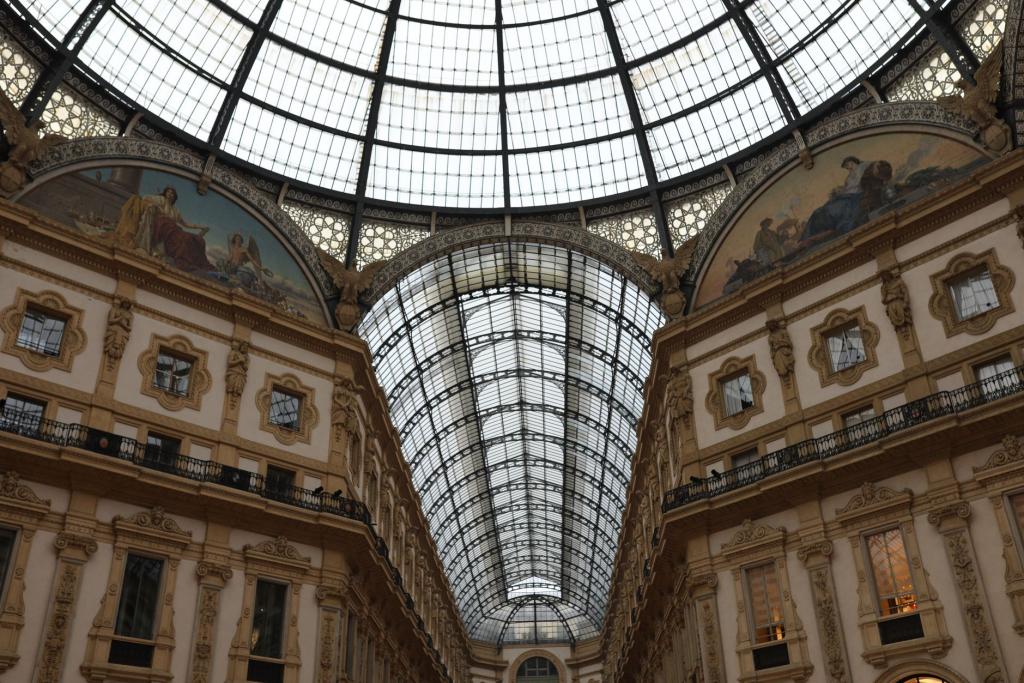
Vogue World closed its Milan edition last week with a troupe of humanoid robots walking the Galleria to Gigi D'Agostino's "L'Amour Toujours." The vogue world robots, built by the Chinese firm Unitree, waved their arms and encouraged the crowd to clap. One did a lasso. None wore clothes. The image that went viral was the pained expression of Valentino creative director Alessandro Michele, caught on camera as the machines danced past him.
The online response was merciless, and it carried a point worth taking seriously. The vogue world robots did not read as a vision of fashion's future. They read as a sponsorship activation, a brand partnership wearing a show costume. When the most talked-about moment of your Milan finale is a grimacing designer in the front row, the stunt has revealed something about the industry's priorities.
A tribute to the human touch, starring machines
The Milan edition's own billing made the vogue world robots harder to defend. The show was marketed as a tribute to Italian craftsmanship and "the human touch" in the age of technology, according to TechCrunch's account of the evening. Then came the fourth act, titled The Age of Intelligence, and the human touch arrived in the form of hardware from a robotics company.
Fashion has absorbed weirder juxtapositions before. A robot can be a prop, a model, even a punchline. The problem was that the vogue world robots had nothing to say. They did not wear the clothes. They did not demonstrate a technique. They walked, they waved, and they asked the audience to clap for them. Viewers at home, who got the moment through viral clips, responded the way people respond to an ad they cannot skip.
Fashion keeps auditioning for tech money
Vogue World is in its fifth year, a traveling spectacle that has already run through New York, London, Paris, and Hollywood. Earlier this year Vogue announced that the next edition will be staged in San Francisco. The Milan edition was sponsored in part by Meta Glasses, with additional support from OpenAI. None of that is unusual. Publications need revenue. What the vogue world robots revealed is the terms of the trade: fashion is not setting the agenda with technology. It is renting the stage to it.
The pattern is older than the robots. Jason Johnson, founder of Culture Impact Agency, told TechCrunch that "publications are figuring out new ways to make money and tech has money," adding that "Vogue has the cultural influence and access that those tech people want." Jony Ive co-hosted the Met Gala back in 2015. Jeff Bezos and Lauren Sanchez landed the Vogue wedding cover and co-hosted the 2026 Met Gala. Each episode gets explained as innovation. Taken together, the vogue world robots start to look less like a bold experiment and more like the logical endpoint of a decade of courtship.
The interesting fashion-tech work is happening elsewhere
The stunt stings because fashion and technology genuinely have interesting things to say to each other, and the lasso was not among them. Muna Ikedionwu, founder of the strategy firm MKEDI, told TechCrunch that the runway robots did not represent the real innovation happening where fashion meets technology. She pointed to the artist duo AA Murakami, designers who are also engineers, working on what she called ephemeral technology: materials and effects built to be temporary. At the Spring 2024 Schiaparelli collection, a robot baby crafted with Swarovski crystals appeared alongside a dress made from vintage tech components like PC microchips. That was technology in service of a design idea. The vogue world robots were the reverse: a design event in service of a technology company's demo reel.
Similar machines turned up on the runway at London Fashion Week the same week, which tells you the Milan robots were not even an original idea. They were a trend, and a lazy one. Fashion has spent the last few years arguing, correctly, that craft and human skill matter in an age of automation. Then it closed its biggest spectacle of the year by clapping along as unmanned hardware took the final walk. The audience reaction suggests the contradiction did not go unnoticed. If the vogue world robots return for San Francisco, Vogue could start by giving the machines something to wear, or better yet, by handing the tech brief to designers who build things instead of vendors who ship them.
Comments 0
No comments yet. Be the first to share your thoughts!
Leave a comment
Share your thoughts. Your email will not be published.