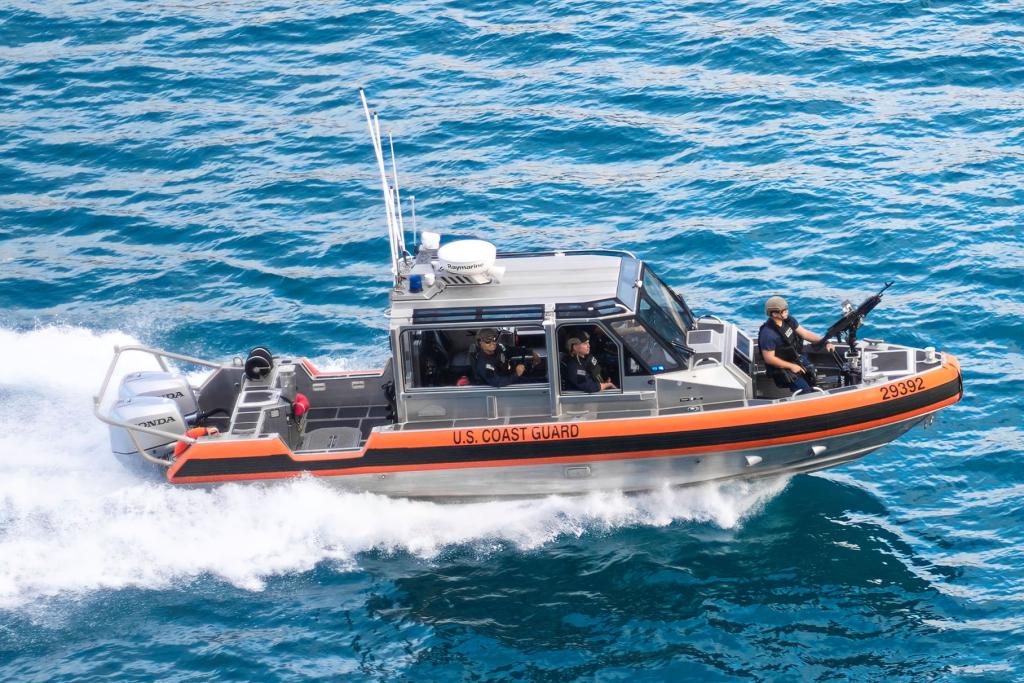
The United States is watching Chinese research vessels operating near Alaska "very closely," Rear Admiral Bob Little, commander of the Coast Guard's Arctic District, said in remarks reported by Reuters during a visit to Oslo for an international Arctic security conference. Little said the activity raises direct questions about the security of the American homeland, according to the report, putting an unusually public spotlight on ship movements that rarely make headlines.
So far this year, four Chinese survey ships have operated offshore in the American Arctic, compared with five across all of last year, according to Little. The vessels sailed through maritime zones off Alaska, including the Aleutian Islands, pushed into the Bering Strait and traveled as far north as the North Pole. They stayed in international waters, the admiral said, but did not notify Washington of their presence in advance through diplomatic channels, which he described as the usual practice between responsible maritime powers. When American forces challenge the ships and ask what they are doing, the answer is typically that they are conducting operations in international waters or carrying out scientific research, responses that reveal nothing about their actual tasking.
Why Washington is worried
The concern comes in two parts, Little explained. The first is that the fleet may be doing scientific research with an eye on exploiting minerals on the seabed in areas that belong to the United States. The second is that the activity could hand Beijing a military advantage or pose a direct security threat. When foreign vessels operate inside American exclusive economic zones or above the extended continental shelf, the United States treats it as a security concern and watches carefully, he said. His area of responsibility is nearly as vast as Europe, a stretch of ocean and ice that is becoming harder to monitor as the region opens up and more nations send ships north.
The pattern fits a wider push. China describes itself as a "near-Arctic" state and has promoted what it calls a "Polar Silk Road" through the region, according to Beijing's own policy language. Its presence in the polar north has grown steadily, sometimes in joint operations with Russia and sometimes alone. While in Norway, Little compared notes with international colleagues about how they handle similar activity by Russian research vessels. Whether in the Barents Sea or the Baltic Sea, he said, examples of hybrid threats and suspicious activity are easy to find. Russia, he noted, is his neighbor on the western side of the Arctic. Moscow denies that its research vessels do anything illegal or threaten American interests.
The Arctic is the new contest zone
The episode lands in the middle of a broader scramble for the far north. Melting sea ice is opening shipping lanes and exposing resources that were unreachable a generation ago, and the world's biggest powers are positioning themselves accordingly. The United States has been expanding its own Arctic footprint, and the Trump administration's expected security agreement with Denmark and Greenland, reported ahead of this week's United Nations gathering, would deepen the American military presence on the world's largest island. Against that backdrop, unannounced Chinese survey work near Alaska reads in Washington less like science and more like mapping of the ocean floor for future use.
For the Coast Guard, the practical challenge is scale. The four Chinese research vessels detected this year continue a pattern of unannounced visits that forces American commanders to devote cutters, aircraft and satellite time to shadowing ships that insist they are only doing science. Little said allied navies face the same puzzle with Russian vessels in European waters, and the Oslo conference gave commanders a chance to compare tactics. The underlying fear is that seabed surveys, communications mapping and familiarization with operating conditions could all serve military ends later, even when each individual voyage stays technically within the bounds of international law.
For younger Americans, the stakes are concrete even if the geography feels distant. The seabed minerals at issue feed the supply chains behind phones, electric vehicles and defense hardware, the same critical materials now shaping trade fights between Washington and Beijing. Arctic shipping routes could redraw global trade maps within their lifetimes, cutting weeks off voyages between Asia and Europe. And the contest is playing out in real time: coast guard cutters, satellite surveillance and diplomatic protests rather than open confrontation, at least for now. Little's message from Oslo was that the United States intends to keep watching, closely and publicly, as the Arctic stops being a frozen backwater and becomes a front line in the competition between great powers.
Comments 0
No comments yet. Be the first to share your thoughts!
Leave a comment
Share your thoughts. Your email will not be published.