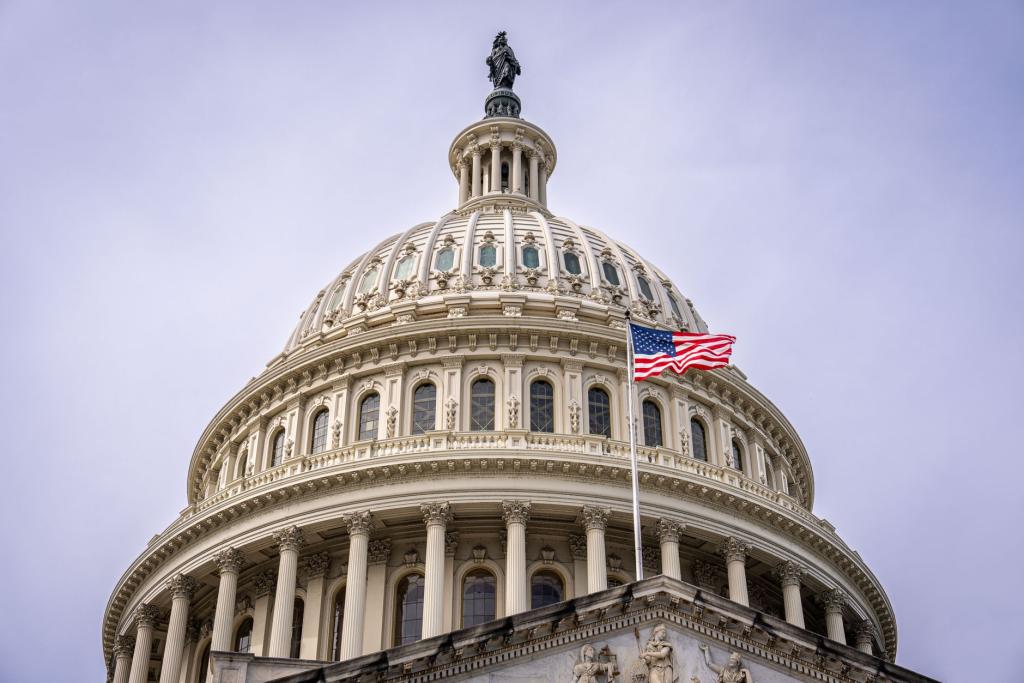
The White House sent Congress a package canceling eight hundred and ten million dollars in spending lawmakers had already approved on the night of Sept. 25, five days before the federal fiscal year ends. The maneuver, known as a pocket rescission, lets the administration freeze the money until it expires, without a congressional vote. The package was transmitted by the Office of Management and Budget with no advance warning to lawmakers, according to Sen. Susan Collins, the chairwoman of the Senate Appropriations Committee.
The timing is the tactic. The federal fiscal year closes on Sept. 30, and the House is out of session through the November election. Congress has no realistic way to act before the money lapses. In a statement accompanying the request, the administration said rescinding the funds was "consistent with the Administration's goal of ending the use of Federal taxpayer dollars to support non-citizens, putting Americans first." The funds were described as "wasteful" and "harmful."
What the package would cut
The largest single cut, five hundred and sixty-seven million dollars, targets refugee assistance programs at the Department of Health and Human Services. The package also zeroes out seventy million dollars for international educational exchanges and twenty-five million dollars for migrant education programs, according to reports of the administration's filing. Other items include a Treasury Department program that provided debt forgiveness to foreign countries making climate-related investments in coral reefs and tropical forests, and a grant program at the Minority Business Development Agency.
The request lands at a moment when several of the targeted accounts still hold substantial unspent balances. The administration has framed that as evidence the money outlived the crisis it was meant to address. Opponents read it the opposite way: as an attempt to strip funding that Congress wrote into law on a bipartisan basis.
How a pocket rescission works
A rescission is a formal presidential request asking Congress to cancel money it already appropriated. Normally, Congress must approve the request. A pocket rescission is the aggressive version of that tool. Under the Impoundment Control Act of 1974, passed in response to President Richard Nixon's practice of impounding funds he disliked, the administration may withhold money while Congress considers a cancellation request. If lawmakers do not approve it, the money must be spent.
The pocket rescission exploits the calendar. The Act lets the administration freeze requested funds for up to 45 days while Congress reviews the request. A president who files in the closing weeks of the fiscal year starts that clock so late that the year ends before Congress can act, and the money expires regardless of what Congress does. The Government Accountability Office describes the mechanism this way: it "occurs when a president asks Congress to rescind funds very close to the end of the fiscal year - so close that the funds expire before they can be used for new obligations."
The administration disputes that reading. Office of Management and Budget Director Russ Vought has maintained that the Impoundment Control Act does not bar a president from canceling funds late in the fiscal year, and that the statute contains no language explicitly prohibiting the practice, according to Fox News reporting cited in coverage of the package. The White House filed the request that evening and indicated it plans to let the funds lapse whether or not Congress approves in time.
Why lawmakers from both parties are pushing back
The sharpest criticism came from within the president's own party. Collins announced the package on X that night, writing that it was the most recent attempt by the budget office "to undermine Congress's Constitutional power of the purse." In a statement reported by the Indiana Capital Chronicle, she said the budget office had "intentionally withheld these funds for months to execute this unlawful cancellation of appropriations that were approved on a bipartisan basis and signed into law."
"Not only is the delay itself an impoundment that was not reported to Congress, but also it is a usurpation of Congress's appropriations powers," Collins wrote. "OMB is an agency of the executive branch. It does not get to decide which programs are worth funding."
Sen. Patty Murray of Washington, the ranking Democrat on the Appropriations Committee, called the move "theft from the American people, plain and simple" in a statement. She added that every Republican who voted for the funding bills should be furious, because Vought was telling them their votes did not count. The Government Accountability Office, the nonpartisan congressional watchdog, has sided with the critics. Agency spokesperson Sarah Kaczmarek said in a statement shared with States Newsroom that the office "stands behind its legal position that pocket rescissions are illegal and not authorized by the Impoundment Control Act."
What comes next
The practical effect is straightforward: unless Congress finds a way to stop it in the final days of the fiscal year, the money does not get spent. Refugee-service nonprofits, migrant education accounts, and the international education lines lose funding that Congress had written into law.
This is the second time the administration has reached for the tool. In August 2025, it used a pocket rescission to claw back $4.9 billion in foreign aid, the first such maneuver in nearly five decades. The Supreme Court let that cancellation stand while declining to rule on whether the tactic is legal, according to ABC News, leaving the question open for the courts. A separate, regular rescission request months earlier asked Congress to cancel $9.4 billion for the Corporation for Public Broadcasting and foreign aid programs; both chambers signed off after the Senate preserved hundreds of millions of dollars for an AIDS relief program.
The longer-term casualty may be the annual budget process itself. Negotiations on a dozen full-year funding bills are expected later this year, and those measures cannot become law without bipartisan support. That support gets harder to assemble if lawmakers in the minority party believe the administration will simply cancel whatever funding it does not wish to spend.
Comments 0
No comments yet. Be the first to share your thoughts!
Leave a comment
Share your thoughts. Your email will not be published.