GetSolved, a company that sells AI detection software, surveyed three thousand Americans aged 18 to 28 in August 2026 about what they believe about artificial intelligence. The headline number is striking: 46% said AI has already become conscious. Another 45% said AI labs have already built artificial general intelligence and are hiding it. But the statistic that drew the most agreement had nothing to do with machines. According to GetSolved, 64% of respondents said governments already use AI in ways they do not disclose. The anxiety underneath the headline is easier to name than the headline itself. Call it AI detection anxiety. It is not the fear that the software woke up. It is the fear that someone in charge is lying about what it already does.
That suspicion shows up everywhere in the results. Three in five respondents expect AI-enabled surveillance of citizens, and more than half expect AI-driven election manipulation. Half said whoever controls the most powerful AI will end up with more real power than any elected government. In the workplace, 74% said employers are replacing staff with AI and calling it restructuring, and 58% said companies deliberately understate how much work AI already performs. On the personal question, the split was even: about as many respondents agreed as disagreed that AI will take their own job within five years. Proximity sharpens the fear, and AI detection anxiety is what that fear looks like once it reaches a classroom. Among heavy users, 56% expect AI to take their job within five years, compared with 33% of those who barely use it.
Students are writing like suspects
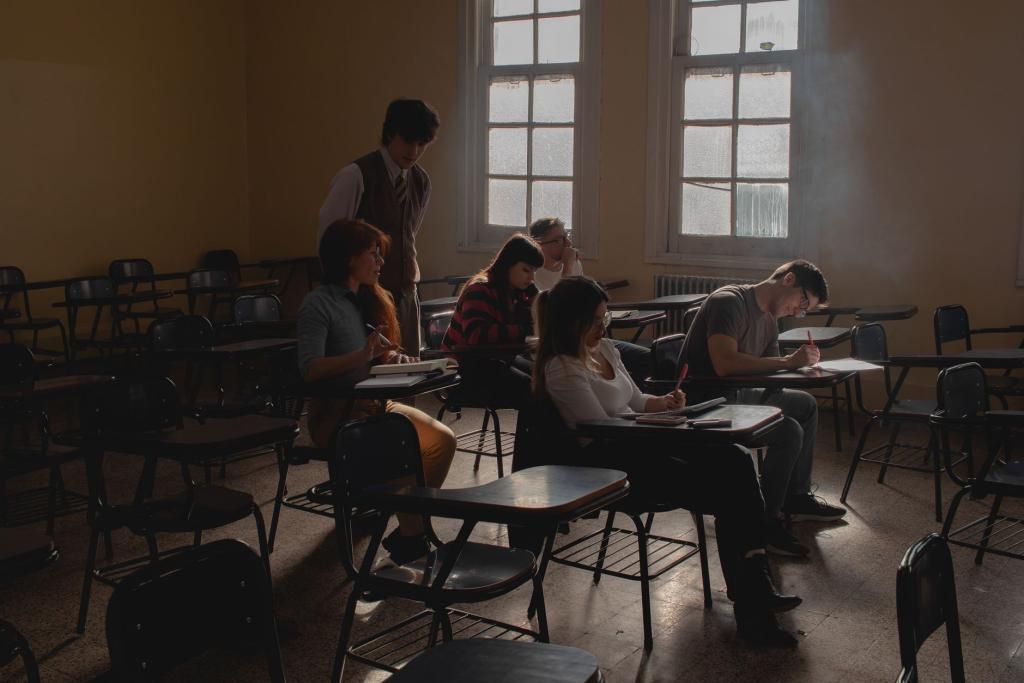
The section of the survey aimed at students is where AI detection anxiety stops being an abstraction. Among respondents enrolled in undergraduate or graduate programs, 79% said a paper that was already submitted and graded could still be retroactively flagged as AI-generated. Two-thirds said they do not trust their school's process for handling accusations to be fair. Nearly two-thirds said AI detectors can no longer reliably distinguish human writing from machine writing. And yet half of students said they always or often worry about a false accusation. These numbers are the anxiety quantified: a majority of students expect to be judged by a tool they believe is unreliable, under rules they do not trust.
The pressure is visibly changing how students write. According to the survey, 57% always or often change their vocabulary or sentence style specifically to avoid sounding like AI. Another 59% worry that using AI purely for grammar could still get their work flagged. Almost half always or often run their own writing through so-called humanizer tools. "Detection anxiety is now producing the behavior it was designed to catch," said Laura Kensington, GetSolved's head of behavioral research. "Students who wrote their own work are running it through AI tools to prove that they did." That sentence is the whole phenomenon in miniature: AI detection anxiety makes the innocent perform guilt. She also described a rational response to a workplace where three-quarters of a generation believes people are being replaced and told it is optimization.
This is the finding that should worry educators more than any poll number about robot consciousness. A detection regime was supposed to protect academic honesty. Instead it has created a classroom where the honest student writes defensively, where a student who used a grammar checker sits in the same fear as one who generated a whole essay, and where the recommended survival skill is running your own sentences through a tool that makes them look less machine-like. That is not integrity. It is performance, and it is exactly what AI detection anxiety produces: writing optimized for the referee instead of the reader.
Nobody trusts the referee
The survey suggests AI detection anxiety is fed by a broader collapse of trusted sources. Gen Z hears about AI risk primarily through TikTok, at 49%, with YouTube close behind. Social media videos outrank news articles, at 21%, and broadcast news, at 18%, by roughly two to one. Only 5% follow anyone specifically for information about AI risk, which means these positions are ambient rather than researched.
Trust in institutions is correspondingly thin. Tech companies are trusted by 30% of respondents, media and journalists by 19%, teachers and professors by 17%, government agencies and regulators at 12%, and social media influencers at the same level. One in five chose nobody on the list. "The statements that draw the most agreement here are not about machines, they are about people withholding information," Kensington said. "Gen Z is less worried that AI will act on its own than that someone in charge of it is lying about what it already does." When every authority scores this badly, AI detection anxiety is almost rational: the detector on a campus plagiarism portal is just another untrusted referee.
The irony nobody should miss
There is one more layer worth naming. GetSolved is an AI detection and writing-integrity platform. It sells detection, plagiarism checking, paraphrasing, grammar checking, and fact checking. Its own survey found that students are running their essays through humanizer tools to defeat exactly the kind of detection GetSolved markets. The company published research documenting an arms race in which AI detection anxiety is the product it both studies and feeds. That does not invalidate the numbers, but it is worth remembering when reading them.
The usage split is the strangest part of the data. Across the full sample, close to half said widespread AI use will make people worse at thinking and learning, against 31% who said better. But the answer inverts with exposure. Among heavy AI users, 47% said AI will make people better at thinking. Among those who rarely or never use it, only 6% said better. Light users held the sharpest version of the contradiction: 68% of them said AI makes people worse at thinking, while almost half of the same group said they personally now think more deeply since increasing their own AI use. Adoption itself is near-universal, with 89% using AI at all and two-thirds using it at least weekly. The people who fear it most are the people who use it least, and even they report thinking more deeply because of it.
Meanwhile, caution runs deep. Four in five respondents assume anything typed into a chatbot is stored permanently, and 83% believe what they say near their phone shapes the ads they see afterward. 62% actively avoid putting personal or work-sensitive information into AI tools. A third of all respondents said they conceal how much they rely on AI at work so they do not look replaceable, and that share rises to nearly half of heavy users. The employees getting the most out of the technology are working hardest to make sure nobody notices. Workplace AI detection anxiety mirrors the campus version.
What schools should do instead
Here is the take: campuses should stop leading with detection, because AI detection anxiety is the predictable result of a detection-first policy. The survey data shows a system eating itself. Students do not trust the detectors, do not trust the process, and write worse, more guarded prose because of both. Australia's move to legislate real AI safeguards shows regulators can act without turning every user into a suspect, and the same principle applies in classrooms: fewer detectors, more teaching.
A detection-first policy assumes a reliable test, and AI detection anxiety is the proof that no reliable test is on offer. The respondents themselves, the people being tested, say no such test exists. Nearly two-thirds say detectors cannot tell human writing from machine writing, and two-thirds distrust the fairness of the process. A school that keeps punishing students on the basis of a tool its own targets describe as broken is protecting the tool, and the tool's vendor, more than it protects learning.
The fix is not complicated. Grade the work, not the suspicion. That is how a campus ends AI detection anxiety: judge the thinking in front of you instead of scanning for the machine behind it. If an assignment cannot survive a student using a chatbot, the assignment is the problem. Oral defenses, in-class writing, process portfolios, and questions that require judgment instead of recall all predate AI and all still work.
What does not work is a regime in which more than half of students rewrite their own voice to sound less like a machine, because the machine was trained on all of us. The survey that found this was commissioned by a detection company. The least schools can do is read its warning and retire the detector era that created this AI detection anxiety. Young workers are already hiding their AI use from employers; students should not have to start that habit in college.
Full results, including charts and usage breakdowns, are published by GetSolved on its blog, and the survey announcement was distributed via GlobeNewswire on September 28, 2026.
Comments 0
No comments yet. Be the first to share your thoughts!
Leave a comment
Share your thoughts. Your email will not be published.