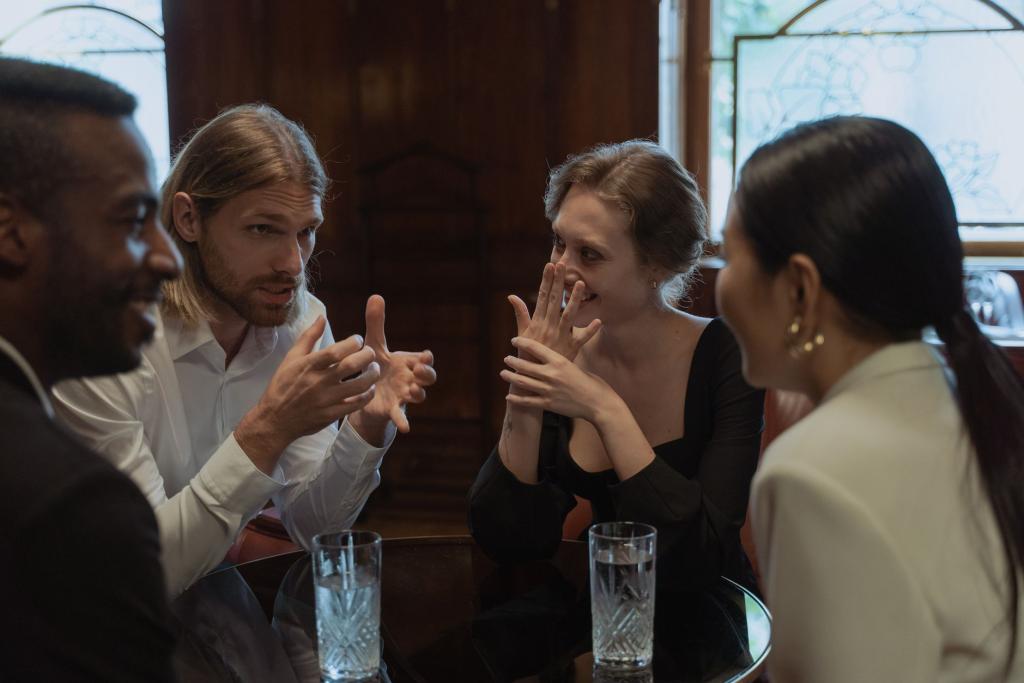
The "Gen Z stare" has been one of the internet's favorite insults this year. The meme goes like this: a young cashier or barista meets a stranger's greeting with a blank, frozen expression, phone in hand, as if small talk were a lost art. It is a joke with a point underneath it, and the point is that Gen Z has supposedly forgotten how to talk to other people. It fits a long-running debate about how Gen Z handles the offline world, from its complicated relationship with TikTok to the trend of proudly doing nothing in public.
New survey data says the opposite. According to Preply's 2026 Global Small Talk Survey, 58 percent of Gen Z makes small talk in person every single day, nearly twice the rate of Baby Boomers at 31 percent. Millennials came in at 53 percent, Gen X at 37 percent. If anyone in the room is quietly waiting for someone else to say hello, it is probably not the youngest adult there.
The survey, conducted with Dataframe in August 2026 among 1,400 adults in the United States, the United Kingdom, Canada, and Australia, also found that 65 percent of Gen Z say they make more small talk now than they did five years ago, more than any other generation. So the generation accused of abandoning conversation claims to be having more of it.
The stare is real, and so is the small talk
None of this means the stereotype came from nowhere. The same survey found that 87 percent of Gen Z avoided at least one live-conversation situation in the past year, and 93 percent use at least one tactic to dodge small talk entirely. Forty-one percent admitted they have stared at their phone to avoid talking to someone. Thirty-seven percent said they have texted or DM'd instead of making a call.
That is the paradox at the center of the data. Gen Z talks more than anyone and still dodges conversation more than anyone. The two facts coexist because small talk, for younger adults, has become an opt-in activity. They chat constantly in the group chat, with friends, with coworkers they like, and in the DMs. Then they look at their phones on the bus. As Preply spokesperson Madeline Enos said in a statement accompanying the results, "Gen Z is communicating constantly. What's changing is when they choose to engage, how they communicate, and which conversations feel worth having."
The phone data sharpens the picture. Outright call avoidance is almost identical across generations: 6 percent of Gen Z say they avoid answering calls as much as possible, compared with 7 percent of Boomers. The difference is in how the call gets handled. Twenty-seven percent of Gen Z typically let a call go to voicemail and then text back, versus only 7 percent of Boomers. It is not that younger adults refuse the phone. They reroute it.
Even the topics are different
What people talk about has shifted, too. Weather remains the classic Boomer conversation starter, cited by 56 percent, compared with just 28 percent of Gen Z. Younger adults are more likely to talk about weekend plans, restaurants, and social connections. The safe, impersonal opener is losing ground to something more personal, which might explain why small talk with a stranger on the elevator feels harder for some and more natural for others. Asking about someone's weekend requires more social energy than commenting on the rain, and it also requires more interest.
There is a lesson in here for anyone who manages, teaches, or hires Gen Z. The generation is not antisocial in any broad sense. The data says they are the most social generation in the survey, at least by frequency. But they are highly selective, and they will not perform friendliness on demand. Mandatory icebreakers, forced networking, and the old rituals of polite stranger chat read to many of them as social tax rather than social glue. They will happily talk for an hour about a restaurant they loved. They will not pretend to care about the weather with someone they will never see again.
That selectiveness gets mistaken for rudeness, and sometimes it probably is rudeness. Looking at your phone to avoid a cashier is a small cruelty, whatever your generation. But the broader pattern is not withdrawal. It is curation. Gen Z is deciding when a conversation happens, where it happens, and what form it takes. The stare is real, and so is the conversation. The survey just shows which one shows up more often, and the answer is not the one the meme would have you believe.
The results were reported by Morningstar, which carried the ACCESS Newswire release from Preply on September 21, 2026.
Comments 0
No comments yet. Be the first to share your thoughts!
Leave a comment
Share your thoughts. Your email will not be published.