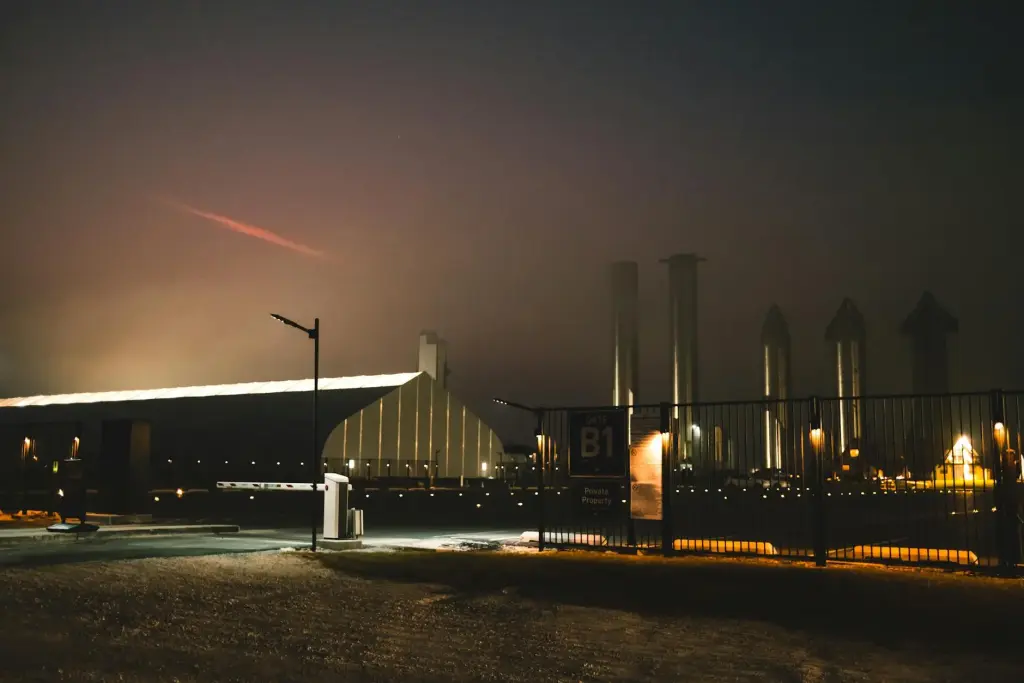
SpaceX is on the verge of launching its most powerful rocket ever. The company's next-generation Starship V3 has successfully completed critical cryogenic testing, with Ship 39 passing a series of rigorous validation tests that bring the revolutionary spacecraft one step closer to its maiden flight expected in early April 2026.
According to Space.com, SpaceX engineers conducted cryoproof operations on Ship 39 at the company's Massey's test facility in Texas. These tests, completed on March 8, 2026, represent the first full validation campaign for the next-generation Starship V3. The vehicle underwent comprehensive testing of its redesigned propellant system and structural integrity, including specialized squeeze tests designed to mimic the forces the spacecraft will experience during future catch maneuvers.
What Makes Starship V3 Different
The Starship V3 represents a significant evolution from its predecessors. SpaceX has completely redesigned the propellant system to support longer-duration missions and faster launch cadences. The upgrades are crucial as SpaceX competes with Blue Origin for future NASA Artemis moon missions and works toward its ultimate goal of making humanity a multi-planetary species.
One of the most anticipated features of Starship V3 is its enhanced docking capability. The new vehicle includes docking adapters specifically designed for in-orbit propellant transfer between Starships. This technology is essential for deep space missions, including NASA's Artemis program, where Starship is contracted to serve as the lunar lander. The ability to refuel in space transforms Starship from a heavy-lift launcher into a fully capable interplanetary transport system.
The Road to Flight 12
The successful cryogenic testing of Ship 39 marks a critical milestone on the path to Flight 12, which will be the first launch of the V3 variant. SpaceX CEO Elon Musk announced on March 7, 2026, that the launch is expected in about four weeks, placing the historic mission in early April 2026.
This timeline represents both a continuation of SpaceX's rapid iteration approach and a significant technical achievement. The V3 upgrades include a new fuel propellant transfer tube system, sized comparable to a Falcon 9 rocket, which enables speedy refueling and simultaneous engine startup. These improvements address key challenges that will determine whether Starship can achieve its ambitious goal of full and rapid reusability.
Competition for the Moon
The Starship V3 development occurs against the backdrop of intense competition for NASA's Artemis lunar lander contracts. Both SpaceX and Blue Origin are racing to deliver capable human landing systems. According to a March 10, 2026 report from NASA's Office of Inspector General, SpaceX has faced delays in key tests, including an in-space propellant transfer demonstration originally scheduled for March 2025 that has been pushed to March 2026.
Despite these challenges, SpaceX has maintained momentum through continuous innovation. The company recently revised its approach to Artemis III, planning a low Earth orbit flight test where the Orion capsule will dock with the Starship lander. This modification demonstrates the flexibility of the Starship architecture while addressing technical hurdles.
What's Next for Gen Z Space Enthusiasts
For Gen Z following the new space race, the Starship V3 represents the vehicle that could define their generation's relationship with space. Unlike previous rockets designed for single use, Starship is built for rapid reusability with the goal of reducing launch costs by orders of magnitude. If successful, this could democratize access to space, enabling everything from orbital manufacturing to Mars colonization within the lifetimes of today's young adults.
The upcoming Flight 12 will test not just the V3 hardware but also SpaceX's ability to execute the ambitious catch-and-land strategy. Rather than landing on legs like previous prototypes, future Starships will be caught by mechanical arms on the launch tower, enabling immediate restacking and rapid reuse. The squeeze tests conducted on Ship 39 were specifically designed to validate the structural integrity needed for this revolutionary landing approach.
To follow the latest Starship developments, visit SpaceX's official website or follow space news at Space.com. You can also track launch schedules and watch live coverage of Flight 12 when it lifts off from Starbase Texas in April.
Comments 0
No comments yet. Be the first to share your thoughts!
Leave a comment
Share your thoughts. Your email will not be published.