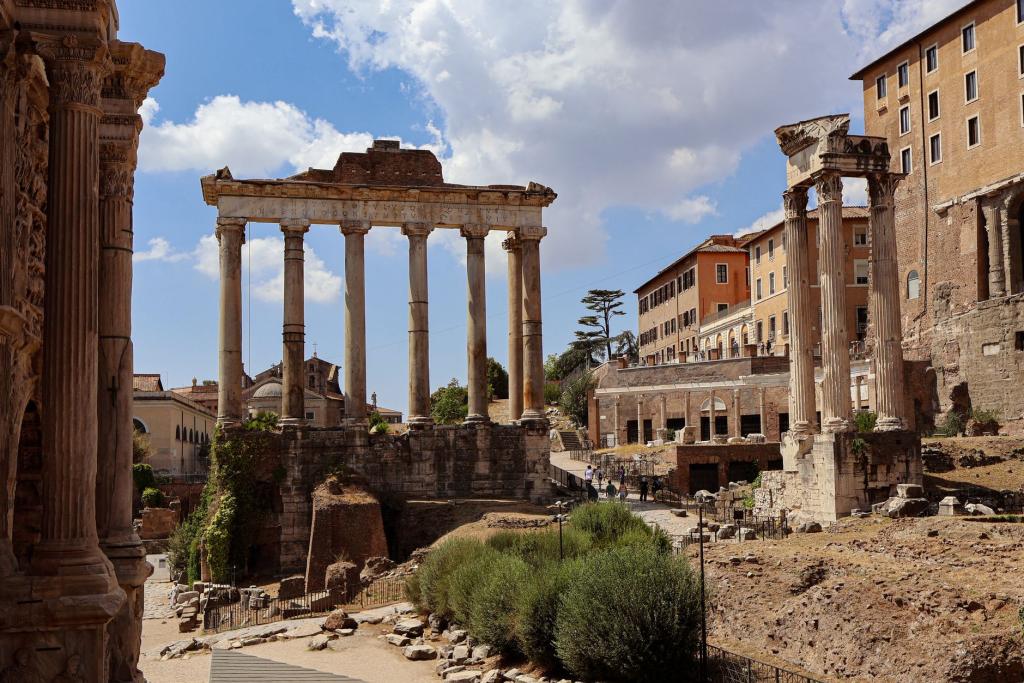
Roman concrete gets described as a miracle material that heals itself, but the real story is more specific. It was not simply an ancient version of today’s Portland-cement concrete: Roman builders used lime, volcanic ash or other reactive materials, and stone aggregates in combinations suited to the job. A 2023 peer-reviewed study found evidence that one Roman wall mortar was made using hot mixing and proposed that its lime clasts could help fill cracks. The team also tested Roman-inspired modern mixes in the lab. Those findings are promising, but they do not prove every ancient recipe self-healed, or that Roman concrete lasted forever.
Two binders, different building materials
Concrete is a composite: a binder glues sand and larger aggregate together. In modern Portland-cement concrete, the binder is Portland cement, made by heating limestone and clay into clinker and grinding it into powder. Water triggers hydration reactions that harden the paste around aggregates, which today commonly include crushed stone or gravel. Steel reinforcement is often added to carry tension, so the concrete-and-steel system has its own design and maintenance needs. University of Utah geologist Marie Jackson describes Portland cement as rock fired at about 1,450 degrees Celsius, used to bind relatively inert sand and gravel.
Roman builders used a different family of lime-based binders. They calcined limestone into quicklime, then combined lime with water, sand and reactive pozzolans—often volcanic ash, but sometimes other materials such as ceramic fragments. Silica- and alumina-rich pozzolans can react with lime and water to form cementing compounds. The Romans also used abundant volcanic tuff and other local rocks as coarse aggregate. In a University of Utah interview, Jackson stresses that Roman concrete was not one fixed formula: ingredients and processes varied across the empire and by use, from inland architecture to harbor structures exposed to seawater.
That difference matters. A Roman harbor mixture designed to react with seawater is not interchangeable with a wall mortar or a modern reinforced bridge deck. According to the 2023 Science Advances study, Roman hydraulic mortars hardened through lime reacting with pozzolanic materials, while ordinary Portland cement is produced from clinker phases that hydrate after water is added. Similar-looking stone structures can therefore owe their durability to different chemical systems, aggregates and environmental conditions.
What the 2023 study found—and what it tested
The study by Linda Seymour, Admir Masic and colleagues examined mortar from the masonry of a city wall at Privernum, Italy. The researchers used scanning electron microscopy with elemental mapping, X-ray diffraction and Raman imaging to study lime-rich inclusions—small, bright clasts visible in the old mortar. Across ten samples from that one archaeological site, they saw calcium-rich clast cores and compositionally distinct rims, alongside mineral patterns that the authors interpreted as compelling evidence for hot mixing: adding quicklime directly to the wet mix, instead of, or in addition to, first slaking it with water.
Hot mixing releases heat as quicklime hydrates. The researchers argued that this process can leave porous, high-surface-area lime clasts behind in the hardened mortar. Their proposed mechanism is that water entering a crack can dissolve calcium from a nearby clast; calcium-rich fluid may then deposit calcium carbonate in the fissure or react with pozzolanic material. The study connects that idea with calcite-filled cracks documented in Roman concrete. It is a plausible, evidence-based mechanism—not a claim that every crack in every Roman building was automatically repaired.
The team’s laboratory result is a separate line of evidence from its analysis of the archaeological material. They made modern Roman-inspired mixes using Portland cement, fly ash, sand, water and quicklime, then compared lime-containing specimens with controls that lacked it. For the mortar used in crack tests, the base mass ratio was about 1:0.2:2:1 for cement, fly ash, sand and water, with quicklime added at 7.5 to 15 percent. Researchers split and rejoined cylinders with cracks about 0.5 millimetres wide, preconditioned them with two months of wet-dry cycling, and then monitored water flow during a further 30-day test. The lime-containing mix showed crack-filling behavior; the control did not show the same response. This supports the potential of lime clasts in a modern formulation, but the formulation itself was Portland-cement-based—not a recovered Roman recipe.
According to MIT News’s account of the research, cracks in the experimental material closed enough to stop water flow in about two weeks. That is a controlled lab test of a particular mixture, crack width and water exposure. It is not a field trial proving performance across decades of traffic, temperature shifts, salts or changing water chemistry. Nor did the study establish how frequently the same manufacturing method was used across Roman sites. Its ancient evidence came from one city wall, even though the researchers noted that the samples resembled other Roman architectural mortars.
Longevity is more than a self-healing trick
Roman concrete’s survival is not explained by lime clasts alone. Pozzolanic chemistry, the type and reactivity of volcanic aggregate, the binder-to-stone balance, workmanship, structural geometry and intended exposure all shape how a construction behaves. In some Roman concretes, reactive volcanic fragments contributed to continuing mineral reactions; in others, marine water altered the chemistry. A 2026 Science Advances study of a second-century structure at Hadrian’s Villa, for example, examined a different inland concrete and reported volcanic lava aggregate, a water-to-binder ratio around 0.4 to 0.45, and calcite-rich cementation in pores and fractures. Those measurements describe that specific sample, not an empire-wide specification.
Structure and setting matter as much as the binder. Thick unreinforced walls and massive harbor platforms do not face the same stresses as a slender modern beam, a road slab or a reinforced concrete tower. Saltwater, freeze-thaw cycling, rain, soil chemistry, earthquakes, loading and corrosion can each affect a structure differently. Jackson told the University of Utah’s Wilkes Center that Roman mixes varied with their applications and that mineral growth can help resist crack propagation; she cautioned that Roman concrete was not necessarily high in compressive strength, but could become more resilient. That distinction—resilience rather than super-strength—is important when comparing old remains with modern engineering standards.
Finally, the surviving monuments are not a complete record of every Roman pour. Archaeologists and materials scientists can analyze what remains, but those examples cannot show that every building endured or that ancient builders never repaired their work. Modern concrete also depends on mix design, construction quality, exposure controls, inspections and maintenance; it is not fairly judged by comparing one exceptional ancient remnant with a poorly maintained contemporary structure. The practical lesson from Roman concrete is not “copy one secret recipe.” It is to design materials for their environment, understand how aggregates interact with binders, and test any proposed crack-healing system under realistic conditions before relying on it.
Sources: Seymour et al., “Hot mixing: Mechanistic insights into the durability of ancient Roman concrete,” Science Advances (2023); MIT News, research summary (2023); University of Utah Wilkes Center interview with Marie Jackson (2024); Zhu et al., “Mineralized carbonates contribute to the millennial durability of Roman concrete,” Science Advances (2026).
Comments 1
Leave a comment
Share your thoughts. Your email will not be published.