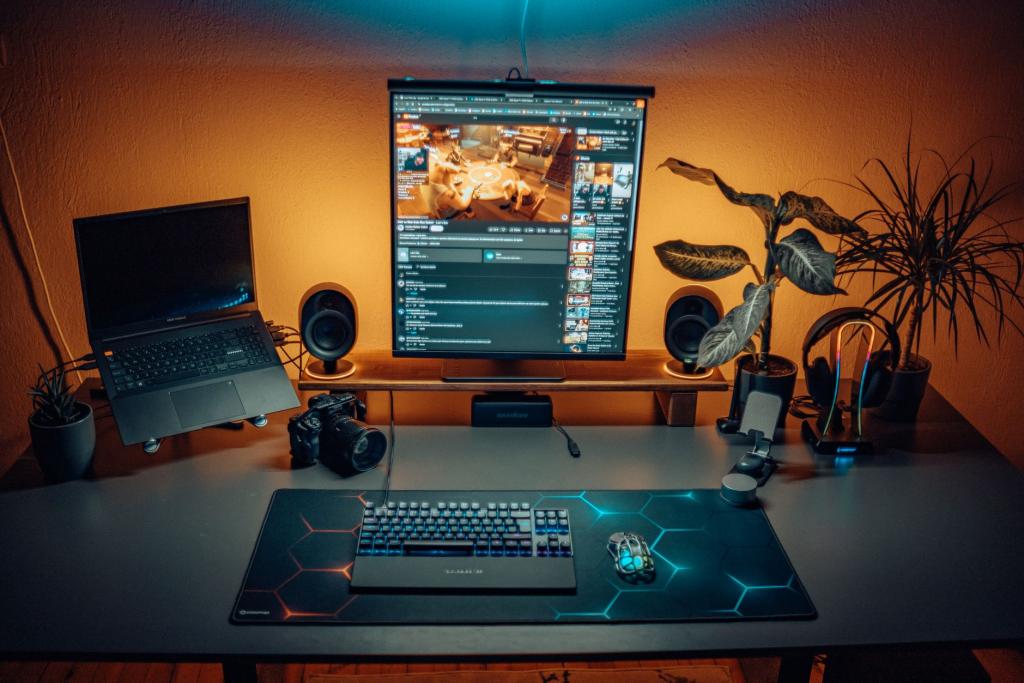
ASUS has started selling the first mainstream creator laptops built around NVIDIA's RTX Spark chip. The new 16-inch and 14-inch machines went on sale in Canada on October 16, 2026, and the company announced United States availability the same day. They are pitched as a different kind of AI purchase: instead of renting intelligence by the token from cloud services, you buy a machine that runs capable models on its own hardware.
The headline trick is memory. Ordinary laptops force AI models to squeeze into the graphics card's limited video memory; these machines share up to 128GB of unified memory between the processor and the graphics chip, so models that would choke a normal PC fit comfortably. ASUS says the setup delivers up to 1 petaflop of FP4 AI performance and can handle language models of up to 120 billion parameters with a context window of a million tokens. For creators, that translates into local image and video generation, model fine-tuning, and agent workflows that never leave the desk.
The pitch: trade your AI bills for one big purchase
The economics are the story. Cloud AI charges per prompt and per generated image, so heavy users watch costs climb with every retry. ASUS argues a local machine converts that metered spending into a fixed, predictable cost — iterate all day and the bill does not move. The company even published an illustrative comparison suggesting that people who run heavy cloud AI-agent workloads daily could rack up costs beyond the price of one of these machines within five to ten months. That figure is the company's own marketing math, and it only holds for power users, but it frames the trade-off honestly: the laptop pays off when it replaces a stack of subscriptions, not a single chatbot plan.
Both new Creator Laptops carry prices that reflect the bet. In Canada, the 14-inch model starts at about three thousand five hundred Canadian dollars and the 16-inch at about five thousand, with the fully loaded configurations running far higher; in the United States, the range starts at about twenty-six hundred dollars. Canadian shoppers can order through the ASUS Store, Amazon Canada, Best Buy Canada, Memory Express and Newegg Canada, with shipping beginning on October 16, 2026, according to ASUS's Canadian announcement. In the US, the machines are on sale at the ASUS Store and Best Buy, with in-store availability at Best Buy and Micro Center expected early in the fourth quarter. The 16-inch model measures just 12.9 millimeters thin and weighs 1.77 kilograms, while the 14-inch comes in at 13.9 millimeters and 1.48 kilograms.
What the new silicon actually does
Under the hood sits the N1X superchip: a Blackwell graphics processor with up to 6,144 cores paired with a 20-core Grace central processor on one power-efficient platform, tied together with fifth-generation Tensor cores and an NVLink-C2C interconnect. That is the whole point of the platform — one chip company now makes both the processor and the graphics engine, plus the fast link between them, instead of bolting two vendors' parts together. Where a typical thin laptop ships with 16 or 32GB of memory that the graphics card can only borrow from, this design gives the whole system one large pool to draw on.
The software story is open by design. ASUS preloads MuseTree, an app that runs the FLUX and Wan image models locally for unlimited generation without token charges, plus StoryCube for AI-powered media organization. It has also partnered with Nous Research and the team behind Comfy, the popular visual workflow platform, so creators can chain AI steps into repeatable workflows and hand them off to agents. "We built Hermes to provide intelligence you can truly own, rather than simply rent," said Dillon Rolnick, chief executive of Nous Research. "Creators want to run the best AI models on their own machines, with full control," said Yoland Yan, chief executive and co-founder of Comfy.
How we got here
The chip did not appear overnight. NVIDIA chief executive Jensen Huang unveiled the new platform at Computex in Taipei on June 1, 2026, promising with Microsoft to reinvent the PC for creators, gamers and AI agents, with machines from ASUS, Dell, HP, Lenovo, Microsoft and MSI to follow. Microsoft's Surface Laptop Ultra, carrying the same silicon, was announced on October 7, 2026 — and ASUS opened pre-orders for its two laptops that same day, with US shipments slated for October 16, 2026, the date Canada also went live. Singapore follows on October 30, 2026. The gaming angle matters too: these machines arrived with games ready on day one, as earlier RTX Spark gaming coverage noted, and some analysts argue the new wave of Windows PCs could reshape the platform.
Who should buy one — and who should skip it
This machine is for people who burn through AI credits: video creators regenerating clips, designers iterating on image models, developers fine-tuning open models, and students building agent workflows for a portfolio. For them, the appeal is threefold — predictable cost, privacy, and control. Prompts and project files stay on the device, which matters for client work, and local workflows can keep running offline after setup. Eligible models even come with a three-month Google AI Pro bundle for hybrid work that mixes local and cloud tools. If you mostly use one chatbot subscription, though, these Creator Laptops are a want rather than a saving.
There are real reasons to wait. The upfront price is steep for anyone not already spending heavily on AI tools. The platform runs Windows 11 on Arm, which means some plug-ins, older hardware drivers and competitive games with kernel-level anti-cheat software may run slowly or not at all — check your workflow's compatibility before buying, as DANAMIC noted in its detailed breakdown of the pricing and the Arm caveats. Memory is soldered on board, so pick your configuration at checkout, because there is no upgrading later. And independent, long-term reviews are still pending; launch-day claims about performance and battery life deserve the usual skepticism. The broader trend is worth watching regardless: with open models increasingly arriving on consumer hardware, as with Meta's open model running on Apple Macs, local AI is moving from datacenter curiosity to something you can actually buy.
Comments 0
No comments yet. Be the first to share your thoughts!
Leave a comment
Share your thoughts. Your email will not be published.