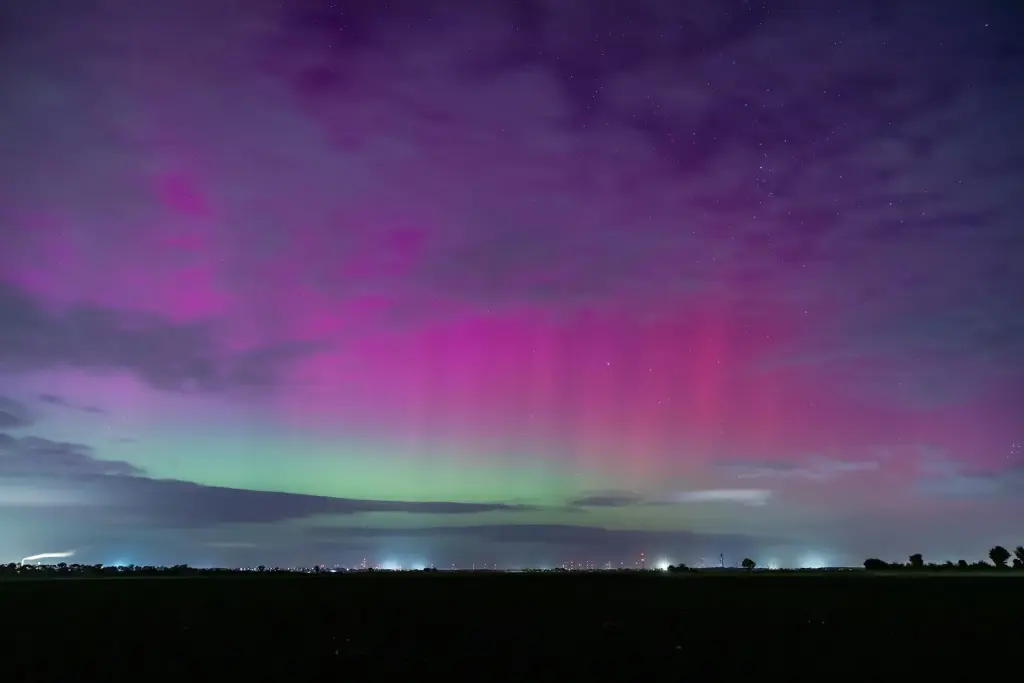
Skywatchers across nearly twenty U.S. states are gearing up for a spectacular celestial show tonight as a powerful geomagnetic storm pushes the Northern Lights 2026 further south than usual. The National Oceanic and Atmospheric Administration (NOAA) has issued a geomagnetic storm watch, forecasting that aurora borealis could be visible from Alaska all the way down to parts of the northern continental United States. This rare event offers millions of Americans the opportunity to witness one of nature's most breathtaking phenomena without traveling to Scandinavia or Alaska.
What Is Causing This Northern Lights 2026 Display
The Northern Lights 2026 are created when charged particles from the sun interact with Earth's magnetic field. These particles travel at high speeds and collide with oxygen and nitrogen atoms in the upper atmosphere, creating the colorful ribbons of light that dance across the sky. When heightened solar activity sends material toward Earth, the resulting geomagnetic storms can push the aurora visibility much further from the polar regions where it is typically seen.
According to Forbes, NOAA's Space Weather Prediction Center has projected a Kp index of 6 for Friday night, indicating quite bright and active lights that should be visible to the naked eye from darker viewing locations away from city lights. This Kp index measures geomagnetic activity on a scale from 0 to 9, with higher numbers indicating more intense and expansive auroral displays.
Which States Can Expect Northern Lights 2026 Visibility
NOAA's aurora viewline map shows that the Northern Lights 2026 could be visible across a sweeping band of northern states. Alaska has the best chance of a full display, while states including Washington, Idaho, Montana, North Dakota, South Dakota, Wisconsin, and Michigan also have strong viewing potential. Some forecasts suggest that if the storm intensifies to G3 levels, the aurora could reach as far south as Illinois and Oregon, making this an exceptionally rare opportunity for skywatchers in those regions.
The timing of the display is crucial for optimal viewing. The best window typically occurs between 10 PM and 2 AM local time, when skies are darkest and the aurora is most active. The equinox effect, which occurs around the March vernal equinox on March 20, also plays a role. According to Forbes Science, around this time Earth's axis is tilted most favorably relative to the sun's solar wind, making auroral displays more likely and more intense.
How to Maximize Your Northern Lights 2026 Viewing Experience
Finding the right location is essential for catching the Northern Lights 2026. Experts recommend getting as far away from light pollution as possible, ideally to a dark sky area with an unobstructed view of the northern horizon. State and national parks often provide ideal settings, though any location with minimal artificial lighting and a clear view toward the north can work.
Photographing the aurora requires some specific settings. A camera with manual controls can capture the lights far better than the naked eye, which struggles to adjust to the low light conditions. Using a wide-angle lens, setting ISO between 800 and 3200, and using long exposures of 10 to 25 seconds can produce stunning results. Smartphone cameras have improved dramatically and can now capture auroras in many cases, though dedicated cameras will yield better quality images.
Looking Ahead for Northern Lights 2026
The increased solar activity driving these displays is part of an approximately 11-year cycle of solar maxima and minima. We are currently approaching solar maximum, meaning more frequent and intense auroral displays are likely in the coming months. This presents a golden opportunity for Americans who have never seen the northern lights to catch a glimpse without expensive travel arrangements.
Beyond its aesthetic appeal, space weather has real implications for technology and infrastructure. Strong geomagnetic storms can disrupt radio communications, affect GPS accuracy, and even impact power grids in extreme cases. Airlines may reroute polar flights to avoid increased radiation exposure, and satellite operators monitor conditions closely to protect their assets in orbit. The current storm is not expected to cause major disruptions, but it serves as a reminder of our vulnerability to solar activity.
For those in the affected states, tonight presents a genuinely unmissable opportunity to view the Northern Lights 2026. The combination of favorable timing, strong solar activity, and clear skies in many regions creates ideal conditions for what could be one of the most widespread auroral displays in years. Step outside, look north, and prepare to be amazed by one of our planet's most magnificent natural phenomena.
Comments 0
No comments yet. Be the first to share your thoughts!
Leave a comment
Share your thoughts. Your email will not be published.