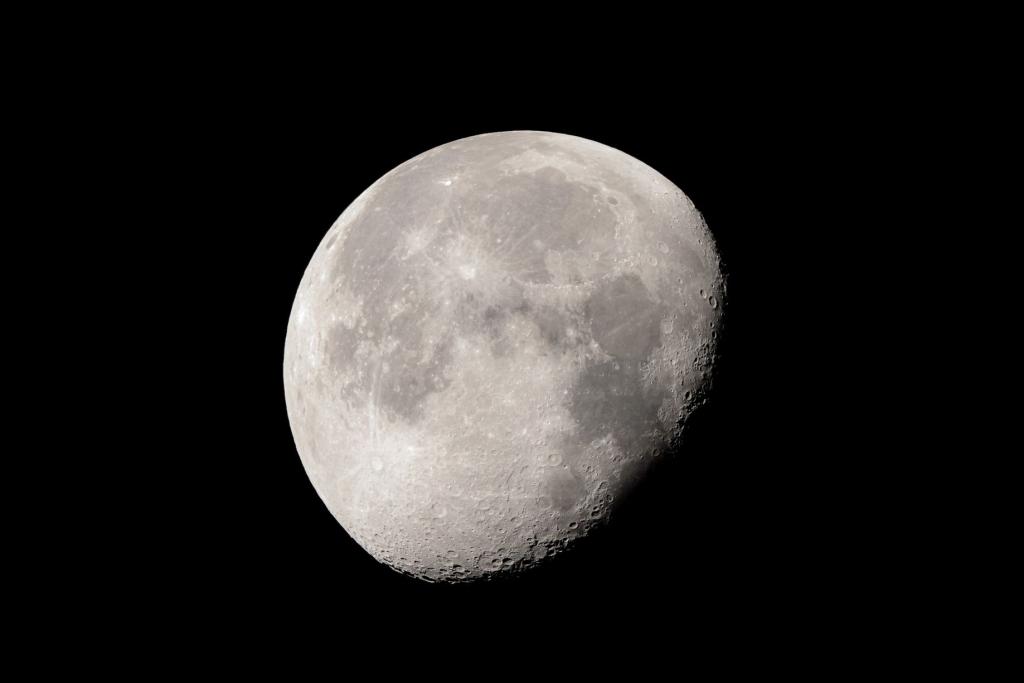
Two years ago, something slammed into the moon hard enough to carve out a hole about twice as long as an American football field, and nobody on Earth noticed. Scientists have now found the scar: a steep-walled, 222-meter moon crater, wider than the Roman Colosseum, and the biggest impact crater known to have formed on the moon in recent times.
NASA's Lunar Reconnaissance Orbiter spotted the moon crater on the near side in May 2024, just weeks after an incoming fragment of an asteroid or comet blasted it into existence. The strike escaped real-time detection by every telescope on Earth and in orbit, so the crater sat unrecognized in the spacecraft's own images for more than a year.
A once-in-a-lifetime blast
This moon crater is three times bigger than the previous record holder, a fresh impact the same orbiter team found about a decade ago. Researchers estimate that blasts on this scale strike the moon only once in roughly 132 years, which is why the scientists called it, in the journal Science Advances, "effectively a once-in-a-lifetime observation."
The crater stretches 222 meters across and reaches about 43 meters deep. According to the Associated Press, its formation was narrowed to a window between April 11 and May 22, 2024, by comparing before-and-after images from the orbiter's cameras. The wide-angle pictures were buried in the mission's data archives in the crush of incoming observations, and the moon crater was not recognized until August 2025. Closer images last fall showed a crisp rim and bright rays of fresh ejecta, and the discovery was confirmed early this year.
Two papers published September 16 in Science Advances describe the find from different angles. One, led by Mark Robinson, chief scientist for the orbiter's cameras, documents the moon crater itself; the other, led by David Paige, tracks how the blast altered the regolith, the loose surface soil, across more than 66 miles, revealing how far a single impact's fingerprints can reach. In a statement released with the findings, the Lunar Reconnaissance Orbiter camera team said the 222-meter moon crater is the largest ever formed and discovered during the spacecraft's time at the moon.
What it means for a future moon base
The International Astronomical Union has officially named the crater McGetchin, after Thomas McGetchin, a former director of the Lunar and Planetary Institute in Houston and a renowned volcanologist. His 1973 model of how crater ejecta spreads remains a core tool for reading impact debris, so the moon crater now bearing his name also serves as a test of his half-century-old predictions.
The blast hurled dust and rocky soil away at a steeper angle than expected, Robinson said. He is now at Intuitive Machines, and co-author Julie Stopar is with the Lunar and Planetary Institute. That detail matters for practical reasons: NASA is planning a long-term base on the moon, and engineers need to know what flying debris from a future impact could do to it. The next step, Robinson said in an email to the AP, is to calculate the risk of ejected crater material striking that base, information that will help designers harden structures so astronauts worry less about damage.
The crater also corrects a popular belief about the moon. The Apollo astronauts' footprints are often described as lasting forever, but on a surface this active they will not; they will "definitely be long gone in that time frame," Robinson said.
For the Lunar Reconnaissance Orbiter, which has mapped the moon since 2009, this is the largest crater ever found that formed during its own time there. A fresh moon crater shows the immediate aftermath of an impact before space weathering and later strikes soften it, giving researchers a rare look at the cratering process from start to finish.
No comparable moon crater has formed within living memory, so this one is the first scientists can study in high resolution. Every mission planner working on a lunar base now has a fresh data point on what the moon's surface does when it gets hit. It has been a busy stretch for deep-space observation overall; see our earlier Science story on NASA's Roman Space Telescope seeing starlight for the first time.
Sources: AP: NASA spacecraft discovers a huge new crater on the moon; Lunar Reconnaissance Orbiter camera team announcement.
Comments 0
No comments yet. Be the first to share your thoughts!
Leave a comment
Share your thoughts. Your email will not be published.