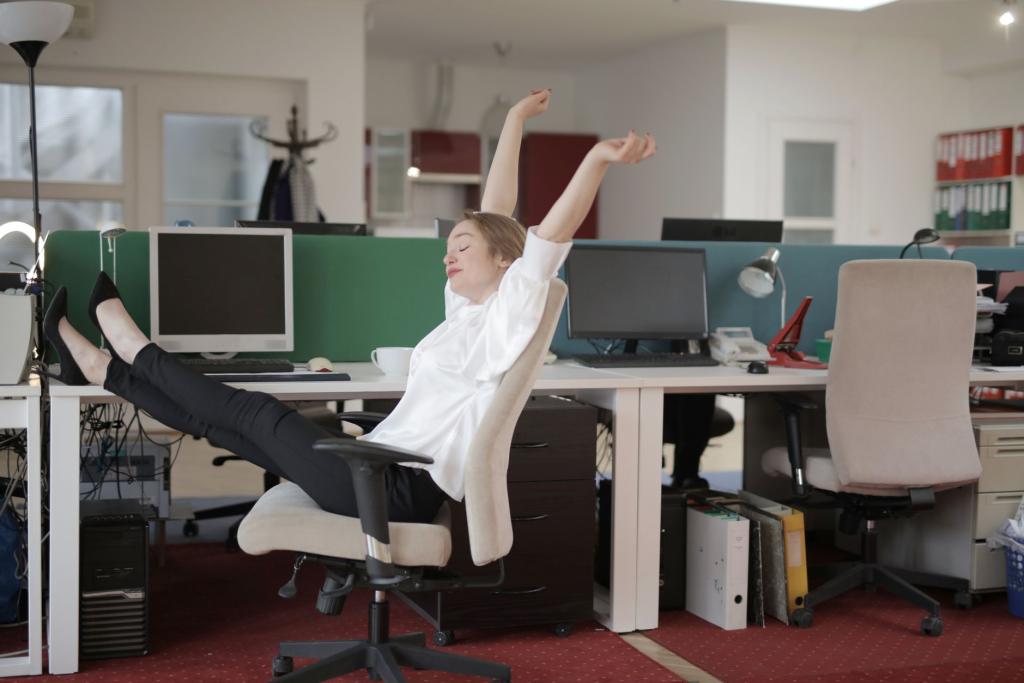
You know the guilt. It's 2:40 p.m., your eyes are burning, the Slack channel is alive, and the idea of standing up feels like a small act of treason. So you stay put, grind harder, and somehow get less done. Fresh science says the exact opposite move works better: short, well-chosen microbreaks can lift your energy, motivation, and focus — and pairing them with a quick planning task makes the effect even stronger.
The strongest new evidence comes from a University of Queensland study published in August 2026. Researchers there tracked office workers across an entire workday — not just asking how they felt, but measuring heart rate variability with monitors and collecting hourly surveys. What they found, according to the university's write-up of the research, reframes the microbreak from a guilty pleasure into a performance tool.
The study that measured real physiology
Associate Professor Stacey Parker of the University of Queensland's School of Psychology led a team that followed 91 office workers — people in IT, HR, administration, consulting, and education — through roughly eight-hour workdays. Each participant wore a heart rate monitor and answered brief surveys once an hour, generating more than six hundred hours of data. Because the team captured physiology alongside self-reports, the results don't rest on mood alone.
The researchers sorted all those hours into five energy-management profiles. Some people defaulted to "Moving" — short walks or stretches. Others chose "Socializing" — a brief chat with a coworker. A third group did "Meaningful organizing" — updating to-do lists, checking calendars, reflecting on why their work matters. The worst profile was "Passive strategizing": no breaks, no organizing, just pushing through hour after hour.
The winner was the combo nobody was doing much of. "Active strategizers" — people who mixed short pauses with organizing work inside the same hour — reported the highest energy, motivation, and sense of mastery at work, according to researchers at the University of Queensland. Parker summarized the takeaway: employees don't have to choose between working and taking a break; restorative activities and work-focused strategies can be combined even within a single hour.
Here's the striking part: that winning approach showed up in only about six percent of the hours studied, and only roughly a quarter of the employees qualified as "effective strategists" who used beneficial strategies regularly. Most people either rested without a plan or planned without resting. The microbreak alone helped; the microbreak plus a small organizing move helped most. That's the microbreaks lesson in one line: pause, then plan.
Not all breaks help — some make things worse
Before you start scheduling five-minute escapes, the fine print matters. A broad meta-review of break research, reported by Inc. in August 2026, found that work-related microbreaks — like checking email — actually decreased well-being and worsened mood. The physical breaks helped: walking, stretching, even gazing out a window reduced fatigue and lifted mood. Relational breaks, like chatting with a colleague, boosted energy. And short videos, in some trials, improved both recovery and performance.
So the scroll isn't automatically a break; it depends on what you're doing. That distinction is the quiet core of the microbreaks research: the evidence points toward getting up, moving, or talking to a human — not switching to a different flavor of screen.
Other trials reported in August 2026 back up the performance side. In one, workers who took three-minute breaks every forty-five minutes cut data-entry errors by seven percent — from 4.5 to 4.2 mistakes per thousand entries. Separately, ICU nurses who took at least three five-minute microbreaks per shift scored thirty percent lower on emotional exhaustion and made twelve percent fewer omission errors, according to reporting on the findings. These were high-stakes, precision jobs — not wellness retreats — and the microbreak still paid off.
The pattern also lines up with older findings. Earlier research in a major applied psychology journal found microbreaks were especially protective on days workers arrived already tired, and people took breaks more freely when they believed their employer genuinely cared about their health. Environment shapes behavior; science can only do so much against a culture of presenteeism.
How to do a microbreak that actually works
Translate the research into a routine you can start this afternoon. Set a loose hourly rhythm: once an hour, stand up for two or three minutes and pair the pause with exactly one organizing move. Walk to the window and glance at your calendar. Refill your water and reprioritize the next two tasks. Stretch at your desk and text a coworker a quick hello. The formula is movement plus a small planning gesture — the "active strategizing" combo that the Queensland team found beat every other profile.
The counterpoint worth hearing is that not everyone gets to choose. Hourly, surveilled, or frontline workers — the ones most prone to exhaustion — often can't decide when to pause, and the Queensland study itself found only a small share of employees naturally used the best strategy. If the advice lands as "just take breaks," it risks blaming workers for rigid workplaces. That said, the research points a finger upward too: managers who normalize short pauses and protect an hour's autonomy give their teams measurable gains in energy and accuracy.
For young workers, this matters now more than ever. Entry-level desk roles pile on screen time precisely when people feel the most pressure to look busy and skip breaks. Burnout rates skew young, and the costs show up in mistakes, exhaustion, and evenings that feel like recovery shifts. The microbreak study hands you a zero-cost, science-backed lever: stop powering through, start pairing pauses with planning, and let the day's energy work for you instead of against you.
Your body clock is not the enemy of your output. For more on managing energy at work, see our story on Productivity — and check how a healthy routine starts with your body clock for the broader picture of rest as strategy.
Sources: University of Queensland research write-up (news.uq.edu.au); phys.org summary of the Parker et al. study (phys.org); meta-review synthesis reported by Inc.; methodology deep-dive at Earth.com.
Comments 0
No comments yet. Be the first to share your thoughts!
Leave a comment
Share your thoughts. Your email will not be published.