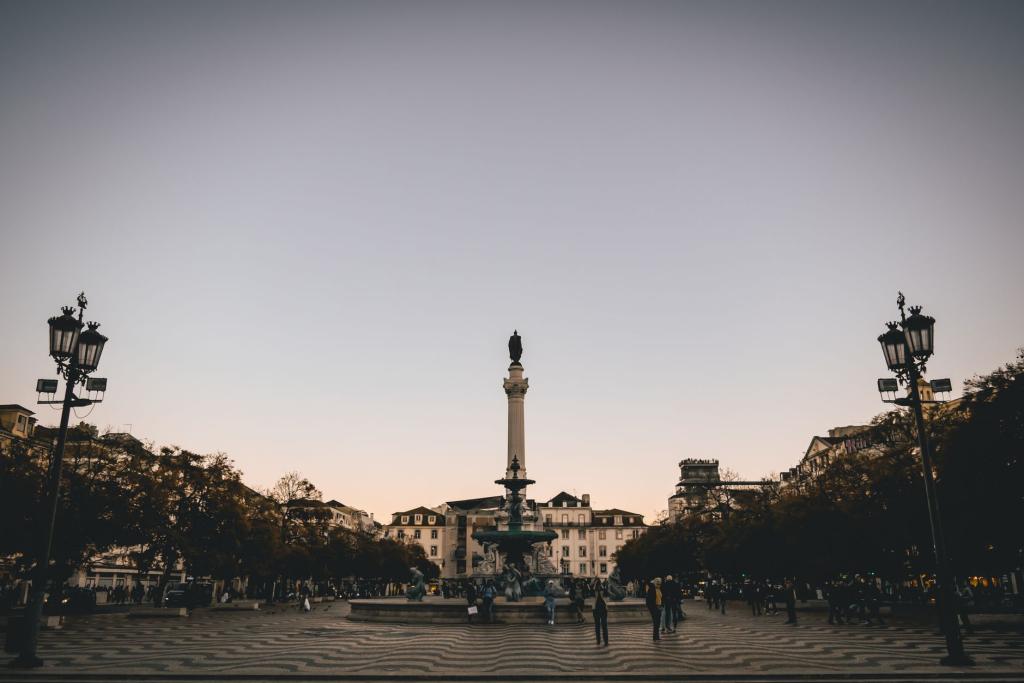
By Saturday night, October 17, Rossio Square in the middle of Lisbon did not look like a square anymore. It looked like a campsite. Several dozen tents stood in rows around the statue of King Pedro IV, and the young people who pitched them there planned to sleep in the square. For the young people running the camp, it is the boldest move yet in the Portugal housing protests. Hundreds of demonstrators sat around the central statue late into the evening, singing and talking in groups, while cameras from the evening news circled the edges.
The camp capped a nationwide day of action that had started hours earlier in three cities. Thousands of people took part in marches organized by the CGTP, Portugal's largest trade union confederation, marching under the banner "Higher wages, better pensions and public services" and a shared message against the rising cost of living. In Lisbon, the main column set off at half past two in the afternoon from Cais do Sodré and ended at Rossio, where the tents were already going up. Parallel marches in Porto and Coimbra began that morning, drawing their own crowds before converging on the same demand.
Affordable housing was the grievance that pulled the biggest crowds and the angriest signs. Elena Costa, a 46-year-old social assistant, told AFP that the tax-paying middle class she belongs to was losing its rights, starting with the right to housing, and that the people gathered were there to show they were suffocating under the strain. Antonio Margado, a 52-year-old engineer, blamed the country's center-right government for what he described as a total liberalization of rents, saying landlords keep gaining protection while tenants who need a house keep losing it. AFP's full account of the Lisbon rally describes a largely young crowd determined to make the protest visible overnight.
Why Lisbon is the flashpoint
The numbers behind the Portugal housing protests are stark. Official figures put the rise in Portuguese home prices at 124 percent between 2015 and 2024, roughly twice as fast as the European Union average, and the burden lands hardest on young renters. Lisbon's greater metropolitan area holds about a quarter of the country's more than 11 million residents, so the capital concentrates both the jobs young people move for and the rents they cannot pay.
Isabel Guerreiro, who introduced herself to public broadcaster RTP as a daughter of Lisbon, said that as a self-employed professional she simply does not earn enough to cover the city's current rents. Her complaint is the one echoed through the weekend: pay has not kept up with a market that prices homes as investments before it prices them as places to live. CGTP secretary-general Tiago Oliveira told the Lusa news agency that Saturday's round of the Portugal housing protests was meant to give a voice to households strained by housing, fuel and grocery costs, and to challenge what he called the steady erosion of public services.
The protest keeps spreading
Lisbon's camp amplified a protest that started in the northern city of Porto. Dozens of tents appeared in a central Porto square during the previous week and turned it into a focal point for the housing fight. The Porto campers had skipped Friday night in the open, saying conditions were too rough, and returned in force for Saturday's nationwide march. The week ended with a harder edge: police intervened against demonstrators at the Porto square, and Portugal's Internal Administration Inspectorate-General has since opened an inquiry into the operation.
The camping tactic itself has a family tree. In neighboring Spain, young renters have been holding public squares for weeks in protests over the same grievance, and the Portuguese movement has been watching. Across the border, the housing fight has already escalated to a snap election fought on housing anger. According to EFE, the young people who set up the Rossio camp were also calling for a general strike across Portugal, Spain and France, framing housing as a problem that runs through the whole continent. EFE's wire report on the overnight camp notes the demonstration drew support from other European countries. Lisbon mayor Carlos Moedas acknowledged that the protests were driven by a legitimate cause, but added that demonstrations must remain within the law.
For now the two sides are talking past each other. The government has not announced new housing measures in response to the weekend, and the camp's organizers have not set an end date for the occupation. Whatever comes next, the Portugal housing protests have already pushed the issue from committee rooms into the public square. What happens next will depend in part on the outcome of the inquiry into the Porto police operation and on whether the unions follow through with more coordinated action. The tents in Rossio are still up.
Comments 0
No comments yet. Be the first to share your thoughts!
Leave a comment
Share your thoughts. Your email will not be published.