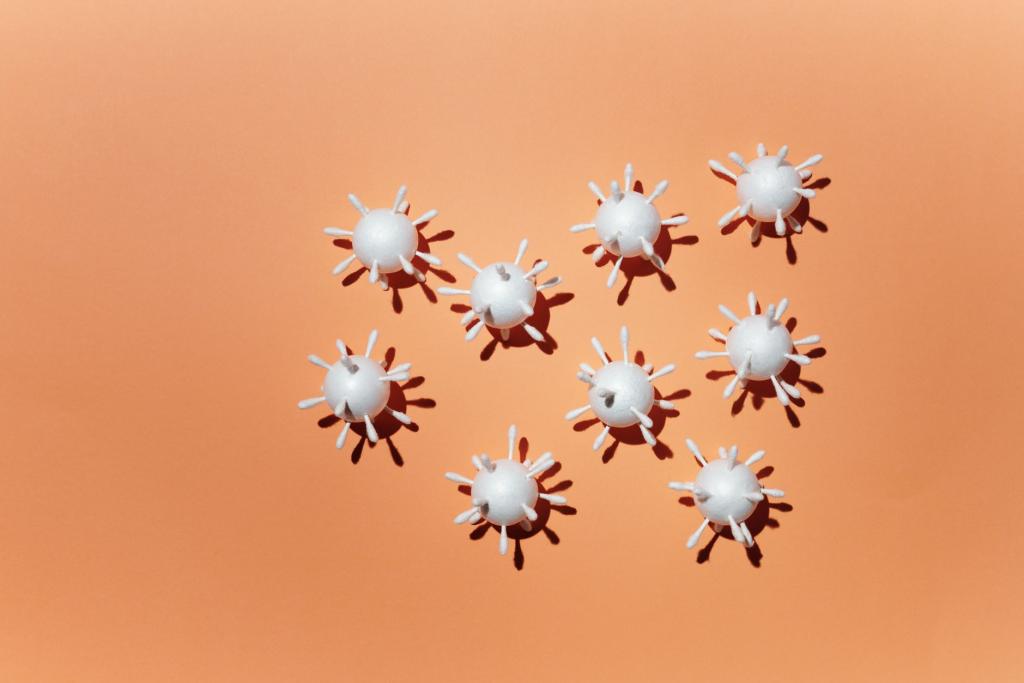
Somewhere inside a virus, there is no architect. A virus is little more than genetic material wrapped in a precisely organized protein shell called a capsid, and the shell has to build itself. Its protein components must find the right arrangement out of a huge number of possibilities, with no blueprint and no machinery directing them. They do it anyway, reliably and fast. For decades, scientists have wanted to know how.
Now they can watch it happen. In a study published September 16 in Nature, researchers at the University of Oxford captured virus assembly step by step, molecule by molecule. They used an engineered virus-like particle built from 60 protein units and tracked its growth continuously. What they found is a construction process that runs on trial and error: protein building blocks make weak, reversible connections at first, so unsuccessful arrangements simply fall apart and get tried again. When the blocks form certain closed structures, their many connections make those structures far more stable. These rare waypoints progressively funnel the process toward the completed particle.
The moment it locks in
The decisive moment comes when five larger protein building blocks join into a closed pentagonal ring. According to the researchers, that ring is the first particularly stable structure in the pathway. After it forms, assembly speeds up, because fewer new blocks are needed to reach each subsequent stable stage.
This explains a pattern virologists have long observed. The first step of virus assembly, called nucleation, is difficult and slow. Once it happens, growth accelerates. "The weak interactions give the system room to make mistakes," said co-lead author Dr. Roi Asor of Oxford's Department of Chemistry and the Kavli Institute for Nanoscience Discovery. "Most encounters don't have to be successful: the components can separate and try again. But once enough of them come together in the right closed arrangement, the structure becomes stable and assembly can move forward."
It also solves the core puzzle. An assembly with an enormous number of theoretically possible routes should take forever to get right. Instead, the process is channeled through a small number of productive stages, because only the correct turns lock into place.
Weighing a virus as it grows
Observing this directly has been the hard part. Capsids can contain tens or even thousands of protein components, and the intermediate structures that matter most are scarce and short-lived. Conventional experiments could show what is present before and after assembly, but not the molecular steps connecting the two.
The Oxford team got around this with a new approach. They combined mass photometry, a technology developed at Oxford that measures the mass of individual molecules by detecting the light they scatter, with a new method for confining single molecules so they can be observed continuously. The combination, the team reports, let them effectively weigh one particle over and over as new protein components joined it, revealing its growth step by step. Where earlier work had to reconstruct virus assembly from snapshots or theoretical models, this time the team could follow one particle as it grew and identify the important intermediate structures as they appeared.
The result is the first detailed model of the construction process for this kind of particle, built from direct observation rather than inference. "A virus has to solve an extraordinary construction problem," Asor said. "Its components somehow have to find the right arrangement among a huge number of possibilities, without a blueprint or machinery directing the process."
What this changes
The immediate interest is practical. Knowing exactly how a virus assembles, and what can disrupt the process, could help researchers design new antiviral treatments. Drugs that interfere with the locking step, or that prevent the pentagonal ring from forming, would stop the shell from ever closing. Co-author Dr. Jack Tan of the MRC Weatherall Institute of Molecular Medicine and the CAMS-Oxford Institute said the molecular-level understanding could matter for vaccine development as well. Virus-like particles, the same kind of engineered shells the Oxford team studied, are already a platform for vaccines and other therapies, and better knowledge of how they assemble could make them easier to engineer.
The principle may reach further than virology. Self-assembly is one of the deep mechanisms of biology. It builds the cellular skeleton and protein complexes, and forms the molecular compartments that organize the inside of a cell. The researchers say their approach offers a way to investigate all of those processes one molecule at a time, the same way they have now done for a virus.
The findings, by Asor, Professor Philipp Kukura, Dan Loewenthal and colleagues, were published September 16, 2026 in Nature (DOI: 10.1038/s41586-026-10948-z), and covered by Phys.org.
Comments 0
No comments yet. Be the first to share your thoughts!
Leave a comment
Share your thoughts. Your email will not be published.