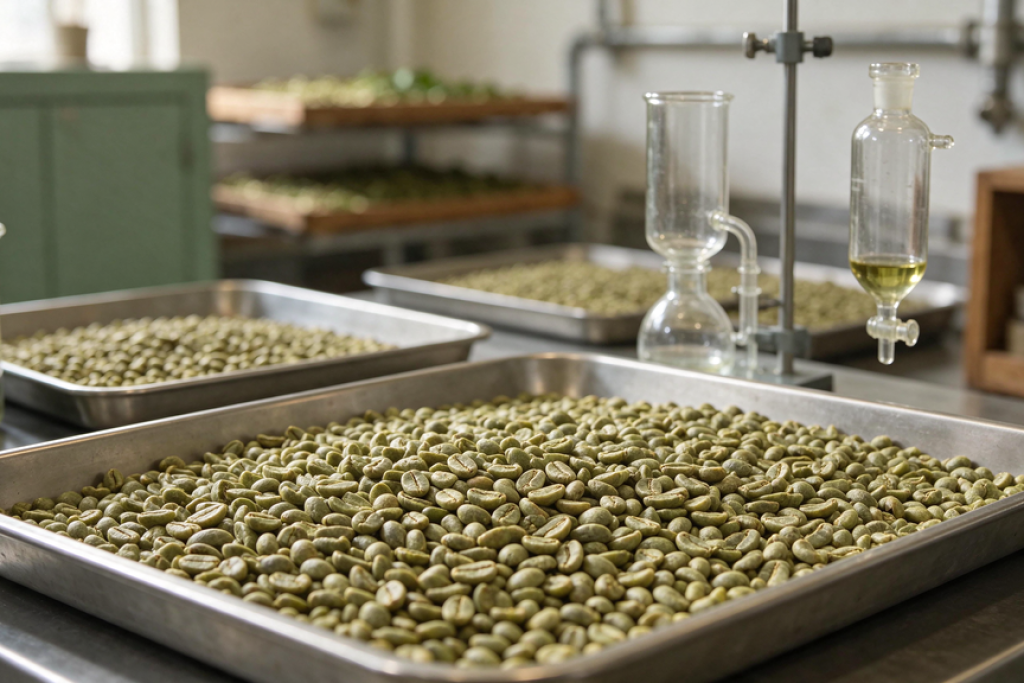
Green coffee decaffeination takes place before beans are roasted, using water, an extraction solvent or pressurized carbon dioxide to move most caffeine out of the unroasted seed. The steps differ, but the basic job is the same: hydrate the bean so caffeine can travel, draw that caffeine into another medium, then separate and dry the beans for roasting. Decaf is reduced-caffeine coffee, not a promise of zero caffeine.
Three routes from green bean to decaf
Water-based extraction: In a water process, green beans are soaked or steamed so their soluble compounds can migrate into water. One variation makes a coffee-rich “green coffee extract” and runs it through carbon filtration; caffeine is captured while other dissolved coffee compounds stay in the liquid. The extract, now with little caffeine, can contact another batch, so caffeine moves out of those beans while the liquid is already rich in flavor compounds. Swiss Water describes its own process this way: hydrate beans, circulate Green Coffee Extract, filter caffeine from the extract, and dry the beans. That is the company’s account of its proprietary process, not a guarantee that every water-based plant uses identical steps or produces identical flavor.
Solvent extraction: Commercial solvent methods commonly use methylene chloride (also called dichloromethane) or ethyl acetate. In a direct process, beans are steamed or soaked, then contacted with the solvent, which preferentially takes up caffeine; subsequent steaming and drying remove solvent from the beans. In an indirect process, hot water first carries caffeine and other soluble compounds away from the beans, and the separated liquid is treated with solvent to remove caffeine. The coffee-rich liquid can then be returned to the beans.
According to U.S. Food and Drug Administration rules, ethyl acetate may be used as a solvent in coffee decaffeination under current good manufacturing practice, while methylene chloride may remain in decaffeinated roasted coffee and instant coffee at no more than 10 parts per million when used to extract caffeine from green beans. That 10-ppm figure is a specific residue limit for methylene chloride in those products—not a universal limit for every solvent, an indication that residue is present in a particular batch, or a head-to-head ranking of decaf methods.
Supercritical carbon dioxide (CO2): Here the beans are hydrated, then loaded into a pressure vessel. Carbon dioxide is brought to supercritical conditions, where it behaves as a dense fluid that can pass through the beans and dissolve caffeine. The caffeine-bearing CO2 then goes to a separator, often where water captures the caffeine; the CO2 can be cycled back through the system. A 2017 industrial-process study by De Marco, Riemma and Iannone reports one plant’s conditions—90°C and 250 bar—and says extraction time in that installation varied by bean type. Those figures describe that plant and are not a universal recipe. The authors’ analysis also shows why a process label should not be mistaken for a simple “best” ranking: extraction, energy, transport and operating design all matter.
| Route | What carries caffeine away? | What the label tells you |
|---|---|---|
| Water-based | Water, often paired with carbon filtration of the liquid | Indicates a water process; brand names identify a particular operator’s method |
| Solvent-based | Methylene chloride or ethyl acetate, applied directly or to the separated extract | Names the extraction route or solvent when stated; it does not by itself describe flavor |
| Supercritical CO2 | Pressurized CO2 that carries caffeine to a recovery stage | Signals CO2 extraction, not a guaranteed flavor outcome or caffeine-free result |
Bean-to-cup: where the process fits
1. Start green: Coffee is decaffeinated while it is still green and unroasted. The beans are cleaned and hydrated, usually with water or steam, to make caffeine more mobile.
2. Extract: A water extract, food-processing solvent or pressurized CO2 contacts the hydrated beans. In each case, the extraction medium takes up caffeine and the process is controlled to leave most—but not necessarily all—of it behind.
3. Separate, recover and dry: The caffeine is separated from the water, solvent stream or CO2. Processors may recover and reuse extraction media; the beans are then dried and reconditioned before they leave the decaffeination plant.
4. Roast and brew: Roasters roast the processed green beans, then coffee is ground and brewed as usual. Roasting does not turn the product into a guaranteed caffeine-free drink; caffeine levels in a cup can also vary with the beans, serving size and brewing method.
What process claims and taste differences do—and don’t—say
The National Coffee Association, a U.S. coffee trade association, says decaffeination typically removes about 97% of the caffeine naturally present in the beans. Treat that as a broad industry explainer, not an exact measurement for every lot or cup. “Decaf,” “water processed,” “EA,” “Swiss Water” or “CO2” describes a product or process claim; it does not necessarily disclose a final caffeine assay, and “decaf” should not be read as “zero caffeine.”
Taste is a separate question from process branding. A 2022 peer-reviewed study by Zou and colleagues compared eight pairs of regular and decaffeinated coffees and found measurable differences in volatile aroma compounds, including pyrazines. It compared decaf with regular coffee, not all commercial water, solvent and CO2 methods against one another, so it is not evidence that one label tastes best. Beans’ origin, the green coffee itself, extraction settings, roasting and brew recipe all influence what reaches the cup; individual tasters may prefer different profiles.
For shoppers, the practical takeaway is to read a process label as information about how a bean was decaffeinated, then choose by the coffee’s origin, roast date and tasting notes if flavor is the priority. If you want a process-specific detail, check the roaster’s or processor’s explanation and note whether it is a technical description or a marketing promise. If you need to know caffeine content precisely, a process name alone will not reliably provide it. Understanding green coffee decaffeination means separating that pre-roast process claim from assumptions about a bag’s flavor or exact caffeine content. The common thread is straightforward: each route aims to reduce caffeine before roasting, while balancing extraction, retained coffee compounds and production constraints.
Sources
- According to the FDA regulation at 21 CFR § 173.228, ethyl acetate may be used as a solvent in coffee and tea decaffeination under current good manufacturing practice; 21 CFR § 173.255 sets a 10-ppm methylene chloride residue limit for decaffeinated roasted and soluble coffee.
- According to the National Coffee Association’s decaf explainer (the NCA is a trade association), decaffeination typically removes about 97% of caffeine.
- Shofinita et al., “Effects of different decaffeination methods on caffeine contents, physicochemical, and sensory properties of coffee,” International Journal of Food Engineering, 2024 (peer-reviewed review).
- Zou et al., “Distinguishing between Decaffeinated and Regular Coffee,” Molecules, 2022 (peer-reviewed research).
- According to Swiss Water’s process description, its proprietary method uses hydration, Green Coffee Extract, carbon filtration and drying; this is a company source.
- De Marco, Riemma and Iannone, “Supercritical Carbon Dioxide Decaffeination Process: a Life Cycle Assessment Study,” Chemical Engineering Transactions, 2017 (industrial process study).
Comments 0
No comments yet. Be the first to share your thoughts!
Leave a comment
Share your thoughts. Your email will not be published.